Marketing to Teens & Tweens with Social Media

McAuley-PinterestDid your high school have a social media club? Probably not if you were born before 1995! If you do work for or attend an educational institution then you’re definitely aware of the power of social media to spread and promote school-related news and events.

Is your social media marketing focusing on the right platforms to reach your students, staff, alumni, and prospective students?

This week, we bring in Catherine and Kathleen from Catherine McAuley High School to talk about their social media club and what they do to promote school events.

Big Ideas:

  • Who am I talking to today?
    • Hi, I’m Kathleen O’Brien.
    • And I’m Catherine McBrady.
  • You guys are both part of the social media club over at McAuley, correct?
    • Correct.
  • Tell me about McAuley. What is McAuley High School?
    • McAuley High School is an all girls college prep school in Portland, Maine.
  • Tell me about your social media club.
    • Ericka Sanborn, who is the director of marketing for McAuley, came to us the summer before our junior year and suggested we start a social media club. She picked us out of school and wanted to start marketing on different platforms.
  • So, in fact, the students are doing a lot of the social media marketing for the school?
    • Yes. They’re in charge.
  • So recently you guys have been broken up to focus on one specific platform. So, Kathleen, what are you doing?
    • Mainly I do Twitter. I’m in charge of all the tweets that McAuley high school puts out.
  • How often are you tweeting?
    • We try to do it at least once a day. It can go from 1 to 2 times a day depending on if something big is happening in the school.
    • Sometimes we have more dull periods but usually once a day is our goal.
  • Is that through the official @McAuleyHS twitter handle?
    • Yes.
  • And how about for your own use. Do you tweet out under your own name?
    • I don’t tweet much under my own name.
    • I tend to go in under my name and retweet that Catherine McAuley High School has tweeted just to help spread the word.
  • How do you get more followers for Twitter? Or is that part of your game plan?
    • It is. We try to engage in our audience which tends to be current students who like to retweet us or talk about us so their followers hear about us more.
    • Those followers can include prospective students and parents who tweet us.
  • So Catherine, what do you do?
    • I’m the McAuley Instagram.
  • So what are you doing for Instagram?
    • The goal is once a day to take a picture of anything around the school or anything we’re trying to promote.
    • If any cool things are happening I’ll take a picture and use the McAuley hashtag which is #mcauleyhs.
  • Is this more for the alumni, the parents, the students, or prospective students?
    • I would say it’s a lot of students and prospective students. Alumni not as much.
  • Because they’re just not using Instragram the way that the kids are?
    • Right.
  • Do you get a lot of followers on the Instagram account?
    • We’re noticing more and more each month. Probably prospective students.
  • What other platforms are you guys using as part of the social media club?
    • We have used Pinterest and Facebook.
  • So for Pinterest, how is that working out for you?
    • Pinterest is not exactly one of our best social media outlets we’ve used this year.
    • It hasn’t gotten a lot of attention. We’ve found it’s not exactly the best site to use for the promotion of the school.
  • Could it be used better for getting in front of alumni and parents? Or are you not seeing that kind of interaction at all?
    • I wouldn’t say we’re seeing much interaction with anyone.
  • You guys are on Facebook. What kind of interaction are you getting on Facebook?
    • We get a lot of alumni on Facebook. That’s really their platform, their generation.
    • It’s a lot of “remember this from your high school days.”
  • Is it that a lot of prospective students aren’t using Facebook? Is Facebook “dead” for kids?
    • Personally I feel Facebook is on its way out for the younger generation.
    • I’m not saying it hasn’t lessened in popularity, by any means, but I feel like a lot of seventh graders are wary of having their kids just have a Facebook account and do whatever they want so it might play a factor.
  • Do you think there are any platforms that you might try next year that you didn’t try this year?
    • McAMaybe try Google+ or LinkedIn.
  • Do you think any students would use those two platforms?
    • There was some talk about creating a Tumblr account for McAuley because Tumblr is wildly popular with kids our age.
    • We haven’t done that yet but I think that might be in the works for coming years.
  • How about Snapchat. Is that something you guys use on a personal level? Because I know a lot of brands are now trying to figure out how to use Snapchat.
    • I use Snapchat personally, but I’m not sure how that would work as a marketing phase.
    • We were talking about Vine for McAuley as well..
  • So what would you guys do for videos 6 seconds long for Vine or 15 seconds long for Instagram?
    • Probably big moments in school.
    • Recently I did a video for the last 10 seconds of the state basketball game and that got a lot of attention.
  • What kind of posts, regardless of platform, are getting a lot of interaction and which ones are falling on deaf ears?
    • Anything that has to do with basketball. People associate us with our basketball and our reputation so if we post anything about basketball then it instantly gets a lot of attention.
    • Also, we found out that we’re a school of all girls and that we’re a big fan of what we call “sappy tweets,” which are those tweets like “we’re so proud of you,” and things like that.
    • The feel good tweets that girls like to see and say, “awesome, my school supports me in everything I do. They’re proud of what I contribute to the community.” Supportive messages that tug at the heart strings.
  • What kind of posts are not working for you so far?
    • Any asking for interaction between McAuley and prospective students, like “let us know, tweet at us” isn’t working so hot.
  • That is interesting because we always say in marketing that you have to ask for the sale or the tweet and there have been studies that show that has been very effective. Maybe it’s because the age group you’re targeting is more cynical or more aware of that kind of approach and that feels fake to them.
    • Right.
  • So, the social media club year one has been invite only. What’s gonna happen with next year. A couple of the kids are graduating out. How are you going to go about getting students for the social media club?
    • We have been asked by Ericka Sanborn, who moderates this club, to keep an eye out for students who we think would be trustworthy because we have to look at people’s personal accounts like Twitter, Instagram and Facebook or whatever it may be. Seeing if they’d be a right fit, so to speak.
    • Because we’re honestly putting that name of McAuley in the hands of the students so we want to make sure that they’re responsible and that they know boundaries and that they know what’s appropriate to tweet, post, whatever it may be and what’s not.
  • Are there any other changes that you can think of that would improve the club for next year?
    • Definitely using our platforms more consistently so we don’t have stretches of silence.
    • Getting used to a schedule every day we found that planning a calendar for what we’re going to post is extremely helpful and helps us on track.
  • With social media club, a lot of has been about marketing the school, have there been any other skills that you think you’ve picked up here that are going to help you in the workplace?
    • Absolutely.
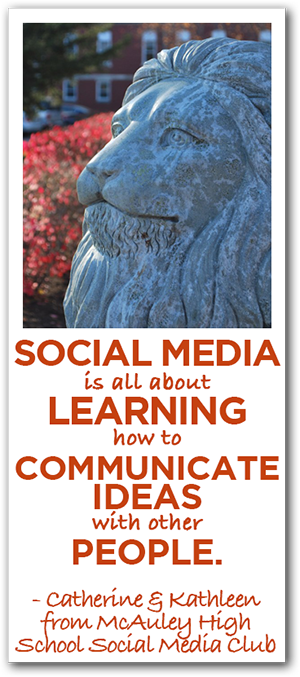
    • Social media is all about communication and communication between whoever it may be is just crucial to whatever you may do later in life.
    • It’s learning how to communicate ideas with other people and things like that.
  • Now you’ve found that anything you share that involves a famous member of your staff seems to go viral at least on a small level. Tell me a little about that.
    • Sister Edward Mary is an idol at McAuley. Everyone knows who she is. You say “sister” you’re talking about Sister Edward Mary.
  • So you’ve used this a couple of times; you’ve gotten her involved in your social media and the things that she’s involved with tend to get shared more?
    • Yes.
  • Any parting words for The Marketing Agents podcast listeners?
    • We’ve learned so much and we’re looking forward to what this club can become in the future.


  • Juicy Links:

    Rich Brooks
    Social Media Student

The Secrets to Get Your Emails Delivered, Opened & Read – Heather Jackson

Heather-Jackson-PinterestLately small businesses are focusing most of their time on social media marketing but neglecting to cultivate their email list while not realizing that both tools working together have the most success.

Is your email list too watered down and bloated? Have you been segmenting your audiences for a more targeted message?

This week, we bring in Heather Jackson from Constant Contact to talk about the importance of a relevant email list and give us some great email marketing tips.

Heather has made a career of helping entrepreneurs reach out to their target audience, and she’s here to share some of her secrets with you.

Big Ideas:

  • How did you end up at Constant Contact?
    • I ended up there thanks to an interesting path.
    • I worked for Boston.com and Yahoo in the late 90s and early 2000s and appreciated the value of online marketing.
    • I started two different businesses and I was a Constant Contact customer for each. I used their services and products.
    • I became familiar with Corissa St. Laurent and I had a business that helped people out with email marketing and strategic consulting for digital marketing.
    • I became an authorized local expert in New England. We could speak on their behalf and I got extra training and accreditation.
    • I just loved every interaction with Constant Contact as a customer and as an authorized local expert and have enjoyed working with them the past few months.
  • What do you say to small businesses that say, “it’s all about Facebook and Twitter and it’s not about email marketing?”
    • I talk to people like this all day in seminars and one-on-one. A large part of my job is educating small businesses about social media and email marketing.
    • They are two tools in a tool box. Social media has a buzz, but the way you have a conversation with someone in email marketing is different.
    • If you think about the nature of these tools; they have feeds and timelines scrolling down. It’s a little quicker and shorter conversation in social media.
    • Think about the conversation you have with your neighbor on your street or in passing vs. one in which your neighbor invites you to dinner. Social media is the quick street conversation and email marketing is the conversation in the home.
    • With email marketing people have given you permission to email them. Your message is going to live in their inbox. There’s a 99% chance they’re going to see your name and the subject line.
    • Compared to Twitter or Facebook, which a 4-10% chance someone happens to be looking at your post in their feed at a given time.
    • Both are really important. The most powerful relationship you have is when you have email marketing driving people to your social media sites and when you’re able to get more customers and visibility through social media through the types of content you post you can then get people to commit to joining your email list.
    • It’s really important to have conversations with both platforms and users, but they are just tools in your digital marketing program.
    • There are some great statistics. I saw a recent study that compared conversion rates for emails vs. social media. The email conversion rate was over 3%, search engine rate was 1.95% and 71.7% from social media conversion.
    • You want to put your effort and call to action on all your platforms.
    • I always ask people if they’ve checked their email. It’s important to use all those tactics to get to your target audience.
  • What’s the value that a small business owner gets from sending out emails from an ESP (email service provider) rather than sending out emails from an inbox?
    • There are a few important benefits.
    • You have the ability to present a much more professional email, insert branding images and videos, make yourself look a lot better.
    • There are so many spam filters with ISP inboxes, that when you send and bcc people from your inbox, it throws up a big red flag.
    • With ESP you have at least a 95% chance the email will get through versus 75-80% chance with an ISP inbox. I’m talking about sending mass mailing. You want to make sure it gets through.
    • On the backend, the ESP is going to provide you with awesome reporting – who received it, what people clicked on, what calls to action they responded to – and you can change and respond to what’s working or not. You want to put more of what works in future email campaigns.
    • You have to have a one “click to unsubscribe” link. Any ESP platform is going to make this requirement much easier.
    • They will also have more subscription options with an ESP.
    • There are so many more tools with an ESP that makes sure the email looks professional, gets through, and then you have that inherent reporting and market research to see what’s working.
    • Based on the tracking that the ESP offers, you can get insight into your customers’ preferences.
  • What are some of the best practices for getting more subscribers through our websites or social media?
    • Yes. It starts with lifestyle design and then we have to work on you.
    • That’s a great question. I work with customers all the time that are putting off getting started until they have their email list perfect.
    • You have to think about an email list as a constant work in progress. It continually has to be added to and cleaned up. It’s quality, not quantity.
    • Your email list has to be relevant to what your message is and the content you send to them.
    • You want to be adding to that list throughout the day.
    • All of these tools are trying to drive people back to our website where the most robust content lives and all the relevant calls to action live.
    • It’s really important to let people know what they’re going to get in exchange for giving their email address.
    • There has to be something of value you you’re going to provide in exchange. You need to let people know what you’re going to do with it.
    • You absolutely want to use your website, maybe use an app that makes a tab for promoting your email list to your followers.
    • Have a “sign-up for my list” link in your email signature.
    • Let people know when you’re face-to-face at events to meet people. You can mention your newsletter and ask for permission to add them to your email list.
    • 57% of people will give an email if asked for it on the phone or in person.
    • I think there’s a lot of different places to ask for permission and I recommend doing all of them.
    • The incentive doesn’t have to be expensive. It could be additional tips or advice or special offers.
    • Arthur Ashe quote, “start where you are, use what you have, do what you can.”
    • I have a lot of customers that have some contacts in Outlook, written on paper, a stack of business cards, some are in QuickBooks, etc.
    • My thought is, start with QuickBooks because you have implicit permission to send to them or start with you Outlook contacts. Just start with something and build it as you go.
  • How do I go from that list of “QuickBooks contacts” and let them know I have an email newsletter if not, sending them an email?
    • There are a couple different ways to address that.
    • If you’re currently transacting business with someone, we load them into the Constant Contact database, you can send those people an email that says, “we have a newsletter that….and would you like to receive this list?”
    • Then you can send them a confirmation email to verify they want to receive an email. That’s for people you’re currently doing business with.
    • There’s an implicit permission there but it’s safer to ask for it.
    • The people you’ve met along the way and contacts you’ve collected, if they get an unwanted email, it’s frustrating. They will remember that frustration.
    • What I recommend you do with people like that is to send them a one-on-one email via your email. It’s time consuming, but do about 15 per day. Send them a greeting and a link to your newsletter with a link to your sign-up page or button.
    • We want a list of people who have said, “yeah, I want to hear from you.”
    • We’re trying to build our relationship, grow our engagement, get people to know us and trust us, to think of us as an expert and resource in our field. When people know and trust and like you, they’re going to buy from you and talk about you.
    • All these platforms allow us to influence people with one email or tweet.
    • What we’re trying to do with email and social media marketing together is to build a relationship and to get customers engaged so they say good things about you and refer you.
    • If you have good content, they’re going to tell their friends about you.
      All I’m trying to do is help people use social media and email marketing to get their customers talk about them and say good things about them and refer them through email and social media.
  • What are your thoughts on buying an email list?
    • First, buying an email list and sending out a mass email is against the law, so I don’t recommend doing it!
    • Second, you’ll alienate more people than you are likely to engage.
    • Third, if you’re using a legitimate ESP, they’re likely to shut down your account due to a high rate of spam.
    • I would NOT recommend it.
  • Can you tell us a little about list segmentation and how we can put it to use for us?
    • Absolutely. List segmentation is another great tool that an ESP is going to offer you.
    • It lets you divide your customers up based on their interests or the role they play.
    • Lets say you sign up for an email list for a company, and the first three emails you get are not related to that topic. You’re going to ask why you got those emails.
    • You can segment the people that give their emails and ask them what they want to hear about from you. “Do you want to know about x, y, or z?”
    • Segmentation allows a business to send the most relevant content to the end user. If you’re getting relevant content, you’ll be much more willing to stay on that mailing list. It allows you to filter who’s getting what message.
    • In Constant Contact you can create different lists or tag contacts with different things by relevant keyword. Then if I send out a newsletter, I can choose which list or tags are relevant and make sure that the email is relevant.
    • I work with a lot of non-profits and they’ll have just a list for board members, a list of joined members, potential donors, fundraiser participants, so they’ll segment it appropriately.
    • It’s a great way to use one tool to get people information only THEY want to know about.
  • What are some of the best practices right NOW to get our emails delivered, opened, and read?
    • Beginning with delivery, using an ESP like Constant Contact is going to help you get through those spam and junk filters.
    • We haven’t seen our open rates go down a lot even with those new Gmail inbox tabs.
    • Again, it comes back to the fact that it doesn’t do you any good to send emails out to people that don’t want to hear from you anyway.
    • I’d rather have people unsubscribe and have a clean list than have a ton of people that aren’t getting any relevance and I’m not getting engagement.
    • A couple tips for getting opened and read, the “from line” is very important. You need to be recognizable. You want to be sure the “from” is from you or your business – you want to make sure that’s identifiable.
    • One big mistake is having your marketing person send that newsletter out and the email is coming from that marketing person and not you. They don’t know who they are.
    • The subject line is the biggest key to getting your newsletter opened.
    • Gone are the days of the “March newsletter” or “March update.”
    • One good example, if you had a gardening newsletter, which would you be more willing to open up – one that says “March gardening news” or “5 ways to have a beautiful garden this spring?”
    • I encourage people to go to the magazine section of their local store and check out those teasers on the cover pages of whatever industry magazines you read. See what they say to get you to open that magazine.
    • Instead of saying “real estate tips,” why not say “how to sell your house in 30 days.”
    • Be specific and offer value in your subject line.
    • You want to make sure that the content you’re putting in there is valuable to the end user. Often times what’s valuable to them is not always valuable in our eyes.
    • You need to remember what is valuable to the end user – and that’s usually tips or how-to advice.
    • Provide relevant information to your audience and you’ll get much better traction. They’ll be more likely to open your email next time too.
    • Don’t be afraid to share your true expertise. Even if it seems second nature or obvious to you, it may not be so obvious to your audience.
    • Shorter is better.
    • Giving true advice not only proves you know what you’re talking about, it builds trust in you as an expert.
    • Being a resource and sharing your expertise is going to build trust
    • The more self-serving our content is, the worse it’s going to perform.
  • What are some of the tactics we might be able to use to take advantage of a mobile email user?
    • They key to mobile is to make it short, simple, and easily readable. Think about how you think on mobile devices and how you consume it.
    • Everything is faster and in smaller pieces for us to digest and you can take that same approach to email marketing for mobile.
    • 50% of people use their mobile to read their email. 23% of time spent on mobile is reading email.
    • First, when you’re choosing a template, choose one that’s mobile friendly. Choose a single-column layout.
    • You want to increase the size of your fonts to make it easier to read. For a headline, 22pt font, and for the body, 16pt font is where you want to be which is a step up from what a lot of us use in regular documents.
    • I absolutely recommend using relevant images or videos. Everyone engages more with visual images or video. Don’t make them too big though.
    • Send yourself a test first and open it up on your mobile phone to see if it’s easy to read.
    • A lot of it speaks to understanding your customer audience and when and what they want to read.
    • You can test this on the back end. What day and what time is the best to send an email? It varies by audience.
    • We tested this with one client and it turned out that Fridays had much greater traction for them and one email at 4pm had much more engagement than 9am the same day.
    • Testing and testing and revamping can help you find out what day and time is best to send.
    • You want to maximize the time and return on your investment.
  • Do you have any advice or best practices for getting your subscribers to take that next step down the proverbial sales funnel?
    • I think you hit the nail on the head when you mention goals and objectives.
    • It’s important to know what those goals and objectives are.
    • Sometimes people may not be ready to take that next step now, but might be at a later point.
    • What is your objective? Grow your business, make more money with less effort, or more donors, etc.?
    • You need to have a goal and then narrow it down to a more specific objective which would be, e.g., get more calls, more prospectives, etc
    • If you know this then you need to make it super easy for people to make this call to action that supports this objective.
    • Many times businesses don’t even put their phone number in the email or how to get in touch with them!
    • You want to make this important information prominent and visible both above the fold and below. You want to make it clear for people and have them contact you with the least amount of effort.
    • It’s important to be super specific. If you want someone to “sign up and bring a friend” then you tell them that.
    • I heard a study on NPR with psychologists that talked about the impact of the subconscious and without even knowing it, how we respond to specific requests or calls to action
    • If you know that goal and you have your specific objective, don’t be afraid to ask them to do something and then make it super easy to take action – call, email, visit, sign up, enter a contest, etc. 
  • Juicy Links:

    Rich Brooks
    Inbox Decider

How the Right Mindset Leads to Maximum Success – Jeremy Frandsen

Jeremy-Frandsen-Pinterest

Sometimes you can have everything in place: you’ve got a website, your active on Facebook and other social media platforms, you’ve got an email list, but things still aren’t clicking.

Is your mindset to blame?

This week, we bring in Jeremy Frandsen from Internet Business Mastery to talk about the importance of mindset to your success.

Jeremy’s been wildly successful helping entrepreneurs create the life they want to live, and he’s here to share some of his best secrets with you.

Big Ideas:

  • How did your podcast start?
    • It started because I moved from LA, after quitting my corporate job, to Salt Lake city to lower my expenses and start a real estate business.
    • Started going to a local real estate group I realized I didn’t like real estate.
    • One of the guys that started the group also taught internet business and information marketing.
    • I got completely into it. I originally had started an ebay business.
    • All I knew was ebay – there was no Facebook and Twitter.
    • I was selling information on ebay from a home office.
    • What happened was I realized that I didn’t know anyone else that did this.
    • I started looking to find someone to network with.
    • This young guy, Jason – who’s now my partner – ran a seminar and told me he was selling an information product that was a seminar video.
    • We started getting together and talking about internet business and internet marketing.
    • Jason told me that he was going to do a podcast – this was 2005 – I was excited to do it, so we started the Internet Business Mastery podcast.
    • We wanted to record information on what we were learning.
    • Jason wanted to become a podcast expert so he started 3 or 4 podcasts just to learn about podcasting.
  • When you got started, you didn’t have a roadmap for success. Did you have any fears since nobody had ever done that? How did you overcome that?
    • Yeah. I was terrified most of the time.
    • I had a home, wife, kids, car, and that normal stuff. There was no direct roadmap.
    • I was not from a tech background.
    • I pieced it all together. I kept trying things.
    • Jason and I would go to conferences and hire people to teach us.
    • We paid a lot of people for courses. We’d learn a little bit more and a little bit more.
    • I worked as much as possible trying to make it to work.
    • I’d talk to as many people as possible to learn everything I could.
    • If there had been a step-by-step system, I would’ve done that, but there wasn’t.
    • A lot of it is so easy now, but back then you couldn’t do that stuff.
    • I wanted any sort of course I could get. I’d buy ebooks on how to start a business.
    • I’d try anything I could to get the knowledge from somebody who’d done that.


      The idea of freedom was so huge for me that I was willing to do whatever it took to have that happen.

    • I wanted freedom of time, freedom of location, freedom of finance.
  • Do you feel that a desire for financial gain is required for success? Is that all you need to succeed?
    • Absolutely not. It completely depends on how you’re doing this and what you want to do it for.
    • One of the things we do is help people design their lifestyle. We don’t even talk about business right away.
    • Some people love their jobs, but even those people can learn how to make money doing podcasts and other things on the side.
    • If you DO want financial freedom, we do talk about that.
    • It’s about fulfillment. It’s a humongous thing for us. We weren’t talking about this when we started because we thought we had to make money from this.
    • We were seeing all the people, about 5000+ folks, some weren’t making it.
    • It was the people who were JUST trying to make money that were failing.
    • They weren’t picking stuff from a fulfillment point of view.
    • When you’re working a job just for the money, it’s a grind.


      Of course most of us want to make more money, but when we make that the sole focus we forget about all the other important things.

    • When I was working more and making a ton of money, it took over my life and I hated it.
    • It can’t just be making one product and focusing only on selling it. That’s not what we teach at all.
  • So it sounds like we should start by envisioning the life we want to live?
    • Yes. It starts with lifestyle design and then we have to work on you.
    • What is it YOU are passionate about.
    • What’s your “single motivating purpose.”
    • What will make you fulfilled?
    • Then we find your audience and market and finding value for other people.
  • It sounds easy to find your passion, but is it so easy? Do most people really have an easy time finding their passions? Or does it take deeper digging?
    • We’re taught early on how to get rid of our intrinsic motivation.
    • Intrinsic motivation is what YOU are interested in and not what others tell you to be focused on.
    • My learning was about me, it was about getting a good grade and not what I was interested in. That’s extrinsic motivation.
    • We have to teach you to go back and learn how to focus on your intrinsic motivations.


      Finding your intrinsic motivation leads to your single motivating purpose which is a statement that describes how you can have the greatest impact in the world by doing what you love.

  • So we start with a vision of our life, discover our motivating purpose, what’s next? Is audience the next step?
    • Then the audience is going to come from that lifestyle design.
    • How big do you want that business? Does that fit your lifestyle?
    • With our purpose in mind, and type of lifestyle in mind, we can start looking for a business and audience that fits that.
    • Who are you going to be creating value for?
  • Let’s say we now have discovered our audience and how big we want our business. How do we create a product or service these people?
    • The great part about this is it’s not gonna cost you anything.
    • Some people we just start with Twitter.
    • You can find people, and we simply ask our audience what they want.
    • We started doing surveys – what do you want, need, what is your goal?
    • We created a coaching course based on that feedback. Then we asked them what they wanted to be coached on and we did that.
    • The key is to start creating value for your audience and getting a big enough audience to offer a product.
    • Even if you share other people’s material, you can start to create value.
  • How about someone that is already running a business? Can they apply these techniques to grow?
    • To be honest, that makes it even easier because you already have a product and an audience.
    • It’s a matter of taking it to the internet, so to speak.
    • One client wanted to market more but ended creating an information product that served his audience better.
    • We’ve got a membership site that has money coming in every month and that passive income helps us have freedom.
  • You need to have the right mindset. What are some things that keep entrepreneurs from succeeding and how might we overcome them?
    • In the beginning some of the fears I had were that I wasn’t an expert.
    • If you don’t feel like an expert, then get the knowledge. Immerse yourself in knowledge and very quickly you get to that level.
    • Most people don’t realize that that’s the case.
    • We talk about different things about what it takes to be an expert. It’s very quick if you immerse yourself. Also, you’ll always be ahead of the beginner.
    • There will always be people in your industry that will know more than you, but you have a unique voice on that dataset.
    • Two other fears are, “why would anyone care what I have to say?” and “someone is saying it better.”
    • The interesting counterpoint about those statements is point of view.
  • Tell us more about the point of view thing.
    • The really cool thing is that we have 7 billion people on the planet and a couple billion are on the internet so far. With all those people, your point of view will resonate with a group of people, and it doesn’t even have to be a big group of people.
    • We don’t even have a huge email list. Ours is really small compared to others.
    • We have a specific group of people that we resonate with. Our point of view speaks perfectly to this group of people that ends up being our audience.
    • There’s no such thing as competition in our business. There’s only possible collaborators. We all go on each others’ shows and write for each other but we have different points of view and focuses.
    • We have this different point of view and different personality.
    • People like our show and how we are.
    • That’s the thing that makes us unique so were not all selling widgets.
    • It took me a couple of years to realize this when I started.
    • Point of view and trust are key.
    • Our angle wasn’t that we were not millionaires or big gurus standing in front of our Ferraris. We said we were regular guys that made our living online.
    • This resonated with people. “I wan’t to learn from someone like me.”
    • Creating a high level of trust with our people was a way to break through that fear of there are other bigger guys doing it better than me.
    • People loved that. They loved that transparency.
  • So, you have a unique perspective, words, passion, and intonation that resonates better with your people than the big guys.
    • Absolutely. We see it time and time again.
    • One of the upsides of us being around so long is that we see the cycles of what resonates with people.
    • The world is bigger than you realize. There are always going to be people that have never heard the big guys but might hear you and your point of view.
    • A lot of your perceived competitors are just offering different angles and points of view rather than competing with you.
    • There’s no such thing as competition.
  • Are there any other things that are holding back small businesses and entrepreneurs as far as mindset stuff goes?
    • One of the things we deal with more than anything else is the “it has to be perfect” scenario.
    • Even if you already have a business or want to start a business you get stalled by this whole concept of perfectionism.
    • One of the things we talk about is progress not perfection. The goal is to be continuously moving forward and go ahead and try things instead of waiting for it to be perfect.
    • People kept telling us to start a course but we didn’t do it for a while because we wanted it to be perfect.
    • I had a mentor that told me to just launch a course now. Do it as you go. It was one of those progress not perfection things. He said to just take action. That really redefined how I thought about business in general.
    • If we hadn’t gotten over that perfectionism issue, we wouldn’t be where we are not and we wouldn’t have helped all those people.
    • We could’ve failed or quit since we couldn’t get it perfect.
  • If there was one thing you could tell yourself back when you and Jason were first getting together, what do you think it would be?
    • This is such a weird one, but it’s at the core of stuff that Jason and I still to this day we still wrestle with being okay with being ourselves.
    • Since we are our business. We are talking. Our audience buys our courses, but they’re buying us teaching it.
    • I used to really hold back on who I was and am.
    • That’s a lot of mindset stuff. I said a couple years ago to myself, “I can’t NOT do this anymore.” This is really who I am. Now that I see this that if anyone that isn’t making it happen is all mindset stuff.
    • If I could go back and I’d tell myself “be you.”
    • That IS the key behind it.
    • You have to break through that issue to be able to succeed. It’s okay to be you and the single motivating purpose is part of that.


    Juicy Links:

    Rich Brooks
    It’s all in your mindset.

16 WordPress Plugins You Can’t Live Without! – Syed Balkhi

Syed-Balkhi-PinterestWordPress isn’t just a blogging platform, it’s a publishing platform. 

And with the right plugins, you can multiply the reach and power of your WordPress website and blog.

However, many small businesses don’t know which WordPress plugins are worthwhile and helpful. That’s why we asked Syed Balkhi, web marketer and tech guru in this week’s episode of The Marketing Agents Podcast.

Big Ideas:

  • How did all this come together?
    • I started using WordPress in 2006 for adding blogs to my own sites. At the same time I was doing consulting and creating sites for local businesses in HTML and CSS.
    • I wanted a way out and thought “why don’t I switch my clients to WordPress and save a lot of time?” I gave my clients that option and the majority said yes.
    • What I realized, I didn’t get rid of them! At that time there weren’t any sites that focus on beginners.
    • I thought, “why don’t I create an FAQ site for beginners?”
  • What’s the business model for WP Beginner?
    • Advertising, affiliate marketing, partnerships with other businesses, and consulting revenues from small and big clients.
  • You said you had another business, List25. What’s that all about?
    • List25 is a really popular entertainment site that’s all about lists.
    • We have bizarre, entertaining list articles with info that you don’t know normally, but now you know.
    • We have over 100 million YouTube video views, and about a million subscribers.
    • I started that in September 2011.
  • What do you say to the people that only think of WordPress as a blogging platform?
    • WordPress’s reputation has stuck with it since it was initially a blogging only platform.
    • I show people applications built using WordPress, and show them how much more powerful it is now.
    • After I show people what it does, they see that it’s a great publishing platform.
  • First of all, for those who don’t know, what IS a plugin?
    • A plugin is an extension or application for WordPress that allows you to do a certain thing inside WordPress.
  • What are some of your favorite opt-in plugins?
    • I may be a little biased here because it’s one that I use and I built it. It’s called Optin Monster.
    • I built it because I was frustrated with all the solutions out there.
    • It allows you get leads from emails through various opt-in forms whether it’s a pop up, floating bar, a static sidebar form, etc.
    • It allows you to have exit intent so it tracks your mouse and only pops up when you user is about to leave the site.
    • It allows you to target users so it will only show a specific form on a specific page.
    • It also allows you to do A/B testing.
  • Does Optin Monster allow you to tie into a blog post to offer a download but opt-in to an email list?
    • Yes. You can lead them to a success page with a download.
    • You can control your downloads from your email campaign provider
    • It works with every popular email campaigns.
  • What is your go-to tool for sharing buttons on a blog post?
    • Usually I’m not a big fan of those social plugins.
    • I use Floating Social Bar.
    • It follows the user as they scroll.
  • Why do so many social sharing button plugins slow down a website?
    • You’re loading additional JavaScript from each of the social media provider servers.
    • It shows you a fake button with your count. It updates on a specified time frame.
    • The cool thing about Floating Social Bar is that it only loads the JavaScript when it sees a users about to click on the share button.
  • What are some of the plugins or resources that will help our sites load faster for visitors?
    • One of the first things I recommend is to install a cacheing plugin. W3 Total Cache or W3 super cache. Enable the page cacheing and that will help your site load a lot faster.
    • Another thing you can use is a CDN (content delivery network). I use Max CDN for our CDNs. It takes all the static resources and it distributes it across various data centers or servers.
    • You can also optimize your images. If you do that you can use Photoshop, JPEGmini, or Tiny PNG. It makes a big reduction in page size.
  • For those that don’t understand, what is cacheing?
    • I get to know the blogger and the blog itself.
    • When you come to a WordPress website, it goes to the URL, php, template, looks up which file it needs, then gets code from the database, finds that data, etc.
    • Then it renders it into HTML and styles it.
    • Every time a user comes to this website it has to reload all of that again.
    • What cacheing does is create a static html page for 1 or 2 hours or whatever your time limits are.
    • So, next time, when a visitor returns, it’ll pull that cached file instead of reloading the whole thing again.
    • Setting it to cache once a day is perfectly fine.
  • How does a CDN work?
    • It’s a monthly fee based on your service.
    • Let’s say your host is in Dallas. It takes your data and distributes it across your provider’s data network and it will distribute the load and spread out the load therefore reducing it.
    • It keeps your site from going down due to overload.
  • If I’m optimizing my photos in Photoshop, is there anything else I should be doing?
    • Photoshop is fine. I use it. Most images are better served as jpeg vs. maximum quality. People can tell much of a difference.
    • You can use Tiny PNG. It does a great job and sometimes is better than a jpeg from Photoshop.
    • PNGs are great for transparent backgrounds with effects or shadows.
  • Let’s talk about protecting our WordPress websites. What can we do to protect ourselves from the “big bad wolves?”
    • You do get attacked on WordPress, but ANY website can get hacked.
    • There are several things you can do to protect your site.
    • I use Sucuri. It blocks PHP execution. You can disable your theme and plugin editor because a registered user can find a loophole and escalate their permission.
    • You can also limit login attempts. You can put your WordPress admin behind a php login.
    • Your best security is to have an up-to-date backup.
  • So are there plugins that do an automated backup so I don’t have to think about it?
    • Yes. I personally use VaultPress. The best part of VaultPress is that it’s hassle free.
    • It’s $5-15/month for automated back ups.
  • Will VaultPress keep backing things up and keep multiple versions?
    • Yes. It keeps incremental backups and they are real-time backups.
    • You can restore a specific backup.
    • There are other plugins that may be paid.
    • Backup Buddy is great because you get support and it’s been around forever. You can back up on Amazon, Dropbox, or a cloud.
    • BackWPUp is a free plugin, but it does offer you a lot of same features.
  • When it comes to hosting, some bigger companies are known for getting hacked more often. Is that because they’re bigger targets or they’re not doing enough to protect us? Do you have recommendations for WordPress hosting?
    • WordPress and bigger companies are an easier target because less work can go into hacking many sites.
    • Smaller hosts are no less secure though.
    • No website is totally secure.
    • Managed hosting providers are more secure. They’re built only to host WordPress sites. WP Engine, Pressly, or Pagely, etc.
    • These companies are optimized to make it faster and have better security and blacklisted plugins so you can’t install them.
    • The bottom line is, anyone can get hacked. If you use good plugins and strategies you can minimize your risk.
  • What SEO plugins are you using for your sites and why?
    • The main plugin that I use is WordPress SEO by Yoast. It has so many features and it’s fast.
    • It’s a very comprehensive plugin with many features.
    • You can use great add-ons for video SEO and it has a lot of best practices of SEO in one plugin.
  • We’ve talked a lot about plugins. I’ve heard that if you have too many plugins it will slow down your site. What can we do?
    • The quantity of plugins doesn’t matter as much as the quality of plugins.
    • We have 53 plugins running on our site and our site loads in .6 seconds.
    • You can have 4 terrible plugins and it’ll slow down your site.
    • Your functions.php file in your theme is basically a plugin. You can add 10 different functionalities in that file and it’s like adding 10 plugins but it’s more streamlined.
  • Are there any plugins that you love that we haven’t touched on?
    • Yes, definitely. I love quite a few different plugins!
    • One of them is Edit Flow. It’s a total lifesaver for anyone running a larger blog or a multi-authored team. It can put down pitches, workflows, an editing workflow. You can assign authors and teams and view in progress works and publishing schedules. It’s a very useful plugin.
    • Gravity Forms. I cannot say enough good things about this plugin. They also do lead generation. You can do all sorts of forms as drag and drop. I pay for a developer license and I use it so much. You can create unlimited forms.
    • I use WP Bit.ly. It creates a short link for your articles automatically. Imaging if you have a custom link and have it be generated without going to bitty.
    • Another I use and adopted is called Compact Archives. I really don’t like blogs that have really long monthly archives in the sidebar. It compacts them and puts them in a clean display. It’s free and I love it.
    • I also use Random Post Redirect. You can click on a dice icon at the top and it redirects the user to a random post.
    • I use Members so I can manage author roles. Sometimes I want to have a contributor upload images but with limited access.
    • I also use Limit Login Attempts to limit WordPress login attempts.


    Juicy Links:

    Juicy Plugin Links:


    Rich Brooks
    Plugging an outlet for plugging in to plugins

How Guest Blogging Builds Your Business – Kristi Hines

Kristi-HInes-PinterestA lot of small businesses don’t put enough value on guest blog posts as a way to get new traffic. Do you know how to get a guest blog gig and reap its benefits?

Do you know how to look for relevant guest blogging opportunities?

If you don’t, you’re not alone. Many small businesses don’t know why guest blog posts are useful and how to go about getting seen on an industry blog. That’s why we asked Kristi Hines, blog marketing strategist and freelance writer, in this week’s episode of The Marketing Agents Podcast.

Big Ideas:

  • You do a lot of content development for other businesses. How did that all get started?
    • The idea is to create content that will draw people (with a bigger platform than you) to your site in hopes they’ll share it.
    • I started out blogging for myself and guest blogging on sites like Social Media Examiner, and Search Engine Journal.
    • Out of the blue, one of my first clients contacted me and said they’d pay me to write for their blog.
    • I hadn’t thought about being a freelance writer and it just sort of snowballed from there.
  • It’s hard when you’re wearing so many hats, to see the value in creating content for your small business. What do you say to people with a mindset like that?
    • I always tell people that content is what people want to share.
    • If you want people to talk about your business, you have to do something awesome or you need to be creating content that people find useful.
  • What should a small business consider when they’re blogging?
    • Consider what your audience would be interested in.
    • Write what customers would want to read.
    • It should be very specific to what we’re doing but we can also write on broader topics that would appeal to most customers.
  • How do you develop a content strategy for a business?
    • Start with what that business has and what their competitors are doing.
    • I try to find a good blend of what the company can keep up with and what their competition does.
    • You don’t need to reinvent the wheel.
    • Look at what is getting comments and shares and replicate that.
    • You can make similar content but use your own voice to tell a unique story.
  • How importance is consistency? How do you deliver content on a regular basis?
    • You have to balance it.
    • What can you do and keep up with and what do your customers expect.
  • How about consistency in voice? Do multiple bloggers affect this?
    • Screen it and make sure you all have a similar voice and theories.
    • You can look at someone’s writing and know what’s going to work with your business or not.
  • How frequently should you be blogging for your business?
    • Honestly, it should be only when you can put out good content.
    • One great thing a week is better than mediocre posts every day.
  • How long should each blog post be? Is there a magic number out there that Google sees?
    • A minimum of 600 words is good. It’s a lot but not too much.
    • Your audience depends. Start off shorter and then see if a long one does well.
    • Just see what works.
  • Do you every get involved with blog post images?
    • I generally put at least one image in it because it’s great for sharing on social media.
    • I go to a stock image site or at least do a screenshot so I have something in there.
  • You’ve done some guest blogging. Can you explain what guest blogging is?
    • You basically look for sites in your industry in which your target customers would already be interested in and you see if you can submit a blog post to them.
    • It gets your name out in front of a new audience.
    • It increases your credibility.
  • Do you have any tactics for getting a guest blog post?
    • I get to know the blogger and the blog itself.
    • I interact them on Twitter and then I reach out to them and ask them if
    • I can submit a post on related things they haven’t covered yet.
  • It sounds like you got started with guest blogging. Do you think an occasional guest blogging opportunity would help small businesses get their feet wet?
    • I’ve seen some businesses do it this way but the challenge is getting a good buzz on other sites.
    • You don’t want people go to your site to find that you don’t have enough good content.
  • Matt Cutts recently said that “guest blogging is dead,” but quickly backpedaled on that a little bit. What are your thoughts on that comment?
    • I’ve seen him give some bad examples of guest blogging, but he was probably talking about crappy back linking strategies and not SEO optimized content.
  • In terms of guest blogging, what opportunities should we be looking for?
    • Usually, to qualify a site I look at how much traffic they get, how many shares, how many comments they get.
    • If a site gets little shares or comments then you’re obviously not going to get anything out of it.
    • But if you get a site with a lot of traffic and start becoming a regular contributor, then you’ll start getting traction and traffic to your site.

      You start to build a reputation, credibility and consistency with a new audience as a guest blogger who posts often.

    • Some of the bigger sites will give you return traffic on a single post, but after a few posts their audience will start to come to you because they now recognize you.
    • The exposure and return is valuable outside of the SEO.
    • If you’re looking to build inbound links, then a single post may be successful, but a doing regular posts builds credibility and traffic to your site.
    • Another strategy is to do a bunch of guest posts on a bunch of sites and try to get them launched all around the same time to grab a lot of attention.
  • Are there any content development or blog management tools you use?
    • I use really basic things.
    • I use an idea spreadsheet and I go though it when I’m ready to make a blog post.
    • There are good topic generator tools out there that auto-create headlines (but I can’t think of any off the top of my head!)
  • It sounds like you put a lot of thought into the title of your post.
    • I get more ideas that I have time to write about them, but I like to keep them all in one place because it helps me jog my memory.
  • When you’re writing your post, how much do you consider SEO?
    • My main concern is how my audience is going to react to it. Are they going to want to click on it and then share my post?
    • After I create the content I go back through it and figure out the strongest keyword to focus on.
  • Do you have any specific promotional strategies? And does it differ for your own posts versus guest posts?
    • For my own blog posts I’ll share it on Twitter, Facebook, Google+ and LinkedIn.
    • For client blogs it depends on their goals and how they want to advertise it.
    • Some clients want a ton of links, so I’ll email it to other bloggers and ask them to include it in their link roundups.
    • It really depends on what the client’s goal is though.
  • So you will spend money on promoting a post on your own blog if it gives you extra reach?
    • Yeah, definitely. The advertising on Facebook does help to increase your reach.
    • Facebook is now telling you that you have to spend money to get seen.

    Juicy Links:

    Rich Brooks
    Be my guest…blogger.