Return on Relationships with Ted Rubin

Ted-Rubin-PinterestAre you getting a return on your relationships? Do you know how to give your small business authenticity on social platforms? Do you know how to connect, interact, and engage with your audience on a personal level?

If not, then you’re not alone. A lot of small businesses don’t know how to develop and nurture relationships with customers and clients that are mutually satisfying. By focusing more on ROR than ROI and talking about what matters to your audience, you can build an authentic social presence.

This week, we bring in marketing superstar Ted Rubin, co-author of Return on Relationships, to talk about being human in the digital age, and how to use social media to scale authenticity and engagement.

Big Ideas:

You were CMO of e.l.f. Cosmetics. You basically tripled their revenue in 2 years. What was like that and how did it all come about?

  • It was really an interesting opportunity. They had started the company originally intending it to be a retail brand but they really didn’t have a lot of experience with the cosmetic industry. They were in the garment industry for many years. What they did have amazing experience with was manufacturing products in China.
  • They decided to bring out a line of products at a very inexpensive price point, but to compete (more in their minds and then hopefully in the consumers’ minds) with the prestige brands and basically with a perspective of you can get something very similar for a much less expensive price.
  • They quickly found out how incredibly hard it was to become in an inline brand at most retailers and it became, overnight, basically an e-commerce company.
  • They did have product in stores but it was mostly in retailers you wouldn’t expect to find them in like supermarkets, off-price goods chains, your dollar stores.
  • When I joined them they had built their company strictly on word of mouth – they never had a marketing budget – because they didn’t intend to be that kind of brand. They just didn’t have the money to dedicate to it but they had grown to have a very nice following of people that loved them.
  • They were looking to bring in somebody that wasn’t necessarily a cosmetics marketer, but someone that was more of a business development person, a digital marketer, who could make a lot of creative ideas on how to spread the word about them.
  • They had kind of hit a wall with traditional word of mouth and when I joined them in 2008 the social platforms like Facebook, Twitter, were really just starting to scale. YouTube was already a very big site but it wasn’t really being used as a place to promote a lot of consumer goods.
  • Things were starting to change and I saw a real opportunity to jump into that space in addition to doing a lot of the business development, creative ideas we did by leveraging about half a million people in their email marketing database (back then) – all women – I decided to approach a lot of major brands who wanted to speak to women and convince them that we have a database of women in a very aspirational state of mind.
  • When women are buying cosmetics they’re happy. Women love cosmetics. Whether they’re 17 or 70, you send a woman a box of cosmetics – even dollar cosmetics – they become little girls again.
  • I’m telling you. You can say this to a room full of corporate executives who might not ever admit this in a board room, but in an audience they’ll be shaking their heads.
  • Invariably, when I started sending out boxes of cosmetics to better understand the product the reply I would get the next day after they received the product was, “oh my god, thank you so much. I was up all night playing with my new stuff.”
  • Women play with cosmetics, so I saw a real opportunity in social here because I believe there is no social media without women and I had an aspirational product, a product women liked to play with, liked to share, liked to take photos, and I leveraged that.
  • I built them the largest social media presence for a cosmetics company back in the early days of social, back in late 2008 and 2009, before the likes of Sephora and L’oréal and Estée Lauder, were really allowed to do it, while they’re legal departments were still holding them up.
  • I had the good fortune to be involved in a couple of groups like the CMO club, and a few others where I spent time with guys like Jeffrey Hayzlett, who at the time was at Kodak, and Barry Judge, who was at Best Buy, who both were very early big believers of the power of social marketing and social media.
  • We’d brainstorm ideas and they’d kind of look at me and say, “you try it,” because I didn’t have a legal team to deal with and I could really do anything I wanted.
  • For me it was a tremendous opportunity to grow a brand and learn, experiment, and figure out this new medium. It’s really where I got my “social legs.” It was a fun, exciting time, and it really took hold.
  • One of the advantages were that we were one of the early companies that were really willing to engage in real time about real things, about things other than cosmetics, and the blogging world really appreciated it and jumped in with both feet.
  • We were able to leverage that and now, truth be told, e.l.f. is probably doing in excess of $100 million a year. I say “probably” because they’re still a family owned business and actually privately held. They recently sold the majority of the business to a large acquirer.
  • The company grew dramatically. People were sharing our products. I grew 100,000 Twitter followers back in 2009 when your average company was lucky to have a few thousand. AND we were actually communicating with these people, sharing with these people, saying things that most companies would never say.
  • I think we had 50,000 fans on Facebook back in 2009 or 2010 when I left.
  • We were sharing YouTube videos. I built the first aggregated content site for a major brand that automatically sucked in any content created about the brand in a site called Ask e.l.f. to the point where people were making videos of the cosmetics being used, how to do applications. Every single day there were videos being uploaded to YouTube and all they had to do was upload it, not even tell us about it, and we’d suck it in.
  • We had one of the early blogs in the consumer goods business. We had 250,000 followers of that blog and what we did was we just leveraged our social presence to grow our email database and in return we leveraged our email database to grow our social presence.
  • By the time I left, we had 2.5 million women in our email database and one of the largest social presences and when the company finally got a trial with Target, at the end of 2009, we sold through every single product brought in for that holiday promotion four weeks before Christmas. Bloggers from all of the country were taking pictures of the empty shelves and sending them to us.

What kind of things were you sharing online in social with your audience that wouldn’t necessarily be about, like “we’ve got a great new product, come check it out?”

  • We basically got into the whole lifestyle thing.
  • Here’s what we really did and this is so simple and anybody can do it. We listened.
  • We didn’t just push out information. We started not only listening to the conversations our followers were having with us, we listened to the conversations they were having with each other.
  • We watched what they were talking about on their Facebook pages.
  • We saw what was interesting to them. We found out very quickly and then we tested and we started putting up photos of New York City. We had a creative director who was young, loved New York, had moved here from Sacramento, she would write on the blog about her weekend adventures, about going and finding the best deals on clothes down in SoHo or all over Manhattan.
  • We got so much play from that. It wasn’t easy, but I had to convince management that THIS is valuable. People are coming back to our blog in droves versus how they were when all we were doing was writing about our cosmetics.

At my day job at flyte new media we don’t get the most engagement on our Facebook page, but the posts that tend to do well are when I take a photo of Casco bay first thing in the morning and say, “Good morning, Maine.” Those posts are the most liked, commented on, and shared more than anything else we do like, “3 Ways to Build Your Email List.”

  • Because you’re talking to people about things that matter to them.
  • The simple thing is I get a huge amount of engagement around taking a picture of a cocktail I’m drinking that night.
  • I don’t do it when I’m out. I don’t it when I’m home, it’s been a long day, “join me for a cocktail” and I post a picture of my martini.
  • I start getting emails. I start getting things on different platforms saying, “hey, I’ll join you. Here’s what I’m doing.”
  • People start sending me a picture of theirs or what they’re drinking. What does that do? That’s a door opener.
  • That doesn’t mean I only continue talking about cocktails – it’s like a cocktail party.
  • Most people, if you’re a business and throw a cocktail party, you’re not going there so people can throw back shots and not speak in between. You’re doing it because it creates an environment where people are comfortable engaging, building relationships, and talking about themselves and their businesses.
  • You’ve found a connector there. And guess what, our blog is part of our website. So when people are coming to our blog to read about what Michelle was doing downtown on a Saturday last weekend, they’re also one click away from looking at and buying product.

So, it sounded like you were using social to build your email database, and then using your email database to drive people back to social. Did I get that correct?

  • You did, except I want to correct one thing because of the order I said it in. We actually had our email database originally at that time because with the company social was kind of a new thing.
  • We got the jump start by using our email database but then it became a back and forth kind of thing.
  • We would promote our email signups, our subscription, and our newsletter via social and then we also got a lot of email when people just came for our products and joined our newsletter or just signed up to be a part of the site and then we would use that to drive people to Facebook – people asked how we did that – well, we talked about it in our newsletter. Like, “hey, come visit us on Facebook! Great interaction, special offers, etc.”
  • I mean we mixed it up. We did all different kinds of things and what we did was we supported each medium using the other medium.

Talk to us a little bit more about your blogger outreach program. How did all that come about? What exactly were you doing to get these bloggers? Did you ask them to talk about you or was it kind of implied? How did that all work?

  • First of all, let’s put a little bit of perspective around this. This was early days – 2008, 2009. Bloggers were not being as bombarded as they are now by brands asking them to do things.
  • What happened with me was I was fortunate enough to be in a very early Jeff Pulver event (Jeff runs the 140 conferences based around Twitter). His original name was Social Media Jungle. I was at an early event in 2008. I was there with Gary Vanderchuck, Chris Brogan, and I got to meet a lot of these guys a little bit early on and he had a VIP party and there were these five mom bloggers.
  • The real big push in the mom blogger movement started in about 2007 when my ex-partner from Collective Buys, John Andrew, started Wal-mart Moms and started recruiting mom bloggers to be a part of that.
  • So, four or five of these moms had also known John and I hadn’t met John yet but they were a part of this and they did a panel at Jeff’s event about bloggers and mom bloggers and I was fortunate enough to sit next to them at this dinner and we began talking and they heard I was from e.l.f. Cosmetics and they said, “that’s really cool. We’ve seen your product and wow, it certainly isn’t Trish McEvoy or Chanel but then again it’s a dollar a piece. That’s amazing! We’d love to get any product,” and I said, “Sure.” They said, “hey, we’ll be happy to write a post about it,” and I said, “terrific!”
  • Very quickly I realized the power of this and I didn’t ask them for anything and they were a little bit amazed, like, “wow, Ted sent us this whole box of cosmetics and didn’t even ask us to write a post!”
  • Because to me it was like, if they like it they’re gonna do that. I started learning very quickly that if I did it for them without asking they tended to deliver even more.
  • Beyond that, I was just myself I said, “hey, you know, you should be doing something like this on your site and you might want to change this,” and I started reaching out to them with help and they were like, “thanks. What can we do in return?” I said, “you don’t have to do anything in return. I want to be your friend. That’s what I do for my friends.”
  • So little by little this relationship started to develop with these bloggers and they started introducing me to their friends and and their friends and to more bloggers and then shortly thereafter I came up with this idea for “make-up at home parties.”
  • Unlike the companies that do these parties so they can sell product at the parties, I had no desire to sell product at the parties. I didn’t even want to go through that effort. I wanted to give product to women at home to have friends over just to introduce them to the product – just to give it away for free.
  • One of the bloggers, Audrey Maclellan, who was called Mom Generations, she’s a publishing business, she’s one of the lifetime moms, she’s very well known, Audrey called me up and she said, “you know I love this idea. How are you going to introduce it?” and I said, “well, you know I was thinking Blog Her is coming up, maybe I’d do a party there.” She goes, “You know what? Let me do the party with you and I’ll invite all the bloggers that should be there. Instead of the invite coming from you – where you’re just a brand and you’re asking them to come – it’ll be coming from me, their friend. Look, you’ve been so good to me I just want to help you out.”
  • It was a major thing, we had to turn away bloggers at the door. Blog Her got upset that I did this party that was unsanctioned. I reached out to them first and tried to partner with them but they were like, “$50,000 for this or $30,000 for that,” and I was like, hell, I’ll just rent a suite in a hotel and do this myself I had offered them tons of product. I offered them what I could offer them – product in exchange for something – and they had no interest which hey, it’s their business and they run it the way they want, and I didn’t get upset at all, I just pivoted and came up with a different idea.
  • Then a lot of these bloggers who were invited to the party had other parties that were involved with Blog Her and they asked me if I’d give them product for the parties and I ended up making a bigger splash at Blog Her than the premiere sponsor, McDonalds.
  • Again, my eyes just grew wider – look at the power of this community and take this and layer it on top of social platforms – you’ve got marketing on steroids.
  • When I say you don’t have to pay for it, there’s always a cost. It can be in time, in can be in product, it can be in friendship, it can be in delivering information, but to me the cost was obviously was exponentially less than buying media to accomplish the same thing.

Your book is called Return on Relationships and I know that there are people out there that don’t feel that relationships impact the bottom line. What do you say to these people?

  • I say, open your minds and use common sense.
  • Everybody prefers to do business with somebody they like versus somebody they don’t like. Everybody wants to have a good experience.
  • The way I define “return on relationships” is simply put, “the value accrued by a person or a brand due to nurturing a relationship.” Whereas ROI is simple dollars and cents, ROR is the value perceived in real, that you’ll accrue over time through loyalty, recommendations, sharing, and I use it to define and educate companies, brands, and people about the importance of creating authentic connection, interaction, and engagement.
  • I’ve never really sat across the table from somebody that’s said (unless they were looking to make a name for themselves or write something that gets them noticed), “relationships don’t add value.” What they say is, “how do you quantify it?” “What’s the ROI?” “How do I dig down right into their return on investment?”
  • First of all, what I like to correct, some people think it’s ROR vs. ROI. That is not even CLOSE to what I’m saying. What I’m saying is return on relationships will enhance ROI. We always need ROI. Even if it’s in your personal life, there needs to be some kind of value for things that you do.
  • Very few people will continually go on and on doing something unless they get something in return. When I say something indirect, I mean Rich doesn’t have to do something for me. I might do something for Rich because I know that other people will do for me because they know I did for Rich. They know that I was there. They know that you’re a good person and they want to help you.
  • What I try to make brands understand is that social media itself is very much like traditional branding. There’s not a company out there that hasn’t grown their brand, except for strictly direct marketing companies, by building their name and enhancing their reputation.
  • Tell me what the ROI is of a billboard in Times Square? Tell what me the ROI is of a TV commercial? You can’t track that directly through a click.
  • Social is now the most advanced way to build that ROR at scale. We can all do it in the store or over the phone, but to do it at scale, to let other people view how you’re doing it and participate vicariously, so many more people in addition to the ones you engage with become a part of that relationship because they see you having that relationship with others.
  • It then becomes a part of anything else that happens with your company. You share a voice, that brand perception, your net promoter score. These are all things that say how quickly and easily will someone recommend you. How many people know about you and think of you in a good light?
  • Those are very important things and the problem is a lot of people think when I say, “relationship,” that it’s the same relationship Rich Brooks and Ted Rubin will have. We’re two individuals. We met each other. We’re going to meet each other personally. We can actually hug each other face-to-face. We can shake each others’ hands.
  • Whereas, a relationship with a brand isn’t the same thing. Experts will say, “people don’t want relationships with brands,” – of course they do! What they want is a relationship with a person at the brand. They want to know that that customer service person, that vice president, that general manager, that store clerk, says, “oh, Rich is here.” Or, even if they don’t know Rich, treats him as if he’s a friend. He is somebody they care about. There’s some value to what they’re giving him.
  • Those relationships enhance business across the board especially (and I think you’re market and the listeners to your podcast) small to mid-sized businesses. That value to a small to mid-sized business is even way more than a large multi-national company.
  • Those relationships make a difference. The way someone feels about your company makes it much more likely for them to come back.
  • Let’s break it down to something really simple – trust and loyalty. If somebody trusts you, they’re going to be loyal to you. If they’re loyal to you you’re going to make more money off that relationship as a business. You’re going to have a longer lifetime value from your customer and these are things that every corporate executive understands – lifetime value of a customer, average order value, and frequency of purchase.

How can we as entrepreneurs and small business people as non profiteers make our help and our relationships more authentic in this space when so many other people seem to be jumping into the space screaming, “no, I’m all about relationships and I’m all about people!”

  • Listen, every person will one day see through a poseur.
  • If it’s not authentic and it’s not really who you are, if you’re not true about it, if you’re not willing to do for others without any expectation of something directly in return, people are going to figure that out very quickly.
  • What I like to say is in someways it’s a better opportunity than it was before because there’s all these fakers out there and if you’re authentic and if you’re real and you’re actually trying to help people.
  • I love the movie Miracle on 34th Street. One of the scenes I love best is when Santa starts sending the customers to Gimbels from Macy’s because Macy’s doesn’t have the product. The general manager freaks out and is like, “oh my god, I don’t care if they have better product they’re here to buy.” My Macy says, “oh my god, what a fabulous marketing idea. Of course we should send them there then we’re the good guy. We’re the one that’s looking out for our customers and not just trying to sell them something.” So in the long run, that will make you more money. It’s not just about the extra buck.
  • I really believe that. There’s a lot of people that say that’s crap and nobody really cares, they only care about what they can get cheapest today. But I think there’s a big change going on. I think that we went through this dramatic change from small business, local businesses to mass marketers where people wanted to be anonymous. They just wanted to buy at the cheapest price and they didn’t care.
  • I think the world is making a major shift. I think things are coming back mainly because of the ability to share because of how much information is available. Because a change in generation. Millennials care about companies that care about people. They care about more than just the cheapest price. They’re different people. It’s not just them. All of us are coming that way.
  • First of all, we’re following our children. Second, we’re following their lead. Third, we’re recognizing the same things. We want our world to be a better place. We want cleaner air. We want better food products. Look at Chipotle that makes a series of TV shows called Farmed and Dangerous making light of but giving education about the dangers of corporate food manufacturing. They put a lot of their marketing budget into these films that made fun of an industry and did it through storytelling and content and were able to tell the story of why their product is better without saying, “our product is better,” but by explaining what happens in most food processing.
  • That was remarkable and now there’s a lot of other companies saying how can we be doing the same, but the only way you can be doing the same is that you’re authentic because if you’re a company that is using those processes you can’t do the same story. Again, if you’re legitimate and you try to help people and I buy your product and I call up and I say, “hey, you’re gonna have customer service whenever you need it,” and then I can’t get it over the weekend or I call up and I told, “we’ll only give you answers as to why your product isn’t working for the first 90 days, now you have to pay us $39/year.” I’m sure you’ve experienced that.
  • I’ve bought wireless devices and I call up and I’m told, “oh yeah, it can be reprogrammed but you’re not on our new programming,” and I’m like, “goodbye. I’m gonna go buy somebody else’s wireless router. I’m not gonna buy from Linksys anymore,” because Linksys is now charging me to fix a product that’s not working and it’s as simple as an upgrade in the software they do over the phone. Meanwhile, when they’re marketing their products they’re saying, “we’re here to serve you and to help you.” Now granted, initially they’re probably going to up their profit margins, but over the course of time I go into homes and I don’t even see Linksys routers anymore.
    • Because things are so public these days and they’re shared so quickly, that when a company is not being authentic that they’re outed a lot sooner and social media has accelerated the pace that we discover what brands aren’t being authentic.
  • They’ve accelerated that process. Here’s the problem. Because so many things have accelerated, what brands and companies assume is that building a social presence and making it pay and seeing the ROI can happen overnight.
  • They want to see the ROI the same way they do when they buy a Google ad or even put up a banner. What they have to understand is that because social media, social marketing, and social relationships live so much on digital platforms, companies make the mistake of believing that they’re digital marketing and they’re not.
  • You can’t measure them like search, like banners, like email. You have to measure them more the way you’d measure your branding efforts, your experiences with people on the street, your billboards, your radio, your TV.
  • There are things that take time to show up in the numbers and you have to be looking at them quarter to quarter, year to year, and not minute to minute. That’s not where you’re going to see the results. Now, if you buy a Facebook ad or a Twitter promoted tweet, that’s an advertisement, that’s not social marketing. That’s advertising on social platforms.
  • Don’t mix that up with building shareable content, engaging, interacting, and building relationships.

Juicy Links:

Rich Brooks
Relationship carpenter.

Why Your Networking Is NOT Working – Derek Coburn

Derek-Coburn-PinterestAre you attending networking events and not generating any business leads? Do you know how to utilize social networks to extend your networking to relevant clients? Do you know how much time to dedicate to your networking efforts?

If not, then you’re not alone. A lot of small businesses don’t know how to approach networking in an effective way. By using certain tools and techniques, you can get the most out of your time and effort and quit wasting time at the same old events.

This week, we bring in Derek Coburn, author, financial advisor, and networking expert, to talk about how we can get the most out of all networking opportunities and give us relevant leads and connections.

Big Ideas:

How did you get to be known for networking and how did you end up writing this new book?

  • Wow, so we’ll be skipping over a lot to get there! Ha ha…
  • I am still relatively unknown, and that’s fine, but I had a wealth management business that I had built up and primarily was successful in terms of qualifying for certain events and hitting certain thresholds in that business.
  • People in that industry would say, “okay this kid is doing really well.”
  • I mainly got to that point by being great at cold calling. I sort of joked to say that the reason that my business took off was that I was better at dealing with rejection than anyone I knew.
  • I got to a point that I was working 80 hours a week for eight or nine years and had a lot of clients that I don’t like working for and I don’t like the arrangement we have. I wanted to put myself in a position were I could find people I had more in common with and people that I could better serve.
  • Networking and going to these events was sort of the natural next steps and backing off of cold calling.

You seem to not like these giant networking events. What is not working when going to a network event for you?

  • I think that the biggest problem with networking events is that the larger ones is that most people show up for completely different reasons. Whether you’re there to look for a new job, to land a new client, to meet a couple of great professionals to collaborate with – none of those answers or reasons are wrong per se, but when you have a lot of people converging on one location for different reasons it’s gonna be hard for anyone to consistently get value and feel like they’re using their time wisely.
  • So, for that reason most people network, and unlike cold calling when they go to these networking events, you don’t feel that rejection.
  • I know so many smart people that in my industry or another industry had to go find something else to do for a living because they couldn’t handle slamming the phone down and getting stood up for meetings multiple times a week.
  • With networking events you can go to them three or four times a week and have relatively nice conversations with nice people and because you’re not feeling that ouch factor, just continue to do it and waste so much time.
  • In some cases people never realize how much time they’re wasting because they never really get that negative reinforcement to remind them that it’s not the best use of their time.

Let’s say we’ve come to the conclusion we’re just not generating enough business from these networking events. What do we do? How do we fix this?

  • So, I make an attempt to redefine networking at least for the purposes of my book and what I do with Cadre in Washington, DC with my wife.
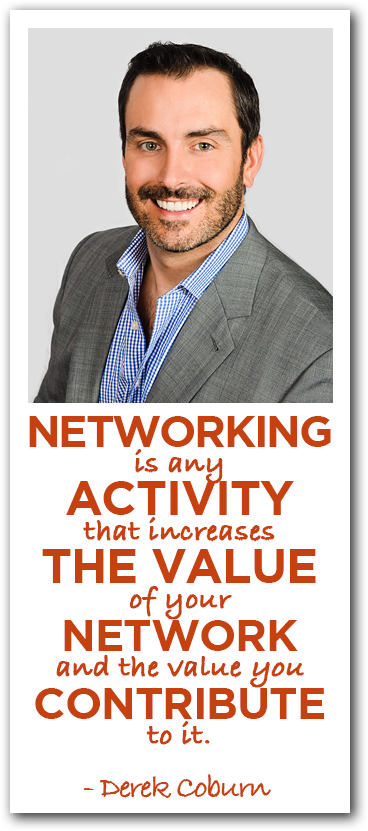
  • I define networking as any activity that increases the value of your network and the value you contribute to it.
  • I think that’s a pretty good definitely of networking for professionals who aren’t looking for jobs who recognize that it’s not a place to go to pitch your goods and services. It’s a place you go to connect with other professionals that are at a level that you’re at or maybe interested in the same things you’re interested in.
  • The problem is that most books and advice around networking centers around this sacred cow of a large networking event. The advice is sometimes good, but it’s normally “get a higher quality grade paper for your business card,” and “only drink for the first half hour,” and “when you follow up, use this word and not that word.”
  • I think that because networking events are sort of already past the point where we’re going to fix them or change them. What I have found to better a better solution is to not go to them all together.

If the networking events aren’t working for us then what should we do? What did you do when you decided to create a new type of networking?

  • Well, my reasons for networking were to develop these relationships with other professionals and get together to find ways we could potentially help each other out.
  • I compare networking to dating. If you’re approaching networking from a long term perspective and looking to develop relationships the right way with other professionals, the dating equivalent of that is looking for the love of your life.
  • If you were to buy the best dating books on how to find my soul mate, how to find the person I’m meant to be with, none of those books start off with “continue going to bars and night clubs every night.” It’s more about leveraging your friendships, hosting dinner parties, doing things that were the complete opposite of what you were doing.
  • I started figuring out ways I could borrow form the dating world and apply some of these strategies to what I was doing with my clients and as an extension, some of the people they knew and the relationships with related people.

In your book, you mention a “connector.” Tell us a little about the connector model.

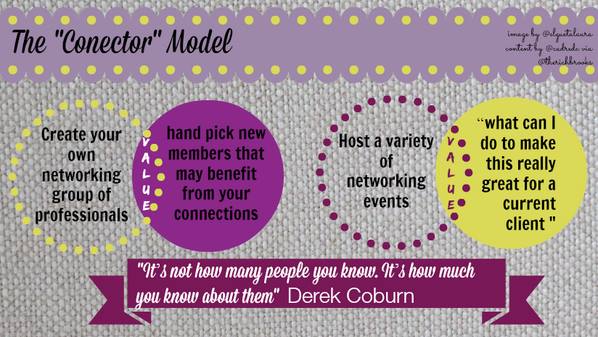
  • The connector model is a series of strategies, a lot can be applied individually and I’ll share a few of them with you, and I think they could work really well on a one off basis for just about anyone, but when you put them all together it takes you through the strategy I use.
  • What I ended up doing was putting together my own networking group that consisted of about twenty five professionals. They were some of my clients that were great clients but also business owners that would perceive this as a value extension in terms of what I was bringing to the table by facilitating introductions and making connections between them and other clients and professionals that I knew.
  • Then I would go out and find others that I would hand pick and find ways to bring them into the fold.
  • I would host a variety of events and would focus on ways that I could add more value for them and to a large extent my networking events are always successful because they start and end with, “what can I do to make this really great for a current client of mine.”
  • I find ways to incorporate networking and events and interacting in different types of settings where, worst case scenario, my client enjoyed themselves, but best case scenario, I’m going to be in the same room with other people that could end up becoming clients of mine.

So, rather than go the traditional networking route, you brought your own core group of people you knew and trusted and you brought them together to try to get as many valuable connections as possible.

  • Absolutely. “Clients” is the first part of the “connector” acronym. “C” for “clients.” It’s really about, “what can I do for my existing clients,” which is a way to go above and beyond the core deliverable that I’m providing them.
  • I had an experience, a story that I share in the book, with a client of mine (names are changed of course), I refer to him as David the landscaper in the book.
  • David called me up back in 2009 and said, “hey man, I received a call from one of my best clients and they have a family member who’s getting into the wealth management business” and they want me to take meeting with them.
  • I let them know how great our relationship is and I wasn’t looking to make any changes, but they said, “just take a meeting with this person” and I’d be doing them a big favor. I said, “no problem, thanks for letting me know.” I gave him a summary of what he had with me and he called me up a few days later after the meeting and said, “Derek, so I met with this advisor and I got a bit of a pitch that took about forty five minutes and at the end he revealed a portfolio that had I been investing my money with his firm for the last couple years I would’ve averaged two or three percent more per year than what I had by investing with your firm.”
  • His reponse was, “Derek’s referred me to really great clients over the past two years that have generated me over two million dollars of revenue for my business. So, in theory, Derek and his firm could’ve lost half the money in my portfolio (which we didn’t do), and from a net perspective I would’ve been better off working with him.”
  • What I realized was that I was doing this sort of thing for my clients on a regular basis but what if I could, as an extension of what I was doing as a financial advisor, almost become an extension of my clients’ business development and marketing departments? Because hey, who doesn’t love to receive a great referral?
  • If I was able to focus my networking efforts and outreach to other professionals when identifying the opportunities for my best clients, then they would love me even more and would be more receptive to introducing me to more people that they knew.
  • So that was at the core of a lot of what I do.

Do any social networks fit into your networking plan, or is that something completely separate?

  • I love Twitter. The reason I love it is that I use it and approach it as if it is the world’s best networking event in terms of its size. It’s always open. You get to see who’s there and who you want to connect with.
  • I just shared a story with you that highlighted how my focus and networking efforts would be focused on my best clients. What I talk about in the book and what I’ve mentioned before, is let’s say networking 1.0 is all of us showing up at networking events and we thought we were going to meet clients when we went to an event.
  • For most of us, that wasn’t going to happen and we changed gears and unfortunately there are still a few people out there practicing networking 1.0.
  • So then, networking 2.0 is this idea of, “hey, we just met for the first time and I’m really interested in you and how I can help you,” which I think is kind of weird. I think that people that use this approach, and I’m all for paying it forward, but if you’re at an event and someone comes up to you that you barely know and they say, “hey, what can I do for you, how can I help you?”
  • I always say, “what’s going on with this person and their business that they’d be so willing to go out of their way to help somebody that they just met?”

I get squeamish when somebody comes up and says, “how can I help you?” at a networking event. It comes off as disingenuous.

  • Yeah, there can also be problems with these people when they approach networking they approach it from a quid pro quo perspective. If I give this person a referral I’ll get one, but you really have to be careful about who you introduce, especially if it’s a good client.
  • If you’re putting a good client of yours in the hands of someone you don’t know that well in the hopes that they will do a great job for your client and then pay you back by giving you a referral, the risks far outweigh any potential rewards.
  • What I call networking 3.0 is when you’re meeting people (and this is what I do on Twitter a lot) it’s me showing up at these places thinking about my best clients and what they currently need and are interested in.
  • So, if I were to go to a physical networking event and I meet someone and as soon as the person says, “what do you do?” I say, “I’m a financial advisor,” there’s always this really quick excuse, “I don’t have any business cards and I never want you to call me.”
  • Somebody may say to me, “I’m currently saving up all my money to buy a new house and I’m not really in the market for a financial advisor,” and I’ll say, “that’s great,” and what I immediately think about are real estate agents in my network that I can connect them with.
  • I’ve found this to be one of the more effective and productive ways that you can connect and develop relationships with people because in this scenario, if I introduce the person that I just met to the person I have more of a relationship with, like my real estate agent, I’m potentially setting something up really valuable for my real estate agent.
  • I’m not really putting myself in any sort of scenario where there going to be mad at me. I say, “hey look, I just met this person and they say they’re in the house for marketing.” Now, they could’ve been lying and potentially wanted to blow me off, but if they were being sincere then I’m doing them a favor by connecting them with a great real estate agent and if they end up working together (and that sometimes ends up happening), they remember you as the glue that kept it together.
  • Obviously, I’m going to be the person they reach out to once they buy their house, they’re in their house, and now they have some money to potentially invest.
  • This is really easy to do on Twitter. So, the next time you’re on Twitter, a lot of people show up and say, “what do I want to push out there about myself or how can I do this for this person.”
  • If you think about some of the best clients have, or prospective clients you’re trying to work with and just listen to what other people are saying, you can really do some effective networking and meet prospective clients by just listening and making those connections.

In the book you mention using LinkedIn to find some people. Walk us through that process.

  • Alright, for LinkedIn, if you are sort of buying in to what I’m talking about and being this connector and being somebody people are turning to in your network as a resource, you want to make sure you can deliver as much as possible.
  • What I mean by that is if someone came to me to say, “hey, I’ve been to you for two other things and you’ve been really helpful, do you know a really great chiropractor or a really great interior designer?” If I say, “no,” then I’m really lowering the potential they’ll come back to me again the next time they need something.
  • One of the strategies that I use that has really worked well for me on LinkedIn is I would send InMails to professionals who were in industries where I didn’t really know anyone.
  • A good starting point for me was if I had clients or individuals that were part of my networking group say, “hey, do you have a recommendation for ‘x’?” and I didn’t know anyone I would reach out to them and I would say, “I’m looking potentially for a great ‘fill in the blank’ to refer my clients to.” This is all coming from a point of complete authenticity.
  • There are ways that people can manipulate this, but I would simply say, “hey, I’ve been asked recently by clients or otherwise for an introduction to someone who does what you do. I currently don’t know anyone, but based on our mutual connections and what you’re doing on paper it sounds like you’re doing a great job and I would love to schedule a ten minute phone call to learn more about you. If I get asked this question again going forward I’ll know if you’re someone I feel comfortable recommending that I could help.”

How much time should we be dedicating to networking?

  • The first thing that I’ll share is regarding time. I hosted six wine tasting events – one per quarter, spanning a year and a half, and I ended up generating about $150,000 of revenue from new clients that I previously wasn’t working with, that attended these events.
  • I know that your show is all about helping your listeners find their ideal clients and to leverage different types of marketing, so I’ll walk you through the process for how to do this.
  • I would reach out to my best clients and tell them we’re setting up a networking event and let them pick the best dates for all of them. I would say, “we’re putting this thing together. We’re going to serve some good wine, we’re gonna have good food. It’s gonna mostly be about connecting and catching up and having a good time, but there’s also going to be 10-15 minutes of some sort of information, something that’s relevant to our industry that we think will be good for you to hear.
  • Every invitation to my clients was for them to come, and in some cases their spouse, but also they were able to invite up to two more people to join them. While they could invite anyone they wanted, I really tried to encourage them to bring their partners, fellow board members, or best clients. We’re not going to do any pitching, but if you feel like they may be an ideal client for us that would be great if you could bring them.
  • What would happen is that people would show up. There wasn’t a pitch. There wasn’t any expectation. I would spend about 10 minutes giving an overview of a topic that in all likelihood would be new or interesting, or something they probably haven’t heard from their existing financial advisor. It wasn’t like a get rich quick thing. It was more of something to make them think like, “I wonder why my financial advisor hasn’t brought this up to me before?”
  • So, what would happen at the end was I don’t have to sell in that environment because I have 15 clients and 15 guests, so my clients are talking us up, hyping us up and what we’re bringing to the table.
  • What would always happen was people would leave and in the worst case scenario they would say, “you know, I like my financial advisor fine, but I’ve never been invited to a wine tasting event and been able to hang out with some of my friends. So even if Derek and my current financial advisor are equally skilled in terms of what they’re providing me, this is a cool little tie-breaker.”
  • The second component is that it would usually shake them. They’d show up thinking everything was fine and I would raise an issue or a topic that they might not have addressed. They may go back to their existing advisor to address it or they may think to themselves, “why didn’t they come to me about this in the first place?”
  • Having all these variables and different moving parts created a scenario where people were showing up thinking that they were just have wine and spend time with their friends who were my clients, but without me following up, without me pitching, a number of them after each one were reaching out to me and say, “hey, can you give me a call because I’d like to learn more about whether we’d be good clients for you.”

Are you using any tools or can you recommend any tools that we can learn in terms of the networking process?

  • Yes, so there’s one that’s amazing, but first, have you heard of SaneBox?
  • The primary way SaneBox works is that imagine you show up at the end of each day and someone has sorted through your physical mail, and not junk mail. Here are bills, here are invitations, and things you don’t have to deal with right at that second, but will have to deal with at some point. So we put those in a separate pile and we only leave the things in the primary pile that are really important and have to be looked at right now.
  • Every morning I wake up and check email. SaneBox uses an algorithm based on whether I’ve ever responded to them, similar to what you’re seeing right now with Gmail and the promotions tab, but if I haven’t responded to them and there’s a frequency for how often I respond, they just won’t show up in my primary inbox.
  • I used to have 25 emails in my inbox when I woke up at 7am and now I have seven and they’re all really important.
  • The other thing I like is that it’s got a boomerang-like feature where I can blind copy 3 days, 6 days, 10 days, 3 weeks, 2 months, at SaneBox.com and I’ll get a reminder at the top of my inbox if the person hasn’t responded. It’s a great way if I’m connecting people together and I can introduce Rich to Joe and blind copy 5 days at Sanebox.com and neither one of you responds to the other then I can give you guys a hard time and say, “come on, I made this introduction. You said you wanted it. Let’s get on it.”
  • Contactually is actually a really incredible tool that I’ve been using a while now and they continue to roll out new features that I’m just amazed by and all of them are really relevant to me and anyone who makes connections and who manages a lot of personal relationship via email.
  • The first thing that’s really cool about Contactually is that they have a bucket feature. With the bucket feature you can throw – clients, prospective clients, centers of influence, people that are really important that you just want to ping from time to time – and you can create these “buckets” and a certain time frame associated with each one.
  • For my clients, I have them all in a client bucket with a 30-day follow-up requirement. What that means is that it’s running in the back of my email that if I do not email a client or they do not email me over a 30-day time period, then I’m going to get an email saying, “okay, you wanted to keep in touch with this person every 30 days and you haven’t actually done that.”
  • The cool thing is that unlike a CRM, where you can set up these reminders every 60 days or every 90 days, is that is if that client emails me into the new 30-day window the 30 days resets automatically so it becomes 30 days from that last point of contact.
  • In fact, I will have those reminder emails go to my assistant so I don’t even get them. It has team functionality, so if you have four or five or twenty or however many people you have on your team you might not necessarily be the one that’s following up with your best clients every 30 days but you want one of four people on your team to be doing so. Then, if none of them respond to the person inside of 30 days you can have that email reminder go to the team leader and then they can say, “who needs to follow up? How should we handle this?”
  • It’ll link up to Twitter and LinkedIn and they even have an app for your iPhone that if they call you from a number that’s tied to their contact information and vise versa that it’ll count it as a contact automatically.

Any other tools you have for us, Derek?

  • Yeah, it’s more like an extension of Contactually. They just rolled out this feature called “scale mail.” I tell people all the time in my network that if you get an email from me it’s very likely that I didn’t send to just you, but at the same time I don’t send out mass merge emails to a hundred people at a time. I will send out maybe 8 to 10 different iterations of a particular email acknowledging certain information or certain actions that you’ve taken.
  • So, if you are a Cadre member and we have an event coming up and you have not RSVP’d for the event then you’re getting one type of correspondence from me acknowledging that you haven’t signed up and let’s get rolling. But if you have signed up or you have signed up and have also invited a couple guests, then a number of different things happen.
  • You might get an email from me and I’m fine with you knowing that it went out to more than one person, but it’s always going to be relevant.
  • Contactually’s scale mail feature allows me to create templates or emails where the body of the email is the same throughout but then I can customize each one and add a blurb that’s very personal to each one on an individual basis and then send out 20, 30, 100 of them at a time.

Juicy Links:

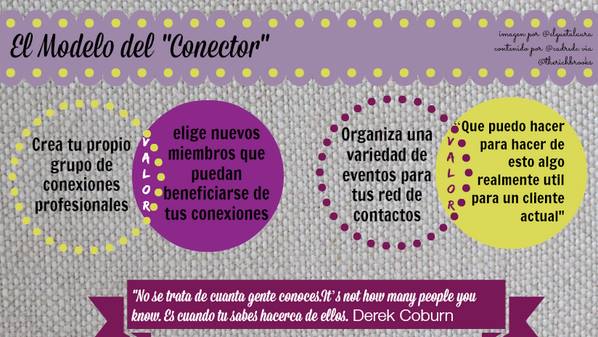
Special bonus! Check out the two infographics that listener Laura Elgueta made based on this episode!

The Conector Model - English

Conector Model - Spanish

Rich Brooks
Takes the “working” out of “networking.”

Optimizing Facebook Marketing for Small Business – Mari Smith

Mari Smith Facebook MarketingDo you have an unused or outdated Facebook page for your small business? Have you had trouble keeping your audience as Facebook continually changes its algorithms? Does your marketing plan include room for Facebook ads?

If not, then you’re not alone. A lot of small businesses don’t think their Facebook page is worth maintaining or not worth an additional ad budget. By using a well-rounded marketing strategy with consideration for organic search, paid promotion, and some creative techniques, you can optimize your Facebook page for growth once again.

This week, we bring in Mari Smith, social media leader and Facebook marketing expert, to talk about how we can tune-up our Facebook page to get the results we want.

Big Ideas:

How did you first discover Facebook and what drew you to it?

  • I’m very blessed to be a natural networker. I have a very outgoing personality and I was always a pretty networked person in the offline world.
  • Back in mid-2000s I got invited to be on the beta test team of a Facebook app and I had barely heard of Facebook in early 2007. I’m very techy. I love people and I love technology. Those are my two passions. I had been somewhat active on LinkedIn, Rise, Ecademy, Plaxo, etc.
  • Also Myspace…I always thought it wasn’t for business – it was for kids and musicians and so I was a little bit of a holdout.
  • I thought, Facebook, not another online social network, so I was a little resistant, but it was an absolute defining moment in my life. I agreed to be on this test team of the app, and it was called PodClass – it was an education app.
  • I pulled up facebook.com and time stood still for a moment. I love the layout and format and the ease with which I could find people I had long admired – influencers, authors, speakers, and leaders – and with a click of a button we’re friends and we’re chit chatting…no middle man, no secretary, no virtual assistant, anything like that.
  • Before long I became a raving evangelist for the platform. I don’t work for the company, but I absolutely love it. I have an admiration for Mark Zuckerberg and his vision to make the world more open and connected, and in a short period of time I was raving to everyone about Facebook.

There’s been a lot of discussion around how difficult it is to get organic traction on Facebook. What do you say to small businesses that think it’s no longer worth it to be on Facebook?

  • The bottom line is you absolutely have to change your strategy. What used to work 6 months ago no longer works, that’s clear and obvious. So, we have to stop tearing our hair out and getting angry at Mark Zuckerberg, and the whole company, and just accept it is what it is.
  • We had a wonderful free ride for many many years and now the problem is where the companies that have built a Facebook audience and have come to rely on their audience on “rented land.”
  • You’ve got think about “where can I build this audience on my own land?” – that would be your email subscriber list, your blog subscribers, migrating people over to your site and platform but still engaging with them on Facebook when you can but being very strategic about making offers and lead generation from Facebook.
  • There are several things here with the drop in organic reach – and I’ll say as a side note, my organic reach per post went from 50,000 on average in late 2013 to now in April 2014, I’m lucky if I can get 3,000 – I’m in the same boat.
  • I have this relationship with Facebook and a love for people and technology and I really study human behavior and psychology. I think how to present information in a way that’s very personable and not markety or salesy, so often I can get an organic reach from 8,000-15,000 people per post.
  • So, it’s still possible to get some organic reach. The other thing is that we do have to set aside a nominal budget to pay for some promotion and get more amplification for people to see our content.
  • DO NOT abandon your Facebook efforts.
  • I tell people the main reason to be active on Google+ is because Google owns search. The same reason applies for Facebook.
  • A main reason to have an active Facebook page with content engagement and conversion is that Facebook is the 2nd most trafficked website in the world. All that content on your Facebook page is good for Google SEO.
  • Another reason is that it’s the number one social network with 2 billion active users. You can’t walk away from an audience that big. You only need a teeny teeny wee percentage of them to respond to your content to get decent ROI.

So, you need to stay there because that’s a way to feed your email list and it’s something you own, unlike Facebook which is like a networking event. Does that summarize what you’re saying?

  • Yes, and want to recommend that people stay away from that boost post button – it’s absolutely ubiquitous and it’s in your face wanting you to spend money. My friend John Limmer, said “the boost button is the ‘crack’ of Facebook.” You spend $5, $10, $50, and you see those numbers go up.
  • Be careful of accumulating vanity metrics – getting more likes. Unless your converting them into leads, getting them onto your email list which you own and can nurture, unless you’ve got that in place, you’re just building likes for the sake of it. Same with the engagement numbers – like PTAT.
  • PTAT doesn’t pay the bills!
  • The bottom line is with paying with post, you use the Facebook ads manager, or even better, the Power Editor. You can get much more granular targeting and placement so you can choose to place your promoted post on the mobile or desktop news feed. 75% of Facebook users are looking at it on your mobile device.
  • The other thing is that you don’t want to just pay to promote a piece of content for the sake of promoting it or getting more eyeballs.
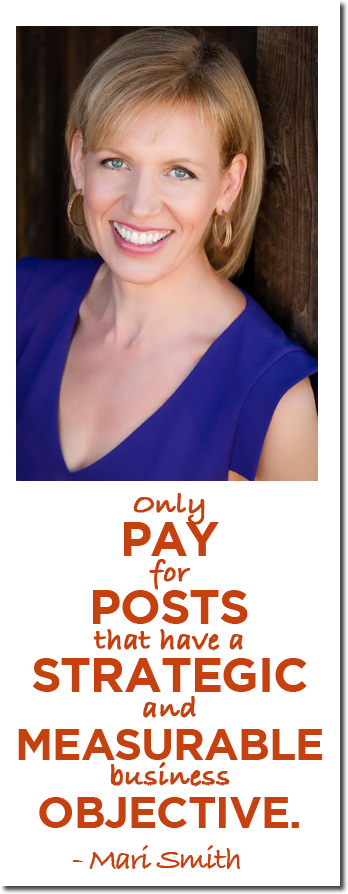
  • Only pay for posts that have a strategic, measurable business objective behind it.
  • Once a quarter, I do a launch. I launch a free webinar and then I sell an online course and that’s my bread and butter income. So, I pay for promoted posts during the time I’m offering the webinar and course – so a few weeks out of a couple months – otherwise I’m just posting regular every day content by adding value and engaging.

What are some of the best practices to set up or maybe optimize a page that hasn’t gotten a lot of love and attention? Where do you start?

  • I really recommend that small businesses have an integrated marketing plan that includes their other channels, so Facebook won’t be the only one, so you’re probably growing out a profile on Twitter, Instagram, and Google+ especially for local businesses because that’s where people find you with the place page on Google.
  • The good news is that it’s not that difficult to have a really good content strategy where it’s a blend of original creative content and curated content and there’s many different apps to cherry pick and pick out the best content and share that.
  • I use HootSuite every day for scheduling tweets. I use Facebook’s own scheduler for posts.
  • I think the key here is consistency. Small businesses optimizing their Facebook page – commit to one good post a day. Make sure you have someone on your team that’s dedicated to watching for engagement and resounding to comments as promptly as possible. Responding to reviews if you have a place page, a local business, you can respond to positive and negative reviews.
  • Take a three-pronged approach to conversion strategy – content, engagement, and conversion. You get those three components in place and apply it to your social networks.
  • Do what you can in the time you’ve allotted. Don’t get overwhelmed and stop before you start!

So, now when someone leaves a review on your business page, you now have the opportunity to respond to that review specifically?

  • Yeah. Just the page owner though. You can’t have a conversation with other fans.

Are custom tabs still relevant for small business and if so how?

  • This is a tricky one because there’s a brand new page design rolling out. It’s very much in keeping with the profiles. It’s a wider single column on the right hand side. The apps have turned into tabs, so you can only have one next to your photo. The rest are shoved way down beneath or even below the fold based on the size of your monitor.
  • As a consumer I rarely click on tabs, but I love to see creative uses of them for two things – one would be promoting other social channels like Twitter, Instagram, Pinterest – letting people know you’re on those and number two, email – having some compelling call to action to get people to get to click and sign up and join your email list.
  • Even if that ad is a simple redirect link. I love being able to put a redirect link and I use an app called WooBox.
  • Any time I’ve got a class going on people can go to my page and they can just click on the badge and it takes them outside of Facebook right on to my sales page. You don’t even have to build an app, it’s just a redirect.

Do you think that it’s still important to keep people within Facebook now, or is that less important these days?

  • I love this question. Remember how I said 75% of users access it through your mobile devices. For a long time Facebook page owners have been blissfully unaware that you can’t access tabs on mobile. The design doesn’t let you click on tabs or apps.
  • However, you can be creative and use TabSite or ShortStack which have great apps that use “smart links” and the device can tell if you’re on mobile or desktop and creates a mobile-friendly version of the link to your app.
  • Let’s say you have a contest. Apps are fantastic for contests. To properly collect leads, and draw winners and random, and a sweepstake, it’s best to use an app.
  • You can create a post on your wall (that you can pay to promote) and you can include a smart link so when people will see it in their mobile feed they can easily sign up to your contest or join your email list.

It seems like Facebook is always tweaking its “EdgeRank” algorithm. What are some of the most up-to-date best practices for organic reach in the news feed for a company?

  • Kudos. Facebook has actually been quite adamant that they don’t use that term. It’s actually called the “Facebook newsfeed ranking algorithm.” It’s much easier to say “EdgeRank” though, right?
  • There are over 100,000 factors that go into that algorithm. Any time a user visits Facebook whether desktop or mobile, there are a potential 1,500 stories it could display because people over the years have garnered more friends. The average is now 350 friends.
  • Over the last year the number of pages users have liked has increased more than 50%.  So we’re liking more pages and we’ve got more friends so that means more stories we can share.
  • Facebook is pouring all of this potential content that we could see through this complex algorithm that weighs all kinds of things about popularity, who else has seen it, the type of posts, how recently it was published, even posting preferences like photos versus just links. It’s crazy how granular the thing is.
  • I’m actually encouraging my clients and students to increase their frequency a little bit. If you normally post once or twice a day, see if you can double up content and do 2 or three times a day.
  • Really experiment with time zones – evenings and weekends. I’ve been harping on about this for years. So many businesses are missing out by not getting on to the newsfeed on evenings and weekends – that’s primetime. That’s when most people are on Facebook when they’re on there for social reasons.
  • Don’t be afraid to schedule things in the middle of the night especially if you have a global audience.

Can I post the same thing multiple times a day, or should it be different content every time? Or a different approach to the same content?

  • It doesn’t have to be unique content. The greatest thing is OPC (other people’s content). Sometimes people get afraid of sharing other people’s content – it’s just amazing. It’s that old Zig Ziglar quote “if you help enough other people get what they want, you’ll get what you want.”
  • Keep generous and abundant with sharing relevant, related, quality content, you don’t have to send people directly, but just value-added content. You can use content curation tools.
  • I use Content Gems (contentgems.com) every single day. I know a lot of people like Sway, or Sponge, there are great tools for surfacing relevant content.
  • I would absolutely not post the same thing in a day. I’d watch how your audience is responding and you can reshare it at a later date on Twitter if it does there (the following week or 10 days later).
  • The same thing with your Facebook page, dig deep into your wall and create a new fresh post with the same content.

I don’t feel the same pressure with Twitter. With Facebook, I’m always concerned that if I put out a dud, Facebook says “people don’t like Rich’s or flyte new media’s content so we’re gonna show them less of it.” I wonder if that’s one of the things that are holding people back?

  • I honestly don’t think people give it that much thought. It is true, Twitter is a whole different animal.
  • People do get really self conscious or are judging themselves thinking how they can come up with something brilliant to say several times a day.
  • The good news is that you’ve got to have a mixture of your own content combined with other people’s content. You don’t have to get that wild and crazy. Just keep experimenting.
  • One of my most popular posts in the last several months, on a Friday night I come home at 1am and put “It’s 11am Pacific time here in San Diego. What time is it in your part of the world?” I got hundreds of responses. I couldn’t believe it. It was something so simple like that.

Are there any other activities as pages we should be engaged in? Is there anything else we can do to increase our visibility and activity on Facebook?

  • A little known trick I love to share is that not many people realize that every single post has its own unique URL.
  • Let’s say you’ve got a post that’s doing really well, and if you want to drive more traffic to it, shorten that URL with something like Bitly and tweet it out. Include one of your Facebook posts in your email newsletter.
  • I frequently see a bump in engagement because I’ve driven traffic outside of Facebook to a specific post. That’s a really cool trick.
  • As a page you can post on other pages.
  • You probably want to make use of the Pages Feed. This is a fairly new thing. Under the Pages category there’s something called “Pages Feed.”
  • If you interact with that on a regular basis with pages you can also get in front of other businesses.

What are some of the benefits that small business owners can get from creating and promoting a personal profile and really leveraging that?

  • It’s a concept that came about in 2012. Facebook introduced a concept similar to Twitter called “follow.” It’s an optional setting in Settings called “followers.” You can choose to turn that on or not and any post you share to “public” people can sign up to see those in their news feed. It’s a similar algorithm to Pages.
  • Anything you share to just “friends” nobody can see but friends.
  • I turn my “follower” on immediately. I think it’s an overlooked feature. I have 423,000 followers. I’ve got to say, many of them are foreigners and don’t speak english, and aren’t my friends, but they do interact with my content.
  • You have three opportunities to be seen in the news feed. One is when you post content to your friends from your profile. Two is when you post content to “public” so that your followers and friends see it. And three, is from your fan page posting to people who’ve liked your page.
  • You want to have a strategy that includes all three. I wouldn’t post the same content to all three audiences, just keep mixing it up.
  • You’ve got to have that top-of-mind awareness. I’m much more personal. I share a quite bit more personal stuff. I like to say to people, “hello, there was life before Facebook. Why would you want to have it super locked down and private?” That’s great, and I’m not judging you, but you could make use of a secret group, like the one I have for my family, where nobody even knows it exists except the people in it. We share somewhat private things in there.
  • Facebook has always been my strategy. I don’t use Facebook for super personal private stuff.
  • Small business owners are missing out by not being active on their profiles.
  • If you look at your newsfeed, 90% of posts are from people, not pages.

How often would you recommend we check our Facebook Insights for our business page? What are some of the most important things we should look at?

  • Some people are religious about checking them.
  • There are some apps out there. One is Edge Rank Checker, another is Agora Pulse, and another is Social Bakers. They have a great amount of social stats for Facebook and more.
  • Otherwise you’ve got your own insights on your page.
  • One thing you might want to check is your demographics. You go to the “people” tab and you want to see where’s the majority of your fans. It shows you three categories – your fans, the people you’ve reached, and the people that are engaging with you. Sometimes they’re in different areas. Most of my own fans are in Los Angeles, but the people I engage with are in London.
  • These are rolling numbers. They’re updated anywhere from a week to 28 days.
  • You can see where your people are located because that will inform you when you do pay to promote posts you can get real granular in the Power Editor and promote to specific areas that are already engaging and active with you.
  • You can also look at when people are online. Facebook shows you when the majority of your fans are online and that’s usually quite helpful – it’s under visits.
  • You can also see where people came from, the external sites they came from. It depends on how analytical you want to get.
  • You can go as far as exporting the data and crunching the numbers on a spreadsheet which isn’t a bad thing. There are a couple columns in there that let you see all of your fans and how many you’re reaching. The “reach” is showing you fans and non-fans, so it’s kind of a skewed number.
  • You might want to download and export your data to see how many of your fans you’re reaching.
  • I’ve gotta say, I’m not a big analytics person. I don’t crunch the numbers like crazy because Facebook is too precarious when it comes to giving me real solid data.
  • You’re better crunching numbers when you’re placing ads.

So it sounds like you can export data, but it’s not crucial unless you’re going to start spending money on advertising and then you’ll want to pay more attention to some of the insights and analytics you can get.

  • Yeah, 100%. By the way, just another plug for ads. Even if people did $10/day for budgets, it is the most targeted traffic that your money can buy.
  • And now, a fairly new feature is called website custom audiences. So, let’s say you have a sales page or an opt-in page, you can take the people that are logged into Facebook and are visiting your page, blog or website. You have a piece of code (or pixel as it’s called), and that pixel fires when people visit that site and now you can then place ads on Facebook targeting people who’ve visited your site.
  • It’s often called retargeting or remarketing. Often, if you’ve visited a website and then all of a sudden that very thing that you were looking at follows you all over Facebook.
  • For me it’s shoes and dresses!

Juicy Links:

Rich Brooks
Facebook marketing is dead. Long live Facebook marketing.

Local SEO & Directory Tactics for Small Businesses – Nathan O’Leary

Nathan-O'Leary-PinterestDo you have a brick and mortar small business? Have you submitted your business address and contact info across all the major directories? Do you keep your information consistent and updated?

If not, then you’re not alone. A lot of small businesses don’t know about the tips and tools to optimize their local SEO and fully take advantage of local business directories. By using Google and social media, we can reinforce the legitimacy of our business in the online world.

This week, we bring in Nathan O’Leary, owner of Mainely SEO, to talk about how we can fine tune our local SEO and get the most out of local business directories.

Big Ideas:

How did you find yourself providing SEO services to small businesses?

  • I started Mainely SEO as a side business from my full time job and I was working with family and friends that have businesses that needed websites and just found that when they needed a website a lot of the times they needed that website to rank in Google to drive them more qualified traffic so I started investing a lot of time and energy researching what SEO is, what it isn’t, good techniques, bad techniques, black hat, white hat.
  • I kind of self taught through most of it.

What do you say to the people that say “SEO is dead?”

  • I would say don’t put all your eggs in one basket.
  • Definitely diversify your traffic sources – email, social, SEO – so if you if you’re penalized or your traffic source dries up you’re not relying heavily on one traffic source.
  • We know that Facebook is changing their algorithms  just like Google changes theirs, so you can’t promise on just any one source.

Can small businesses compete with large corporations that have huge budgets? Can they hold their own when it comes to SEO?

  • They can definitely hold their own. Google is getting smarter from where people are searching from so they can detect their location by IP address or even if you’re not including location based searches when you’re googling something.
  • So if you’re a small business offering cupcakes and if somebody’s looking for cupcakes, they’re more likely to find you in the search engines because Google can tell that you’re a local business related to the area that person is searching from.
  • I would also add, that if you’re blogging, creating great content that also just serves your local market is a great way to get that search traffic.

What is local SEO and why is it so important to small businesses?

  • It’s definitely serving the clients that are in your general area. So if somebody is searching for something, they’re on their mobile device and they’re maybe walking around a city looking for products or services and you’re a local small business, then you definitely want to show up in those search results whether it’s your website that’s showing up in the search results or potentially a directory listing that lists your business as well as a couple of your competitors.

For the local search results, what can we do to get found in those? Is that a different algorithm? Do we need to use special tips or tricks to get found on that local search page?

  • There’s definitely a lot of things you can do.
  • Just making sure that you’re in GoogleMaps and having a Google+ local page for your business is definitely important.
  • Back on your website, make sure your address is clearly visible and in text format (and not in an image) will definitely alert Google that your a business in a certain city or town.

Now you mentioned Google Maps. What is it and how do I make sure I’m listed on Google Maps?

  • You can go to maps.google.com and search for your business and search by your business or brand name to see if you’re in there.
  • There are other online tools that will measure your online presence like Yext and Moz Local (formerly Get Listed) and they’ll go out and scan the web and all these other directories to see if you’re listed in there and if you are, how optimized your listing is with pictures, a link back to your website, your hours of operation, and things of that nature.
  • There’s a lot you may not have heard of, but there are also some bigger ones like Info Group, Factual, Axom, and New Star are a couple that may be unfamiliar to some of the listeners but those are actual data aggregators that funnel some of the information to the smaller directories and also GPS car and things of that nature.

If I want to use Yext or Moz Local, is this a free service, a one-time deal? How does it all work?

  • Yext charges a flat yearly fee and some of the listeners may have used that before and put in their business information and I know some of the clients we’ve dealt with get a bad taste with Yext because they’re relentless and they keep calling you and won’t let go until you tell them to buzz off.
  • You can still use the service if you don’t mind the harassing phone calls to just check your listings.
  • The one I prefer is Moz Local and that will scan for different results and you can use that as a roadmap and you can certainly and go to those directory yourself and claim those listings and optimize them with a nice description of your business, using keywords you know people will be searching for.
  • You can add photos to those listings. You can add yourself to multiple categories and it’ll give you a score based on how optimized your listing is.
  • So, it may take some time and you can go through each individual one and claim them or pay a yearly fee for a service that has these companies go in and do it for you.

You also mentioned Google+ local pages. What do we need to do with the Google+ pages? How does this all work?

  • You do need to have a Google account for yourself.
  • You need to go into the Google+ business pages and create a listing or claim a listing.
  • Google will either call you with a pin number or send a postcard to your business and you have to enter that pin to verify that you’re that business and it opens up a larger dashboard that you can see how many times you’re appearing in those local results. You can see how many times people are clicking on your website or phone number or even asking for driving directions. You can even see the hotspots in what towns people are looking for you.

If I’ve created a personal profile in Google and a business page, is that my Google+ local page or my business page?

  • Great question. It could be just a business page. What you want to look for is a little check mark next to your Google+ business name on the profile page.
  • That little checkmark will say something like “local verified.” That will verify that it’s set up as the proper local business page.

Should I try to merge my Google business page with my Google local page? Is it worth it?

  • I definitely think it’s worth it. You don’t want to confuse Google or your customers that find your Google+ page. Instead you want to direct them to that Google local page.
  • There is a way to merge them and it’s a little difficult and there’s a great article that explains how to do that.

Are there certain businesses that local search is more important for? Or should every small business be concerned about SEO?

  • I think if you’re a brick and mortar location and you have people walking in and visiting your location then it’s more important to have a listed in the maps directories because is someone is searching for you, and they’re looking for your products or services and walking around a town. You definitely want to show up in that.
  • If you’re more of a general contractor or home builder or something like that, there are definitely benefits to being listed in some of those directories but it might not be as important because you’re not asking people to come to a physical location and you’re not getting walk-in traffic.

I’ve heard that reviews matter. If this is true, how can we get more reviews and where should we direct people to leave reviews for us?

  • You definitely want to ask your happy customers to leave a review on your local listings and ask them to leave a review on Yelp or Yahoo Local, and Google Maps so you have a nice slice of reviews and are diversified throughout the web.
  • That can definitely help your listings and rankings.
  • One thing to note on Google Maps is that you might have seen business with the star rating under their name and that happens when they have more than three reviews listed so if you’ve got one or two, try to get that third one and Google will turn on those starts below your name to get you more attention.

How about negative reviews. Should we worry about them? Will they hurt our local listings?

  • I don’t think they will actually harm your rankings.
  • You obviously don’t want your customers to read something bad about your business, so maybe try to resolve it with the customer if there’s a chance to do that and ask them to take it down if you can make it right.
  • After you’ve claimed these listings the business owner has the option to respond to these people. That’s always a positive sign if there’s something negative out there listed under your business, then a potential customer can see that you’re taking the time to respond to that negative review and it shows that you care.

Does our physical location in a city matter when someone is doing a search on something like “Portland, Maine tacos?”

  • It’s definitely a myth. I’m not sure. Google hasn’t really come out and said it.
  • The belief is that if your business tends to be in the center of the city that you’re more likely to get those rankings and show up in those searches than a location outside of the greater city center.

What should we do if we have more than one retail space? How do we handle all the stuff you’ve shared with us so far?

  • If you’re a pizza joint and you have a couple locations in a town. I see no problem with making sure each one of your businesses is listed separately in the maps directories and with Google because you may be targeting different people and different neighborhoods and if there’s anything uniquely distinctive about your multiple locations then include that in the description of your business so that you’re not duplicating content on each one of those listings.

Is there any connection with social media and local SEO? Can we be doing anything in social media that will have an impact on our local listings?

  • Google may take some social signals and take that into consideration in their algorithm.
  • If you’re on Facebook and have a business page, just make sure that your address is clearly listed and the more of those different social networks you’re registered and listed on definitely build more of those citations.
  • The more citations you have out there the more Google is going to see those and collectively assume you’re more of an established business. Maybe you’ve been around a little bit longer so that can all help you get a little bit higher in the rankings.

Any other tips, tricks, or things we should avoid to help us get found in local?

  • Be sure to have your address on your website and making sure it’s in text format and making sure it’s not in an image because Google may not be able to index the text if it’s buried in an image.
  • Make sure the whois information is publicly available and that it matches the same name and phone number you have on your site and directories. I have a feeling that Google can see that and has another checkmark if you have that populated correctly.

I’ve heard that even how you spell your address across these directories (e.g., “street” vs. “st.) that it might actually dilute our visibility if they’re not the same. Is that true?

  • Yes, so having that match across the web and having congruent information with your name, address, and phone number is definitely important.
  • Another thing, is that if you happen to have an 800 number, I’d recommend using your local phone number listed on those directories.
  • If you’re a business and you have a PO box, Google doesn’t favor that because anyone can go and create one, so sign up for a post mail box at a UPS store or a place that allows you to have a mailbox with a physical address can overcome the hindrance of a PO box. It’ll end up being 123 Maine Street xxx instead of a PO Box number.

Note: After the show Nathan shared a link with me that just came out of SMX West, a popular SEO conference. It says to hold off on merging listings and be patient with Google. Use your best judgment!

Related post: What to do when you get a bad online review…and how to fix it.

Juicy Links:

Rich Brooks
Local is the new Social

Online vs. Offline Networking: A Human’s Guide – Susan Baroncini-Moe

Susan-Baroncini-Moe-PinterestAre you better at in-person networking than online networking? Do you follow the same robotic script when meeting people at conferences or through social media? Do you have an assistant handle some or all of your online marketing?

If this sounds like you, then you’re not alone. A lot of us have completely forgotten how to humanize and connect with others on a personal basis and turn off our “marketing brains.” We focus on getting business and not making a meaningful relationship.

This week, we bring in Susan Baroncini-Moe, author of Business in Blue Jeans, to talk about how we can focus on marketing ROI and be humans while doing it.

Big Ideas:

  • So, what world record do you hold?
    • I hold the Guinness World Record for the longest uninterrupted live webcast since 2012.
    • The trick is you have to keep your stream going and be live the whole time.
    • The record was 24 hours when we broke it and we broke it and ended up at 36 hours and 16 seconds.
    • If you’re going to break something, really break it!
    • There was a guy who tried it last year in England, and it didn’t go so well.
    • We may embark upon another adventure and we may try to break our record someday, but for now it’s holding strong.
  • You’ve written and spoken about “business in blue jeans.” Tell me a little about that and why you decided to write a book on the subject?
    • I’ve been doing business consulting and marketing coaching for a long time and the fact of the matter is that it started in a place where I really didn’t want to wear a suit.
    • I wanted to be comfortable and do business in the way that I do it which is rolling up my sleeves and do what I need to do. I do that best in jeans, yoga pants, and pajamas.
    • I realized it’s far more than just a brand the represents me, it’s also a philosophy of doing business that is really about creating a business that has the properties of denim – it’s stable, long lasting, and it’s flexible – and like that great pair of jeans it makes you look good and feel comfortable about yourself.
    • We want business to be friendlier. This is the big push right now for me.
    • We want business and marketing to be approachable so businesses need to be thinking about that. “How can I reach my consumers and employees and be human and friendly.”
  • What’s better for small businesses – online networking or conference networking?
    • They’re different animals and there’s no one right answer. There’s no one right answer for all small business.
    • It’s really dependent on your target and where you’re going to find them most and how you behave and how you handle the medium.
    • If you tend to be introverted, then social media may be easier and manageable for you.
    • If you’re extroverted, then certainly in-person networking makes sense, but there are pros and benefits to each side of that coin.
  • Let’s start with online networking. What do you say when you hear people say “social networking sites are stupid or a waste of time?”
    • If you think social media is stupid or a waste of time, then it’s one of two things – either you don’t get it yet and see how it can be applicable and useful or your target market isn’t there yet which is becoming less and less likely.
    • Everybody doesn’t have to be on every social media platform, and there are some platforms that make more sense for others.
    • You have to find the social media platform that makes the most sense for your business and your personality and you have to approach it with “I’m gonna play this game the way it needs to be played and the way it makes the most sense to play it and effectively play it” and see if I win.
    • I’m not going to just dismiss it out of hand. It’s extremely useful.
  • How can small businesses and entrepreneurs get the most bang for the buck when it comes to social media networking? What do you say to people say they want to get going and know social media is important, but aren’t sure where to start?
    • The first thing is to figure out where your target market is and to understand that each platform has its own culture.
    • You’re not going to go to LinkedIn and post the same way you do on Twitter. You’ll post too much and make everyone crazy. You use LinkedIn a different way.
    • The first thing is to say, “am I B2B?” If you are then you’re most likely you’re going to want to be on LinkedIn. If you’re more B2C then Twitter, Facebook, more platforms may be more appropriate.
    • The first step is  – where should you be?
    • And the second step is – how can you understand the culture of that platform so well that you can leverage it – and when you do that you’re going to be able to make connections with complete strangers, start to forge a relationship, build a connection, and then over time that can turn in to a lot of opportunities.
    • I have spent the last couple weeks focusing on LinkedIn because it’s some place I haven’t spent a lot of time, and not only have I secured some speaking engagements, a couple of clients, I also am in talks with a production company.
    • There are a lot of opportunities out there if you just know how to wield the right tools.
  • How do we understand what the culture is of any given channel?
    • Google! It’s not like the information’s not out there.
    • If you want to know “how do I use Facebook most effectively” look for blogs you can trust, read the blog – does this blog have information I can use?
    • Find out what they have to say about that social media platform and find out what the consistencies are and what people have to say.
    • You don’t have to throw a stone very far to find a blog that will tell you if you want to be on Twitter – here are the things you need to do…be friendly, be approachable, don’t just follow everybody – these are the things you need to be focusing on.
    • Same with LinkedIn, Facebook, any of those social media platforms.
  • I think people would be more interested in LinkedIn if you told them how you got your speaking engagements. How did you get business out of LinkedIn? What exactly did you do to achieve that?
    • One of the reasons people don’t like LinkedIn because it is structured in a way to minimize fluffy social media interaction that you see on Facebook and to maximize the more old style business networking.
    • You have to figure out a way to negotiate that. A lot of people look at LinkedIn and go “hey, I’m not going to accept a connection from someone that I don’t know, who are you?” LinkedIn is kind of set up in that way, but there are a lot of ways around it.
    • You have to play around in the tool and find out ways to get there. I can click connect for a lot of people and not have to say where I know them from.
    • The way I use LinkedIn is that I humanize it. You can’t make it a mass tool.
    • No social media is successful if you try to do everything with mass quantities of people. Just remember these are human beings and you don’t like spam in your inbox so remember they don’t either.
    • So, instead of sending a million connection requests, find people that make appropriate connections for you and send them an actual personal message like, “hey, I’m looking to expand my relationships and I’m looking to meet more people and you seem like someone who would be interesting and I’d like to get an opportunity to talk with you.”
    • You can actually set up a phone call or set up a time to chat.
    • One of the things I’m doing now is building relationships locally because I haven’t done that a lot and I’m reaching out saying “you seem like you’re in the know, let’s have a conversation.” That’s yielded some really incredible conversations.
  • So, when you are reaching out, personalize it so you humanize it. Have a conversation with people in the same way you would have a conversation at a networking event.
    • Exactly. That’s the other piece of it. I could send out a million connection requests and if you approve it, so what. We haven’t built anything there. That’s just an invisible connection that we’re never going to remember.
    • On the other hand, when I have a conversation with someone on the phone I take notes. So, not only do I remember what they do and who they do it for, I also remember their name, their business name. I’m really thinking about that person and I’m really thinking about ways in which I can bring value to them.
    • Do I know somebody that might be an interesting person for them to talk to?
    • I think that we have to be thinking in terms of “how can I bring value to them?” and not how can I get business for me.
  • How do we measure the ROI of our online marketing? Do you have any tools or techniques that you use to see if the time or money you’re putting in is paying off for you?
    • Man, I’m so unscientific about this.
    • For me, I just get a feel for it. If I’m using a tool and I’m getting business from it then “yay, it’s working.”
    • I am not great with numbers. I’m much better at marketing, so I leave the numbers to people who understand them, but I tend not to think too much about that unless I’m putting a lot of time into something and it’s not working.
    • We should all be doing those sort of general calculations whether they’re with actual scientific data or a feel what you’re putting your time into and say to yourself, “look, am I putting time into stuff that isn’t working? If not, I should stop doing it and find something that is working. Replace that.”
  • A lot of people outsource their online marketing and social media networking to a co-worker or a virtual assistant. Are there advantages or disadvantages?
    • My assistant is local, and not virtual, but my assistant does not manage my social media for me.
    • She does some outreach for me in terms of setting up, guest blogging or podcast interviews like this one. She’ll set up different opportunities for me and do outreach and schedule things for me, but she does not handle any of my social media.
    • I feel strongly that for me, because my brand is so closely to me and my lifestyle, that it doesn’t make sense for me to have someone else posting for me.
    • It takes more time for me to set up a list of things like tweets to schedule than to just do them myself.
    • Unless I’m traveling, my assistant might be scheduling a few things for me, but other than that it’s all me.
    • There are times when it makes sense to have an employee do it if they can adequately represent the brand. In larger businesses that makes sense, but for me, because my brand is so tied to me, I do it all myself.
  • Are there any things we should be avoiding when it comes to online networking or social media networking?
    • My god, how much time do we have? Ha!
    • Yeah, I have a whole blog post I wrote – “Social Networking, You’re Doing it Wrong!”
    • I think that’s super important because realistically social media is so tricky and so many people are doing wrong because they’re really just looking at it as a place to advertise. That’s not what social media is about.
    • It’s not about advertising and spamming and trying to get get get business. It’s about connection and conversation and building relationships.
    • If you keep that in mind and stick with that.
    • Focus more on the giving and not the getting.
  • LinkedIn will say 500+ connections if you’re over, but any less than that it’ll say your exact number of connections. Sometimes you need to have a critical mass to let people know you’re taking a channel seriously. Right?
    • Getting to that 500 mark in LinkedIn. I don’t know about that because I’ve been past that for a long time. Is that a thing?
    • I agree but we just have to be careful how we’re getting to that point.
  • There’s no point of being on LinkedIn unless you’re looking to network with other people who are in the same business.
    • Yeah.
    • I had an acquaintance who once said that LinkedIn is kind of like that grandfather that you never talk to.
    • I thought that was funny because you’re in business. Why are you not using LinkedIn? Because everyone who’s there is IN business.
  • My problem with LinkedIn is that it has just become a place where I can promote my latest blog post. I think more controls and settings would be more valuable. After a while everyone is promoting there but nobody actually goes there to read anything. It becomes like drive-by marketing.
    • Yeah, I don’t spend much time in LinkedIn groups. I spend my time with one-to-one connections.
  • So, if I’m nervous, what can I do to best prepare for a conference for a networking opportunity for something like Social Media Marketing World?
    • Okay, so the first thing I always tell my clients about stuff like this is no one knows that you’re nervous.
    • Now we KNOW you’re nervous, Rich! This episode is “Rich tells all.”
    • I think if you start with the premise that no one knows you’re nervous and you don’t have to tell anyone you’re nervous.
    • Not only that, but everyone else is, to some extent, a little nervous as well. That’s the first piece.
    • Knowing that you can talk to anyone. There’s no reason or barrier saying you can’t and everybody else is there to meet and connect with other people and have those conversations is almost a little bit freeing.
    • I like to go without someone. I typically travel with husband but if I’m going to go to an event it’s easier for me to go by myself because I don’t have the crutch of being with someone and then kind of doing that thing where we hang out together the whole time. You don’t get as many relationships built when you do that.
    • I suggest going alone. I also suggest starting to use the online world as a way to start forging connections in advance.
    • Some of the best experiences I’ve had are when I’ve gone to an event where I knew a lot of people who were going to be there, but only from online.
    • When I would get there, people would run up to me, “oh my god, it’s you!” and I wouldn’t know who it was and it’s kind of weird and you don’t really know them. But if you do it intentionally and you do it in a smart way that makes sense, you get there – it’s basically like you’re going to a party with a bunch of your friends and they’re already there and they’ve already started the conversations, so you get there and you continue to forge that relationship and strengthen that bond you’ve already started.
  • One of the things people fear the most is making small talk. People are just terrified by it. Do you have any tips on how we can get over something like that? What can we talk about when we go to these conferences so we can start a meaningful conversation?
    • I like to avoid talking about people’s work. I will start almost any conversation I have I almost always start with my favorite question (which I will eventually have to change because everybody’s going to be using it) – I like to open a conversation with, “So, Rich, I’m really glad that we’re talking. What’s your story?”
    • The most important thing is that you open up a question that allows them to have the freedom to talk about anything that they want so they tell you a whole lot about who they are and what they value.
    • It also creates a conversation and you’re going to find out an awful lot about that person just in the first couple of minutes.
    • I love that question. I tend to ask people about their lives because I want to know who they are. I’m not asking about their business because I know we’re going to get to that eventually, naturally. If I start out with “what’s your story” we often don’t even get to business and it forges a relationship a lot quicker and a lot stronger.
  • Is getting someone’s business card still important? And if it is, should I be trying to get their card, should I exchange cards, should I be trying to make sure they walk away with one of my cards? Or, do I just not care about this anymore?
    • Business cards are still relevant. I don’t care who says they’re not. They are because you have to be remembered and you want to have an easy way to give people your contact information.
    • I think they’re still relevant unless you’re at a super techy conference, then you could just bump your phones or whatever.
    • Wait, is bumping an old way to do that? Ha ha…you can tell I don’t do that a lot!
    • The real question is, “why are you giving them your card in the first place?”
    • I only like to give people my card if there’s a reason. If we have a conversation, I’m not going to be super anxious to hand them my card. It’s more along the lines of having a meaningful conversation and then if we agree we want to have a further conversation or communication after that and I feel like that you’re somebody I want to get to know, then I’ll say that.
  • What should our goal be for one of these in-person networking opportunities?
    • I think it’s really important to understand that we’re all human beings.
    • If there’s a business connection to be made, that’s going to merge organically. You don’t have to force it.
    • The goal should be, “is this someone I want to get to know? Is this an interesting person? Is this a nice person?”
    • I make it a practice to not do business with people that aren’t friendly and kind. I don’t like spending my time with anyone else.
    • I don’t want to work with somebody who’s unpleasant, so I need to ferret it out whether you’re going to be a person I’m going to want to be working with in the first place. That’s the initial part of the conversation anyways – it’s getting to know the person.
    • Not only that, there’s so much more to each person than their business.
    • As you talk to people it’ll really emerge what they do. If you’re an accountant, it’s not like that’s rocket science. I know what you do and I can just ask you, “so who are your ideal clients you do accounting for?” That’s not hard either and we’re going to know whether there’s a business relationship here for both of us or I might know somebody that I can refer you to so I’ll ask you for card so I can can give it to someone else.
    • We want to know why we’re asking for cards. We want to be looking at what the relationship is and what it could be, but we don’t want to make any snap judgements because you don’t know who somebody knows or who they’re going to be a year from now. They might be looking for you.
  • If I’m speaking at an event, how can I maximize my networking opportunities?
    • Good question. I really like to connect with my audience before I speak. It allows me to tailor my speech a little bit and know what their concerns are. “What’s your story” gets a lot of that out there initially.
    • Even as you’re speaking you can reference someone’s conversation with you earlier and reference that to have that connection.
    • After your presentation, stick around and talk to people. Don’t be a snob.
  • As a conference organizer, how can I make it easier for my attendees to chat and network?
    • I haven’t seen anything that blew my mind, to be honest.
    • Obviously, you want to set up hashtags.
    • Having a LinkedIn group for business related opportunities if it’s that kind of conference.
    • Having a LinkedIn group or Facebook group can be a great way for people to connect.
    • Having Twitter chats in advance.
    • Having some of those opportunities to have online engagement before the event can help.
    • Making it easy for people if they want to share rooms, that kind of simple stuff, is a really great way for people to connect.
    • Having some virtual networking events before the actual event really helps.
  • At the end of the day, what’s drives more ROI – online or offline networking?
    • I think that it is a combination of the two. I don’t think that there’s one or the other.
    • For me, online is great and has a huge ROI.
    • I have a lot of clients that really high ROI with offline events.
    • I don’t think there’s a right answer for that, it really depends on you and your business.


  • Juicy Links:


    Rich Brooks
    So, what’s your story?