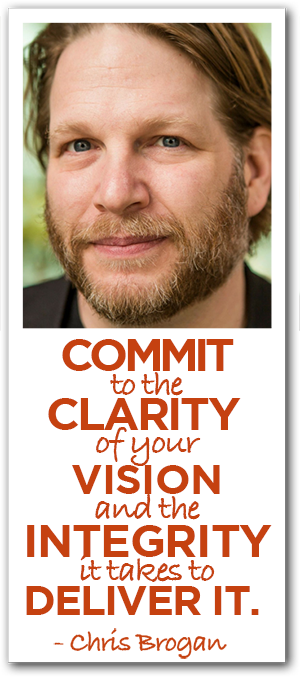
How to Find Your Freaks – An Interview with Chris Brogan

Chris-Brogan-Pinterest-2014Do consider yourself a freak? Do you know how to find other freaks like you? Do you know how to let your true passion and personality shine through to make a business out of it?

If not, then you’re not alone. A lot of small businesses don’t truly know how to “find themselves” and their desired audience. By finding and connecting with your desired audience you can find something you love to do while serving people with the same mindset.

This week, we freak it up with best-selling author, business strategist, and public speaker Chris Brogan, to learn more about how to let out our inner freaks and embrace what makes us special.

Big Ideas:

Chris Brogan, are you a freak?

  • Oh my gosh. I am the freakiest freak. I mean, think about it. I get paid thousands and thousands and thousands to stand on a stage and ultimately talk about pee and poop.
  • I’m definitely a freak. Freaks are people who sort of have tattoo level passion about the things that they’re into. They’re obsessed and they want to work with the people they want to work with on the things that they want to work on and really do it their own way.
  • There are freaks in all styles and sizes of business. They’re the people that really just want to do the most amazing job for themselves.

It seems lately that for the freaks, nerds, and geeks, that our time has finally come…that people are finally coming around to our way of thinking. Do you feel the same way?

  • I saw a kid walking down the street the other day with a Legend of Zelda hoodie and all I was thinking was the fact that you can just buy those at Hot Topic continues to blow my mind. Like, that there’s a mall place that you can get nerd video game clothes pretty easy – that’s not hard to get – and then I was thinking if I wore a Legend of Zelda anything in my day, I’d get beat up! No question.
  • I got beat up once, this one kid, Keith, beat me up in 8th grade, winter time. I get smashed into snow bank. My nose is bloody. He takes my musical instrument and smashes it on the ground and I’m like, “what the hell? Why did you? What the hell’s going on?” And I was a pretty big guy and everyone always thought I was really tough but I wasn’t really into fighting much until then. I said, “why did you break my instrument?” and he said, “because you play clarinet.”
  • I was like, “what? You’re mad at what instrument I play?” and he goes, “yeah, it’s a queer instrument and don’t be a queer.” And I’m like, “oh…okay.” So I take my clarinet home and I’m crying at my mom and I’m like, “ahhh, I can’t play clarinet anymore. It’s queer. I need to play saxophone.” Never in my mind did I not think I should be in band. Like, that I wouldn’t get beat up again just for being in band because he really very specifically said it was the instrument.
  • Yeah, I needed a “manstrument.” So, like Bill Clinton and sax. Literally, I grew up the same way you did. I was playing Dungeons & Dragons with all my friends but we would never talk about it at school.
  • This one kid, Chris, I remember it so vividly. I was very much on the outside of my school and these football guys were standing right next to me and he comes running up and is like, “dude, I just thought of the coolest thing I could do with my ranger character.” I was like, “who are you?” I totally rolled over. I in no way owned my relationship with this kid. They immediately stuffed him in a locker beside me and I did nothing because who would?
  • I remember pulling him out of the locker and he sort of just kept going. “Yeah, you know what I was thinking was what if you could be half elf?” I was like, “dude, they just smashed you into a locker! That doesn’t blow your mind?” and he’s like, “oh, that just happens. It’s whatever. I’ll just kill them later.”
  • I thought, “okay, two things come from this. One, always be friends with this kid so he won’t kill me. Two, don’t talk about Dungeons & Dragons at school.”
  • So, you’re totally right. The world has changed. I mean, Dungeons & Dragons is cool. If I played it in Brooklyn, I would probably be a hipster for doing it.
  • But the thing is, that alone doesn’t make anybody any money. What I kind of lay out in the book a little bit is that there’s plenty of weirdos who still live in their mom’s basement, but there’s this magic trick you can do if you are freakish in a way that’s useful to anybody else or that connects with some other methods then you can actually make business from it.
  • It’s not that everyone has to have face piercings and this is certainly not a kids business and it’s certainly not for small versus big. It’s just all about this real opportunity to do good stuff.

So, I’m reading your book and it seems that it’s geared towards helping people who are creative, on the outside, or have amazing ideas, and tells them how they can take those skills or ideas and run a business so they can make money off of it. Would you say that’s true?

  • That really is the deal. What I’m really trying to get done is I’m saying to people is it’s not enough just to be a weirdo and I’m also saying this isn’t just a weirdo’s game.
  • The strangest thing happened after this book came out is that California’s leading trial attorney said to me, “I’m totally a freak.”
  • These two CPAs who do a podcast for accountants said, “We’re freaks. We love this book.”
  • This guy just the other day wrote me and he’s a dentist and he’s like, “oh, I love this book. I’m such a freak.”
  • I just didn’t expect that. I didn’t expect main street America, shingle on the door kind of people, to be the first people to go nutty.
  • I expected rock ’n rollers, face-pierced people, and whatever, but it’s really true. The other thing is that there’s a lot of books on entrepreneurship out there, but they’re written for people that kind of wanted to go to Harvard but didn’t.
  • This book isn’t that. This book is for people who have got their hands in it. I put my email address all through the book with the very intention that people would write me and I’m getting a lot of that.
  • I met a guy who runs a flooring company and he says, “I’m only part way through your book, but I had just thrown in the towel on my business because I just couldn’t make it work. I couldn’t make enough money off of it. So instead I’m trying to figure out how I’m going to do this and then your book comes along and you kind of laid it out to me. I’ve gotta go find the kinds of people I want to do business with and then it’ll work a lot better.” I said, “well, merry Christmas and that’s the plan.”

Do you have any advice or tips on how we can connect with our own freaks? How do we find people who are as passionate about what we’re talking about as we are?

  • I’d say the very first thing to note is the reason why there’s bats all over the cover of the book is because I couldn’t get DC Comics to let me put a bat signal on because that would be even better.
  • All these new tools we have and these abilities to do things like blogs, newsletters, podcasts like this one, and that sort of thing, all allow us the opportunity to connect with the people who are like us. People who would hear something and go, “oh, I really definitely have some sort of connection with what this brings up in me,” will then want to do business with you.
  • For instance, R.J. Diaz runs this company called Industry Portage. It’s accessories and stuff for guys, so for instance – duffel bags, messenger bags, and stuff like that. He’s in the construction and architect industry and that sort of thing. His things are kind of rugged looking and have this kind of nice, I don’t know, Brooklyn people would love him kind of look, and (I’ve picked on them twice in one day) I would say that he’s done a great job.
  • When he writes his blog post and whatever, he’s appealing to those kinds of people – the kind of people who like Gentle Mint, which is like Pinterest for dudes, would be his crowd.
  • I think you start to find the community where you feel comfortable. Reebok did it by connecting with CrossFit and they have a huge partnership and they also did it by connecting with the Spartan Race. They created shoes. The all-terrain series is made for endurance people doing these obstacle course races. So then they said, “how do we serve you?” So they found a community where they felt like could serve and then they brought their offerings to them.
  • To me that’s the big opportunity. It’s a matter of then crowing to them and talking to them and saying to people, “here’s what I’m into. Because I think you’re into it to, what do you think?” I guess that’s where the big opportunity comes. We go a little wrong there too because we worry about talking about ourselves too much.

How do we know that people will be attracted to our message? At what point do we need to find that balance between what I want to talk about and what you want to hear?

  • It’s definitely a matter of you will lose some people along the way.
  • Let me give it to you in a really straight and personal way. My business, a good chunk of my business, is professional speaking. I charge quite a lot of money to have people have me come and stand on their stage. The people who can afford me are mostly big companies. So, if I wrote a book like my friend John Chance called Duct Tape Selling: Think Like a Marketer, Sell Like a Superstar, Cisco System goes, “I need him at our sales meeting.” Ford says, “I need him at our sales meeting.”
  • I basically wrote a book called “This Book is for a Bunch of Weirdos.” I wrote a book that says no corporation should immediately think to hire me and I’m going to have to really sell it. So I very intentionally made a book that tells the big guys, “you probably shouldn’t hire this guy for speeches.”
  • My first point to you is you will lose some of your clientele when you really announce who you’re gonna work with.
  • Here’s the game – the game is you must find the people that you can serve and you must make sure they know who you are. By the way, when you make an announcement like this you should be smart and have a little extra money for when the money drops off the floor and you don’t notice that’s going to happen. I did not do that and ouch…financial ouch.
  • That said, what I learned is next time don’t do that. What I learned is that when you start find the people you love to serve they will start finding you in this incredible, strange, magnetic way. This takes work. There’s no part of this that’s “just sit there and life’s gonna be fine.”
  • Here’s the deal. In the last three days I’ve closed business that I’ve never thought I would close with people I really want to work with – a brain surgeon and his wife, a guy who is a sports medicine professional for a professional football team, a whole bunch of really interesting, very successful in their own little niche kind of people who are not the kind of people who should work with Chris Brogan.
  • A guy who was in a tug of war with the U.S. military between the military groups who wanted to keep the military huge and this guy who’s part of this tribal doctrine that wanted to make it small. Who is written up in several government documents good and bad who had a great time talking with me because we had a mutual friend in Steven Pressfield. All that’s happened since my declaring exactly who I want to do business with.
  • Believe me. I would love Sony and all those guys who’ve spent money on me in the past to call me up and say, “we’ve got a bag of money with your name on it here, can you come deliver value?” But I’ll tell you. The magic trick, the beauty of everything that I’ve been doing is that I found exactly who I need to do business with, Rich Brooks. That’s priceless.

When you say you’re working with these people. Do you mean you’re consulting these people that you mentioned?

  • No, I did something even crazier. I started a super small private mastermind group. The goal is not to make me the center of this gooey thing. It’s that all of these people contribute.
  • My brain surgeon talks to my other friend who’s a lap band surgeon. The person who is doing the sports thing talks to other people in the group that have a fitness mindset. We all sort of work cross-pollination with each other on any of our business challenges. Because if all they had to count on was my brains that’s pretty finite.
  • We quite literally developed a brain trust. Two dozen or so in there and it’s just growing a little bit a time because I have some requirements. One is that I’ve had to spend some time with you in person and all that. In that process that little tiny brain trust I’ve built this business that’s a lot of high energy. There’s a lot more work to it. We don’t built it and then pay no attention to it.
  • It’s just ridiculously rewarding. The experience I’m having in there is very different than “let me help you build a webinar to get some leads.” It just goes so much deeper at all levels. So, I’ve been having the time of my life with this mastermind group and along the way I’m building other stuff that will help the people who aren’t the right fit for that kind of group so that I can still deliver value there, but still the whole way through serving freaks.

And this has all come about from this book and basically you planting your flag in the ground and saying, ‘this is who I am. This is my type of freakiness” and then through the nature of the universe people have been drawn to you?

  • No question. I asked a few smart people. It’s really funny because just sort of watching Twitter as a background noise while you and I are talking their names are both side-by-side in my stream. So, Kamal Ravikant who wrote a book called Love Yourself Like Your Life Depends On It, who’s done a lot of investing and startup type projects and things like that. Fascinating guy and looks like an anime character. James Altucher, who’s known for having done a lot of interesting business deals, and made and lost a hundred million bucks a couple of times over and that sort of thing.
  • I asked them questions like, “listen, I don’t really seek advice from very many people because it’s usually horrible advice but I think both of you are weird enough to give me the right advice.” And they said exactly the same things. They said, “just go with this. Go as deep as you can with this because it’s going to make your world better.”
  • I’ll tell you that it’s been a magical thing because pursuing exactly what the premise is of the book. If I boiled the entire ocean there’s three things.
  • Number one, business is about belonging. Find the kinds of people you want to serve and serve them deeply.
  • Number two, the manchu is the media. Manchu is an Okinawan word and it means “one family.” It’s sort of the people that you would choose as your family versus the people you just get as a family. It doesn’t mean your client base. It doesn’t mean your peers or your mentors. It’s the people that you’d most want to see succeed in life no matter what format.
  • So the manchu is the media is saying make all your storytelling about the people that you serve. That’s changed my business deeply.
  • The third one is a hair more esoteric but it actually drives to what you need to make these kinds of things happen which is commit to clarity and integrity. Which is to live that brand inside and out.
  • Which is that thing I was saying that fear of needing to serve big business because they have big wallets really held me back for a long time. I had both communities in my world for six or seven years but I was only serving big guys. I was just kind of gently loving on the little guys because I didn’t want the little guys’ money. It’s too hard to take.
  • I couldn’t see immediately how I was going to do both and then I finally found a way when I decided to really commit to the clarity of my vision and the integrity it takes to deliver it. That’s the whole book in a nutshell.

Last question – who is your favorite character in Guardians of the Galaxy?

  • That’s a toughie! It’s Drax the Destroyer. He’s just so mean and angry and he’s just got so much going on and I just have a feeling that he’ll be the one to watch in the movie.

Juicy Links:

Rich Brooks
One of us, one of us…

The Power of Infographics and Visual Content – Donna Moritz

Donna-Moritz-PinterestDo you put shareable images on every page of your website? Do you know how to create a compelling infographic or image and what tools you need to make them? Do you know how to tell a story with an image?

If not, then you’re not alone. A lot of small businesses don’t realize the importance of “snackable” visual content or how to incorporate it into social media. By connecting with your audience in a visual way, you give them instantly recongnizable content that can propel them to share it with others.

This week, we talk it up with visual social media strategist Donna Moritz, to learn more about how to make interesting infographics and visuals for your most popular platforms and how do it effectively.

Big Ideas:

How did you become a visual social media strategist?

  • I was at the Pro Blogger event a couple of years ago, and Darren Rowse was talking about looking for the sparks in your business and how they can lead you in a direction that can really change things completely.
  • I realized that when I was blogging I was really interested in topics to do with word-of-mouth marketing and content marketing but I was writing more and more about visual social media that was starting to become a thing. We were using images more on Facebook and Pinterest and Instagram.
  • I noticed that my readers were really responding to those articles and I was really enjoying writing them. So I started to do more and then Amy Porterfield asked me to do a blog post which was the first guest post on her site actually.
  • Me being excited to do a guest post for Amy I thought, “alright, why don’t we do an infographic,” because infographics were quite big at the time. I’d never done one so I had a designer work with me and we did one on Pinterest and it’s been shared tens of thousands of times, reblogged everywhere.
  • I think we’re about to do a 2.0 because it needs updating.
  • It showed me the power of good embedded visual content in a great extended blog post. So I became really interested in that.
  • I started to do some more. Entrepreneur.com started to post them regularly and they were asking me to do more. From there I started to do some for clients.
  • We do them mainly for top bloggers just to get a really good pace of content going. I really love that whole storyboarding and design back and forth and the creation of a visual story.
  • I actually a wannabe graphic designer. I never did graphic design but I am really interested in design. I’m quite creative so it’s the perfect fit for me.

So, you’re coming up with the ideas, but you’re having somebody else execute this for you?

  • Yeah, and it’s actually good because now a lot of what I do is that I teach people they don’t have to have design skills, they don’t have to have a lot of time, they don’t have to have a design team.
  • It’s actually the best time ever to be creating visual content because we have such amazing tools. We never had the tools we have now, two years ago, Canvo, we didn’t have great apps on our phones that allow you to make instant visual content.
  • Even though we create high-end infographics, I have a designer who’s also an illustrator because we really want to make them unique. But, I do a lot of my own visual content for my business and also when I have managed clients I have been able to create a lot of visual content using really easy to learn tools.
  • We’re now sort of moving into doing visual strategies for businesses and helping them to actually create their own content or doing small projects which might be for a launch or something like that were they need a lot of snackable, easily shared content to promote something.
  • Generally, my big passion is helping people to understand that word-of-mouth-marketing is really enhanced by great shareable visuals. Any one can do it.
  • When you think about the different types of visuals you can create, they’re not all high-end infographics. Sometimes it’s a very easily produced piece of content that they can do.
  • It’s a really good time for people to start playing with it.

What was the information you were trying to get across in this infographic for Amy Porterfield?

  • Amy wanted a how-to post about Pinterest because Pinterest had just started to become quite popular. It was also pushing the boundaries of it because when I wrote it it was almost like it could’ve been converted into an ebook.
  • It was called the 10 Commandments of Using Pinterest for Business. Pretty much if you go to Amy’s website (amyporterfield.com) it will be one of the most popular posts on the right hand side unless there’s been a change (it’s usually there).
  • It was a very simple infographic and it also paved the way for me to think about infographics differently because at the time they were very data driven. They were basically pie charts made to look pretty.
  • I thought, “this doesn’t have to be this way. It can tell a story.” So with this one we really just summarized the key points in the article which were the ten commandments. It was nothing special really, it was just some fun birds doing different things to do with the ten commandments and we had dot points under each one.
  • It was more of a how-to infographic. Since then we’ve really started to do a lot more that tells a story visually rather than just being data. A lot of them have a lot of how-to tips on them and just trying to make them really useful to people so they’ll want to keep them on their Pinterest boards or on their desktop or however they bookmark information.
  • I’ve found that they’re starting to shift from really being just statistics driven to being more useful for people. But, we always include references and things like that at the bottom if we can.
  • That first one was just bright, fun, it was engaging, and it was useful so people shared it.

That’s great. So you can be using more than one type of infographic and you can use it to tell a story.

  • Yeah, I always include data if I can.
  • A good example is one we did for Ian Cleary recently. Ian’s a really smart, savvy blogger and he was amazing to work with because I knew that he would get it promoted quite well (he’s from razorsocial.com and a past guest on this show! view our interview with him HERE https://www.themarketingagents.com/ian-cleary)
  • He wanted to do an infographic about different tools, so a “day in the life of a social media marketer.” That one didn’t actually have any statistics on it at all. It was purely different tools and when you would use them.
  • The poor girl was working pretty hard during the day. As you moved down the infographic it had lots of different tools you would use on the way to work on the train, mid-morning, lunch, afternoon. I convinced Ian to let the poor lady have a glass of wine in the evening while watching television.
  • We had that all designed up and it actually has no stats. It’s just for what tools you wanted to work with it’s great and useful and they’re being used by your industry as a social media marketer you could look at that.
  • Now, if you used them all you’d go crazy, but you can pick and choose which ones. It didn’t have any stats at all. I think we referenced a couple of things but it was mainly reference to Ian. It was his content and we just turned it into a story so it wasn’t just a boring list of tools.

Why do you think we’re so drawn to visuals in social media? Why are they so important?

  • I was talking about this at Social Media Marketing World. It’s a shift to visual social media.
  • We started to communicate more and more in visuals coming from blogs to Facebook with images then to almost completely through marketer blogging and multimedia marketer blogging with Tumblr, and other sites like YouTube and then completely to a point where we’re basically speaking in pictures only on Pinterest and Instagram.
  • I used to talk about it being a shift, but it’s actually kind of a return because really we’ve been communicating in new ways, there’s a great quote by Apu Gupta, the CEO of Curalate – “Our ancestors used to communicate what mattered most by drawing on caves and now we pin, we reblog, and we Instagram the things that matter and we’ve kind of come full circle.”
  • It’s true. We’re back to communicating with images. I think party it’s because we’re hardwired to communicate visually from the moment we’re born. We react to faces and images.
  • Partly, in a way it’s helping us to cut out the noise. There’s so much information coming through that it’s quite obvious when you’re looking at newsfeeds – we do gravitate towards something that catches our attention.
  • Text is very hard to catch people’s attention with. An image will catch attention and then it kind of depends on how you structure that image as to what happens afterwards.
  • I think there’s a lot of emphasis on reach when that’s great. You can get eyeballs on your content but unless it catches their attention, people aren’t going to do anything with it.
  • In general, we’ve come a long way but we’ve kind of almost returned to where we were originally which is back to communicating visually.
  • A recent study said that it takes 13 milliseconds to process an image. I love blogging and I love podcasts and video rocks, but we can’t get that same instant emotional connection that images give so it helps people to make a quick decision when they’re seeing content and they’re trying to filter out the stuff that they don’t want from the stuff that they do want.

How do I use an infographic to use it as part of my marketing, my lead generation program?

  • The trick is to always think in terms of your homebase and where you want people to be.
  • This has kind of changed a little bit and I just want to talk about one thing that you might find interesting, and I’m sure you realize this is happening, historically we’ve always talked about driving traffic to our website which is important, but there’s three types of traffic I think of.
  • One is the traffic to your website which is still very much high priority. That’s because you own that space and you own that website. It’s not rented land like on social media sites.
  • Then there’s the traffic on your website which is where you want to keep people on your website going from possibly one article to another or however you keep them interested and then hopefully signing up to your newsletter list.
  • And then there’s the interesting one which is the traffic away from your website. People might say, “why do you want people to go away from your website?” But to be honest, with sites like Pinterest now there’s a lot of potential for people to share your content back to Pinterest.
  • In fact, you can be asleep and have more content shared that has nothing to do with your marketing. You’re not putting content out there. You’re just putting good images or visuals on your website and people will pin it across Pinterest.
  • I think the one thing you can do to start with – and anyone can do this – this is just to make sure that every page on your website, infographic or no infographic, has a good piece of visual content on it. Because that way people have an option to actually share that visually. It also makes it more engaging if you’re sharing out to Facebook or Twitter or wherever you want to share it.
  • The other thing is when you are choosing to embed something that you are taking the time to do – like an infographic – to make sure that it is in a detailed piece of content that is really helpful to your audience and you know your audience and what they need. Make it really useful.
  • For every infographic, and let’s say the one we did for Ian, I said to him part way along as we were designing, “right, mate. It’s your turn. You need to go and write an awesome blog post.” Which for Ian is not really that hard – he’s a very good writer. He went and wrote a great blog post that worked in with the infographic. It wasn’t exactly the same but it referred to the infographic and complemented it.
  • Then, when he put that infographic on his site he then shared it out on social media sites but he also offered it up to other bloggers and did blogger outreach for them to share the infographic. All traffic led back to his site.
  • So he had two pieces of content. In fact, if that graphic got separated from his website – which it would on Pinterest – it stood alone and it was his own piece of standalone content as well.
  • There’s a lot of different things you can do and even just take away smaller pieces of information and turn them into smaller graphics that then lead back into that infographic.
  • We call them snackable pieces of content. I hope that makes sense!

If we’re sharing an infographic with people, do we want to share that embed code as well?

  • Yeah, I think generally we do that as a rule of thumb now with an embed code.
  • There’s a lot of simple plugins that you can use and I can definitely give you some links.
  • It is a good idea and it just makes it easier for people because they can just grab the embed code. There’s a lot of people that just share infographics willy nilly and for the most part they’re good or bad at them and they reference them back to the site with a link, but the other way is course is to take the graphic off and upload it to your site.
  • Generally that’s considered okay but I think if you’re gonna stick to good copyright and that sort of thing, use an embed code.
  • The other thing about embed codes like you said, it makes it easier for the other person as well.
  • That’s definitely a good thing to do. I think too, if you’re reaching out to other bloggers just use good common sense. I get spammed a lot with people just sending infographics to me that aren’t really relevant to my readers.
  • I know Ian and myself too, we’ve often offered a small guest post to somebody if you’re offering to give them an infographic that you could offer to give them a twist on it and do an introduction on it but sometimes I only need a short paragraph or intro.
  • That’s what we do for entrepreneur.com. I’ll publish them on my site and then a day later they’ll post it with an intro paragraph, so there’s a few different ways you can do it.
  • Definitely, embed codes are a good way to go.

Many people would say, “we’re a one-man shop, or a small business. We don’t have a lot of money to spend on this. Visuals and infographics are outside of what we can do.” What would you say to that?

  • Absolutely not. In fact I have done a couple myself and did some smaller versions as well and I’ll give you a link to an article that’s actually on how to create infographics and it’s got an infographic about how to create infographics embedded in it so it’s kind of a bit “meta.”
  • It’s called the “7 Superpowers of a Knockout Infographic.” That’s got a few links to some really great tools you can use that actually are very templates but you can get quite creative with them and add your own branding.
  • There’s a tool called Pickto Chart and you can get a free subscription to that and test it out and it’s not a lot per month. There’s one called Easelly and Infogr.am. Those three have their advantages and you can find out which one suits you best but they’re really great tools for creating infographics.
  • My other favorite one is Canva because Canva allows you to create graphics of any size so you can do a custom template. You can do a 735px x 4000px high image infographic or you can do shorter, snackable size kind of graphics. On Pinterest, portrait size at least. Something that’s longer than it is wide gets shared better.
  • Canva is great because you can just use it to create a simple infographic and they have lots of grids. You can even just put in a simple photo series. I really love the simplicity of a simple photo series showing how to do something in your industry and then like a header and a footer and this is what the infographic is and then the footer with your contact details and just using text overlays.
  • Anyone can create a simple graphic or infographic. It’s not that hard. These templates are really really cool. You’d be surprised at how great they can look.

Any specific advice if we have an image should we be repurposing it for different places? Or should we not worry about that?

  • Yeah, for sure. I definitely think that repurposing images is a really clever way to go.
  • You just have to be a little careful you’re not just putting the one image on every platform. There’s kind of clusters you can look at.
  • Firstly if you’re mainly on Instagram and Facebook then obviously square images are the best way to go and you might post it first on Instagram and then repurpose it for Facebook. They post quite well on both.
  • With portrait size images, which is sort of a 2:3 aspect ratio like 400 x 600, they do very well on Pinterest. In fact, Curalate did some research and showed that that is the most shared size even more than infographic size, you know, the longer ones. That is a good size to go with.
  • I’ve done some testing and it looks okay on Google+ and it looks okay on Facebook so it is good to have some portrait-sized images in your blogpost or just creating them and sharing them right to Pinterest.
  • The other size that I’ve been playing around with lately is the size that Facebook recommends for pulling in for your linked images in articles which is like 1200 x 627 and I’ve even reduced that to half to make it fit across the blog post.
  • I find you can either use some SEO plugins where Open Graph will pull that image in to make sure it appears nicely on Facebook. Or, I just have that size image on my blog post and that pulls in nicely on Facebook, but it’s also a great size. It’s almost the ideal size for a Twitter image.
  • I recommend just occasionally uploading images directly to Twitter. They do get shared better directly into Twitter or second best, through a third-party app. Images on Twitter get twice the number of retweets.
  • It pays to think about doing some images, especially for your content that you’re spending a lot of time creating and you can then upload to Twitter as well.
  • There are the three sizes – landscape, portrait, and square. Those are the three I tend to go with the most and they would cover most of your platforms in one way or another.
  • That’s the tricky part, but it’s not completely cookie cutter. You have to work out what your top platforms are and it comes back to traffic. Where’s the traffic coming from with these images? If it is Facebook and Instagram then focus on that. If it’s Facebook and Pinterest, then do that.
  • If you’ve got the time, then do that extra image. Once you’ve got the program open and you’re creating an image, whether it’s getting your designer to do it or you’re doing it, it’s much easier to do them in one go than to try to do it later. Then it doesn’t cost much more in time or money.
  • That’s why I say to people, “when you’re creating images, think about a series of images that you could create,” and this is talking about some other tools you can use, like Canva, or another tool like PicMonkey. If you’re creating images you might do a series of two images or quotes or something like that. Don’t just create one, just do five or ten, then you’ve got images for the whole next couple of weeks.
  • You kind of inadvertently brought up the topic of batching. People who batch their videos, podcasts, or blog posts, think of images in the same way and do them in a batch so you’re not constantly going, “oh god, we’ve got to do an image for tomorrow.”

What tips and tactics do you have for something like this, whether it’s a brand in general or maybe an event, that we can really get people to share our brand through visual means?

  • I mean, if you can get sword swallowers that’s the way to go…or fire breathing, walking on coal, all that stuff is instant shareable images.
  • I think there’s a couple elements to it. One is to really give people a slippery slope and make it really easy for them to do it. That part’s kind of covered for us because people are using mobile devices so they often have them in their hand.
  • The second is to make them in the moment. So, obviously when you’ve got a sword swallower in front of you that’s a great way to encourage people to share content. But, for a lot of different businesses they think very much about online but just to go offline for a little bit. Sometimes their business might be offline as well.
  • For instance, there’s a company called ProDive and they run diving tours. They go out for three days and it’s completely catered for and they dive and they hang out on those beautiful boats. They actually have wi-fi on their boat to encourage people to share images about what they’re experiencing.
  • Now, in a conference you obviously have wi-fi and everyone’s there with their phones, cameras, and etcetera. Sometimes it’s as simple as just asking them you know – “I would love you to share images of what’s happening behind the scenes of the conference.”
  • It’s always as simple as giving them a hashtag to add to it because it kind of adds the fun. If you need to you can add an enticement of some competition or something like that.
  • I had one for my session at Social Media Marketing World where people had 300 pairs of 3-D glasses at the end of the session and had a couple of slides in 3-D just for something fun. But then I got them to do an art imitates like where I’ve been talking to about how to get people to share images, I said, “I want to see the best image using a pair of 3-D glasses by the end of the day,” and people were off taking all sorts of weird and wonderful photos and sharing them with a hashtag.
  • In often cases it’s about looking at what sparks your audience. For instance there’s a lady here in Australia who’s a stylist and she often puts up photos of outfits and things like that. She’s a very popular blogger. One of her clients said, “can you post up what you wear every day when you’re going to school pick up and down to the shops or whatever.” So, she posted it up and a simple hashtag #everydaystyle. She didn’t tell them to do anything and people just started to want to post up their own photos of what they were wearing.
  • Before long her Facebook community had doubled. She already had a great community. She was posting summaries of hundreds of photos on all of her platforms where people were just sharing these photos with the hashtag #everydaystyle but it was connected to her brand.
  • Same thing goes for Tourism Australia. They’re encouraging people to share content about what they experience about our country under hashtags. So hashtags can be very popular and in the moment if you’ve got something happening – an activity or event or an on-location thing – then that can really help.
  • If it’s online, then sometimes it’s just about creating great content yourself and encouraging people to add to it. So there’s a number of different ways.
  • I’ve seen that done a lot. It always comes back to your audience. It is all about them but they want to participate in what you’re doing. If they’re interested at all in your business they will love to be involved in that behind the scenes activity and being able to contribute in some way.
  • So, involving them and asking them what they’re doing while they’re listening to your podcast, Rich, is a brilliant idea. And there’s the beauty because it was your audience’s idea.
  • I remember talking to Nicky Parkinson, she’s the stylist at stylingyou.com.au and I said, “how did this start? Did you say to them ‘here’s the hashtag, start sharing photos?’ and she said ‘no, I had someone ask me to do it and I don’t like to tell my audience how to jump through hoops but, then wow, there’s a spark and I’ll follow it.’”
  • It’s awesome that your audience thought of that and that they’re running with it. I’ll have to do one from Australia now!

Juicy Links:

Bonus Info:
…not mentioned in the podcast:
A Bonus Tool for Creating Images: “This is a great app for creating instantly shareable, design-quality tips, quotes and how-to images on the go. It is an iphone app and allows you to create an image in seconds while you have a few spare minutes”.  Warning > it’s addictive!
Here is an article by Curalate that you may find interesting about users pinning more content to Pinterest to websites (85% of content is actually pinned by users and not brands!… from websites!).  It is also a handy article to show your website clients as they often don’t realise that by changing their web content in the wrong way, or not adding valuable visual content, they may be leaving valuable clicks on the table!

Rich Brooks

Graphic About Info

How a Business Blog REALLY Generates Leads – Marcus Sheridan

Marcus-Sheridan-PinterestDo you have meaningful conversations with your clients or prospects? Do you answer the questions you get from them? Do you know how to incorporate teaching and communication into your sales process to build trust?

If not, then you’re not alone. A lot of small businesses don’t realize that by answering the questions most important to their customer they are augmenting their content marketing. By being open and honest with your audience, you invite them to trust your judgement and ultimately choose your business over your competitors.

This week, we chat it up with web marketing guru Marcus Sheridan, to chat about making your prospects stay on your website to learn and engage for longer than you’d ever think possible.

Big Ideas:

How did blogging and content marketing save your business?

  • Not that you asked the wrong question, but I want to change to “how did incredible teaching and communication change your business,” because that’s the way I want the listeners to think about this.
  • We started our company in 2001. It was super small and we just kind of grew as companies do.
  • We were installing in-ground pools throughout Virginia and Maryland, but when the market collapsed in 2008, it was an epic disaster for us.
  • We lost a quarter of a million dollars of business immediately after the stock market crashed and by January 2009 we went through three straight weeks where we were overdrawn in our bank account.
  • I talked to lots of consultants at the time and everybody said essentially the same thing which was, “you need to go ahead and file bankruptcy.”
  • But, if I did that, I was going to lose my home, and my partners were gonna lose their homes, and it just wasn’t a good situation – a very stressful time
  • It was during this time that I realized, “hey, we gotta generate more leads than we ever have, and we don’t have any money to do it. So, what do we do?”
  • I was also looking at the trend that was the internet and how consumers were clearly changing. It was obvious to me, the way I used it – to research and to learn. I knew our customers and prospects were doing the same thing.
  • So, the more I read about inbound marketing and content marketing, and all this stuff, what resonated in my mind was that, “if I teach better than anybody else and I’m really not afraid to address all these questions people have – and I put it on my website and I take the time to be thoughtful – that I’m going to get the reward.”
  • That’s exactly what I did. Our philosophy became four simple words that have changed my life and since then has been the same philosophy we use with every single client which is – THEY ASK, YOU ANSWER.
  • That is, any question we’d ever been asked we were willing to address it on our website. I firmly believe that if a business is not willing to do that, that it’s almost like somebody walking into your store or your office and they ask you a question and you tell them, “yeah, I appreciate that, but I can’t give you the answer. Go ahead and go down the street. They’ll give you the answer and once they’ve given your the answer, go ahead and come on back and we’ll work you up a deal.”
  • It doesn’t quite work like that any more. We did that, and to make a long story really short, like you said, it saved the business. It’s the most trafficked swimming pool website in the world.
  • It’s amazing what’s happened and now we’re moving into the manufacturing space as well. That’s been a great ride and I’m very grateful to be a part of it and I’m grateful that I can now apply those same principles to other companies.
  • It doesn’t change. It doesn’t matter if you’re selling pools or water for pools. Essentially we’re dealing with people and communication and great teaching.

How did answering these questions change the sales process for you? How did you all of a sudden rescue your business by answering people’s questions?

  • There were a few things. It’s a very important question. Let me describe the scene.
  • I was working, at the time, 65-70 hours a week. I would go on a sales appointments during the day and most of them were a couple hours away. Most of those sales appointments themselves would last a couple hours, so I would get home at 11pm-12am at night .
  • I would have heard a question during the sales appointment and it got to the point where I would literally say to myself, “how do I address that on my website?”
  • As I did that, from an SEO perspective, it did very well.
  • To give you an example of what I’m talking about, 5 years ago no swimming pool company had addressed how much a fiberglass pool costs on their website – which is quite stupid if you think about it because this is the first question that everyone wants to know.
  • If they call the company, and this applies to any industry regardless of what you sell, people want to know how much your stuff costs.
  • Nobody’s ever bought anything without looking at the bottom line number. It just doesn’t happen.
  • We answered questions like that. We answered questions like: What are the biggest problems with fiberglass pools?” Are fiberglass pools cheap? Are fiberglass pools ugly? Are fiberglass pools too skinny?  We compared different manufacturers.
  • We just did things that nobody ever did because ultimately when you address the stuff that consumers really care about they force you to have an opinion on things. It forces you to sit there and say to yourself, “I’ve gotta let go of all these traditions that we’ve always had in business and solely focus on what the consumer wants from me right now.”
  • Because we did that, the visitors we got in search was tremendous. Just to give you a feel for this, when we started this our site was about 20 pages. Today the site has about 800 pages and most of those are just answers to questions in a blog format – we’d answer them one at a time
  • Last year we sold about 90 fiberglass pools and we know the average number of pages that these 90 people viewed on our website simply because of the advanced analytics. In this case we used HubSpot, but there are a lot of tools that allow you to know these things.
  • The average customer last year read about 105 pages of the website. That’s insane. It’s stupid! That’s like, impossible. If you had come and told me 5 years ago, “hey, Marcus, check this out. I’m telling you. People that are willing to buy a pool. They’re willing to read 105 pages of your website before they buy.”
  • I would’ve looked at you and called you bad names and I would’ve told you to leave because you don’t understand my industry or my business.
  • That’s the way most businesses feel until they realize that most of us grossly underestimate people’s willingness to become comfortable with a buying decision. The only thing that gets us comfortable with a buying decision is learning more about it.
  • That’s why some people just bought the $250 cell phone but they spent 4 days learning about it – 6 hours a day. That’s just what they’ll do.
  • So 105 pages sounds crazy, but it’s real.

What would you say to someone with concerns like, “I don’t want to discuss prices right away, so I don’t want to put it up on my website?”

  • Let me put it like this that that’s a very nearsighted way of seeing it.
  • Number one, there’s this great traditional belief that’s been around for a few thousand years that says “do unto others as you would have them do unto you.”
  • When we go online and we can’t find what we’re looking for we get pissed and then we leave. That’s just how it works, right? If I ask a room of 1,000 people, “have you ever researched the cost of something online?” then 1,000 people raise their hands. If I say, “how do you feel when you own a website and they talk nothing about costs and price?” 100% of the room says, “frustrated.”
  • It’s the first word I’ve called “the F-word of the internet.”
  • Frustration leads to a loss of trust. When I say, “frustrated,” you don’t look, you don’t say, “maybe it’s in here somewhere.” You don’t do that because you’ve been taught that if you’ll keep looking you’ll find the reward, you’ll find the answer.
  • You also don’t pick up the phone to call anymore. You used to say, “well, they don’t have it here.” You also don’t say stupid things like, “oh, it’s okay that they’re not talking about this because they’re just basing their pricing on value and because they care so much about value they just need to talk to me first. That’s okay. That’s alright.”
  • They don’t have those conversations with themselves. So, we all want it one way when we’re on one end and then when we get on the other end we say, “well, we’re different.” The reality is we are NOT different. That’s the first answer.
  • The second answer to your question is, when people only see this as “I’ve got to give an exact number,” they’re completely missing the mark.
  • The answer for “how much does your stuff, your service cost? – b2b b2c, it doesn’t matter – The answer is that it depends. Unless you’re selling 25 cent gum balls, right – it depends.
  • The key isn’t that you necessarily give me a number the key is that you’re willing to address the subject on your website and give as much detail as to what would drive the cost up and down as possible.
  • I want to feel like, as the consumer, I’ve been fed. The number one reason – and I love asking this question – “what defines the phrase ‘great website’?” It’s a powerful question.
  • Essentially everybody says the same thing (and it’s a two part answer) – “I want to find what I’m looking for and I want to find it quickly.” That is what defines a great website in 2014 and beyond.
  • If you hold on to that philosophy then it’s going to guide you and you’re not going to have stupid debates like – should we hide our secret sauce when in reality it’s not a secret whatsoever. It’s just thousand island dressing.
  • The moment any company really embraces that they’re so much better off at actually inducing trust versus trying to control the conversation.
  • Let me add one thing to this. The number one complain I hear from marketers and marketing departments is, “we can’t get enough content from the staff.” Most companies, the ratio of sales to marketing is like 10 to 1.
  • I love asking companies how many sales people they have. Ten people will raise their hands. Then I’ll ask, “how many emails do you send out a day that answer questions that prospects or customers are asking you?” The answer is always the same – “dozens, hundreds, or thousands.”
  • What would happen if all those sales people in your organization answered a question with any meat, to a prospect or customer, if they bcc’ed somebody in marketing? What would happen? I don’t think anyone in marketing would ever say, “ I don’t know what to write about. I’m not in touch with my customer anymore. I don’t have enough content.”
  • All that would be eliminated by one simple click of the mouse. Nobody’s doing it. It’s unfortunate.

How much does SEO play in the creation of your posts for Sales Lion?

  • It’s huge. Let me tell you how extensive it is.
  • I’ve got a company called Health Catalyst (healthcatalyst.com) and if you want to watch somebody that is crushing it with content marketing just go to their learning center and you’re going to be blow-freaking-away with all the videos, the webinars, the e-books, the white papers.
  • We have done so much incredible stuff. When we write an article with that company, and we’ve got four people that do this together, four of us look at the article – and it’s not a slow process. We still make it fast – we will spend literally as much time talking about the title of the post and what keyword phrase or set we’re targeting as we did about the post itself.
  • That’s how important it is to us.
  • We analyze every single page title. We analyze the URL every time and we analyze the meta description every single time. We take all three of those things very seriously.
  • Then whenever we produce the post we focus very much on where the subheader (h2, h3 tags) opportunities are and what are some secondary keyword goals we can manage from this. By the way, I say to go look at the articles. You’re never gonna think for one second, “wow, they’re writing for search engine.”
  • It shouldn’t feel like, to the reader, that you’re writing for search engines, but it should feel like “someone is talking to me.”

Are there SEO plugins you’re using with HubSpot?

  • First of all, the Sales Lion IS built on WordPress but it uses HubSpot on the back end so that allows me to have all those advanced analytics.
  • The problem with just Google Analytics, as you well know, is that you can’t analyze names of people. You can analyze patterns and you can analyze traffic, but not names.
  • You can’t say “Rich Brooks came to my site today. He read 35 pages. These are the 35 pages he read and this was how much time he was on the site.” I don’t know Rich Brooks came, but somebody came. Right?
  • People need advanced analytics. I do find though that a lot of our clients that don’t use HubSpot they are using something like SEO Moz, or anything that allows them to track keywords.
  • Every time you write an article it should be very clear, for most businesses that are average and don’t have this monster following online, if you are not paying attention to SEO you are going to have a difficult time, in most cases, gaining the traction you could have gotten.
  • Whenever you produce an article it should be very clear that these are the keyword sets or phrases you’re targeting with this post. Everybody that is in marketing should know it. Then, you should have a tool that’s tracking those sets. That way, after a week or a month you can look back and say, “okay, here were our hits, here were our misses from a search perspective and now that we see that this article isn’t going to fly, do we need to redo the article? Do we need to go after a different light? Do we need to edit it?”
  • This is the type of stuff that we do and we do it all the time. It’s worth it. I’m so glad you’re bringing it up because I swear nobody brings SEO to me anymore. Thank goodness for Rich Brooks.
  • Just because something has a low number of searches per month doesn’t mean we don’t go after it.
  • Something might be searched only 15 times a month all over the world, but the 15 people that searched that  – they were freaking ready to buy that thing right now.
  • If your product or service is a $100,000 account or sale, don’t ever allow the fact that something is a low monthly search number, to skew you from targeting what you know to be a very important and relevant prospect or customer question.

So now we’ve got our post. You hit publish. What do you do next to make sure it reaches the widest variety of people?

  • This is one of the areas I would say that once again, it does depend on the business.
  • I find that for the majority of our customers, especially in the b2b space, LinkedIn does very well for sharing things either to groups or to just on your own individual LinkedIn pages or your employees’ LinkedIn pages.
  • Twitter, Facebook are fine, but to me that’s literally what they are. I find for that most businesses Twitter and Facebook are much better as retention tools than they are for “find” tools unless you’re doing targeted ads or things like that. Which to me is a completely different conversation.
  • Most of our clients will share on those platforms and we’re doing a little bit more with Google+. I don’t know if it’s going to be here tomorrow or not, I have no idea.
  • Here’s the one thing about Google+ is other than us kind of like, fringe people, the majority of the world – especially teenagers – they just don’t think it’s cool.
  • When it comes to River Pools, we don’t play with social media. We have a Facebook page but it’s just there. If spent much time at all with Facebook and Twitter it wouldn’t be as nearly as beneficial as producing straight content through text or video.
  • YouTube and the blog is where we put 90% marketing attention and dollars with River Pools. If you shift gears and you go to The Sales Lion, which is my marketing site, it’s very different because I guess probably 25-30% of the traffic is socially driven. It’s just a different place whereas with River Pools it’s 80% organic and 15% is direct search and then 5% is social.
  • I think a lot of people try to be a jack-of-all-social-media-trades and they end up being a master of none.
  • You can’t just come out of the gate and say, “we’re gonna be great in all these areas.” It’s just not realistic. Beside that, the majority of your customers aren’t on 6 different platforms. It’s just not how it works. You don’t find people going to Twitter and saying, “hey all, I just bought a $50,000 pool.” You just don’t see that.
  • You don’t see a lot of people on Twitter saying, “where should I get a fiberglass pool?” You don’t see that either. It’s just the way that it is. It’s the way that the platform is right now. You gotta say, “where are the people at?”
  • LinkedIn is the same way. LinkedIn doesn’t work for swimming pools. I’ve tried. Because, I was just trying to figure these things out. I was experimenting. It doesn’t work. That’s why we put all of our attention towards video and text.
  • One thing doesn’t change though, whatever platform you’re on you’d better understand the problems that your prospects have. You’d better be willing to address those problems and you’d better do it in a way in that they understand what you’re saying.

Are you using either blog to build up an email list?

  • Both of them.
  • How do I do this? Well, with pools I use my list twice a year and I’m going to use it a lot more now that we’re going to be in the manufacturing space as well.
  • What we do at the beginning of each season, like around February when things are slow and people aren’t quite thinking about it, anyone that has filled out a form on our site that’s a legit lead, they are going to get some type of notification of spring specials “get on the calendar now.”
  • From that it’s nothing to generate a few thousand dollars of business from those emails. It’s pretty important. We do that twice a year during slow times.
  • With the Sales Lion I have a list derived from the people that have downloaded the ebook. The ebook has been downloaded about 20,000 times now.
  • I have one conference that I put on a year which is very important, called “The Remarkable Growth Experience.” I also have digital marketing services for businesses that are $5,000,000 and above. So those are the two target markets that I’m going after with my list.
  • For the pools you don’t have many people, but you might have them right when there in the process of shopping. You do see that. You do have some outliers that are weird mavens and are totally into like vendors.
  • No matter what, it ain’t a long term relationship. Maybe 1% is going to continue to come back for whatever reason, but 99% it’s going to be a relationship that’s 6 weeks, maybe 6 months, whatever it takes them to make the decision (once they’ve learned about pools).
  • One thing that we do better than anybody in the world – ha, that sounded really arrogant when I said it, but it’s true – in the swimming pool industry we used to get calls that went like, “hey, I’ve been looking at your site. Could you come out to my house and give me a quote for a pool,” and I used to say, “yeah, sure Rich, I’d love to.” Basically, I didn’t know how informed you were. I didn’t know how educated you were.
  • I found out I kept going out on sales appointments and answering the same questions and I was wasting a lot of time and it was really dumb.
  • So we implemented this thing that I have named “assignment selling.” Assignment selling changed our lives and changed our business and it’s changed a lot of other businesses that have used it in their own way.
  • We found in 2012, when I was comparing two different stats for groups of people on our website, the first group of people on the River Pools site had filled out a form and was interested in a quote but they did not buy. The second group of people filled out a form, asked for a quote, and did buy. So, both filled out forms one didn’t buy and one bought.
  • As I was looking at these two groups one number just jumped out at me and that was the number 30. That number 30 fell under the group that had bought and that number represented the total number of pages that they had viewed.
  • What we found was that if somebody had read 30 or more pages of our website before we went on the initial sales appointment they would buy 80% of the time. The average in the industry is about a 15% closing ratio per appointment. So, if we got them to 30 pages or more, we were golden.
  • This is when we changed the entire way that we sold and we called it assignment selling.
  • So, you’d call me and say, “hey, Marcus could you come out to my house Friday?” and I would say,”Rich, I’d love to come out to your house, but here’s the thing. You’re getting ready to spend a lot of money and because you are you don’t want to make any mistakes – this is a one shot deal – and I don’t want you to make any mistakes. So to make sure you don’t make mistakes, I’m going to make sure you’re educated. To educate you, this is what I’m going to do. As we’re talking on the phone I’m going to send you an email that includes two main things – it’s going to have a link to a video that shows you the whole process of how a pool is installed in your backyard. You’re not going to have to ask me about it because you’re going to see the whole process for yourself. The second thing I’m going to include here is an ebook guide that will answer all your questions like, ‘should I get a cover for my pool? What type of cover is the best? Should I get a heater? Should I get a gas or electric heater?’ It’s going to answer all those types of questions. It’s about 30 pages long, but I promise it’ll be worth your time. Would you do those things before I come out to your house?”
  • 90% of the time the person on the other end says, “yes, I’d love to,” and at which point you say, “great, now Friday morning before I come out I’ll call and confirm that you took the time to do those things.” That is assignment selling and that changed our entire business.
  • Today we have a closing ratio of about 85% which is mind boggling for anyone in the swimming pool industry. We now only have to go on 120 appointments a year to sell about 90 pools whereas before we used to have to go on about 250 appointments a year to sell about 75. Do the math on that!

So these blog posts have really paid for themselves a million times over.

  • Yeah, and people say all the time, “well, if you’re industry is so competitive and SEO is really hard then all this ‘they ask you answer’ is not really gonna work, you know, Marcus?” I’m like, “that is the dumbest statement I’ve ever heard,” because until the end of the internet, people are gonna come to your website and they’re gonna expected to be fed. They’re going to have high expectations.
  • Those ones that communicate and teach the best are gonna earn the most trust. You’re still gonna have people come to your website to vet you. So, once they’re there, what is that experience like?
  • This is such a big deal in terms of insuring if they actually do take a moment – like if they’re a referral – and they come to you or they look in the phonebook and find your URL and come to you or however they come to you that’s non-SEO, social, they come to you.
  • Are they gonna fall in love you when they’re at your site? Or are they going to say, “this person is just like everyone else. They’re just schlepping their stuff. They don’t care about my problems and solving them.”
  • That’s why this content is so very very important. I’m glad you point that out because I just can’t stand it when people say, “this strategy doesn’t work long term.” Really?
  • If someone says, “do you think blogging will work in 10 years?” What I want them to say is, “do you think communication and great teaching will be important for businesses in 10 years?”

Juicy Links:

Rich Brooks
Swimming in Pools of Leads

How Retargeting Generates Leads and Sales with Nick Unsworth

Nick-Unsworth-PinterestHave you been using online advertising to generate leads? Do you know what retargeting marketing is and what pixels can do for your small business conversions? Do you know how to double your leads by combining traditional display ads with pixel campaigns?

If not, then you’re not alone. A lot of small businesses don’t know what pixels are let alone what they mean for your online marketing success. By setting up pixels on your website you can continue to advertise to your customers even after they leave your site.

This week, we target social media coach and retargeting marketing master, Nick Unsworth, to chat about pixels and the importance of zooming in on focused, relevant ads that follow your prospective customers across the internet so they don’t forget your product or services.

Big Ideas:

So bring us up to speed. How did you become “Life on Fire?”

  • Basically my whole life I’ve been an entrepreneur and I’ve always just been about living the dream and yet I had so many darn challenges along the way – a real brutal and tough journey as an entrepreneur.
  • I was always chasing and chasing opportunities in real estate until the market crashed. I did network marketing in college and long story short, I ended up with this dream and vision to sell a business by 30.
  • I tattooed that goal on my own chest on a cross and so I obsessed about it. That was my mission and I sacrificed a lot of my twenties to make happen and sell my business by 30.
  • What ended up happening was it wasn’t what I expected. I got stuck on as the CEO of a 2-year earn out and it the business was no longer mine. I had corporate partners and everything changed and what I realized is that I wasn’t happy. It wasn’t the money that makes anyone happy.
  • It was at that moment where I walked away from the rest of the equity I had left and walked away from a ton of money. I said, “all I care about is that I want to do what I love every single day. I want to live MY life on fire,” and that’s exactly what I did.
  • Once I walked away I had that “a-ha” moment, hired a business coach, and just figured I’d build a business I love and enjoy every single day.
  • That’s how Life on Fire was born and it’s our mission to help you and help other people love what they do for work and usually the money follows. Everything else follows.
  • That’s in part how we do digital marketing. You gotta love what you do but you’ve got to be able to get customers too.

Can you define retargeting for us and maybe give us an example?

  • One of the best ways to think about it is just picture that you’ve gone to the Macy’s website or Zappos or a big box brand and you look for clothes or you’re shopping for anything. You could be at Home Depot.
  • On Home Depot’s website I was looking for this palm tree looking plant and I clicked on it. I didn’t buy, but I clicked all the way through and just wanted to see if the darn thing was available at my local Home Depot.
  • Ever since then, I have this plant that follows me around on the internet – it’s starting to become a little bit annoying – but the plant shows up on Facebook on my feed. The plant shows up in my newsfeed on Facebook. The plant shows up on random sites all throughout the internet.
  • What ends up happening is that retargeting or remarketing means that if you land on a site you get “pixeled.” A pixel is the same thing as a cookie.
  • If you go to a website and in your browser you get pixeled or cookied and that leaves a footprint and that means if you land on a site the advertiser knows that and they can then serve you ads in other places indefinitely.
  • What ends up happening is that if you were to take your website and you were to put a retargeting pixel on the home page of your site so anyone that touches that home page with their browser – even if they just head there for a second – instantly that pixel fires and they get “cookied” if you will, and then you now know that and that’s a virtual asset.
  • Then, you can use a platform like AdRoll.com or Retargeter.com and then you can literally choose to serve that pixeled user display ads throughout all of the internet. You’re talking everywhere. Imagine if they’re on msn.com, your ad might pop up or on Pandora – your ad might pop up. They’re on Facebook – your ad pops up. They’re on Yahoo – your ad pops up.
  • What’s crazy is that you can serve someone ads all throughout the internet because there’s literally hundreds and hundreds of millions of websites that have space that’s on their ads that’s used for Google and Yahoo and Bing and these big advertising networks.
  • So, what’s cool is that just by simply putting this tracking pixel on your website you can essentially pixel the people that come to it. Then you can simply choose to turn it on and serve them ads wherever they may be.
  • These ads are following them around and the whole purpose of all of this is that it’s a newer form of online marketing. It’s all about frequency and being “seen” everywhere.
  • There’s a brand impact. When I advertise on Facebook people perceive that you’re an expert. Whether you’re a local business – you could be a local realtor or you could be a guy like me as a business coach and I might teach on Facebook advertising – and in that market when you’re advertising on Facebook people start to think, “wow, this guy’s an expert.”
  • When you start to throw in retargeting, in addition to just advertising on Facebook, they’re seeing my face, your face on Yahoo too, on nbc.com, and all these other big, huge corporate sites. They start to think, “wow, this person has authority.” Plus, you’re just in front of them over and over which tends to increase conversions.
  • This is all about being seen everywhere and building your brand positioning and most importantly, this is what’s responsible to help people get back to your site to purchase whatever it is that you have to offer through just being all around them.
  • It’s such a great way to build that brand positioning and most importantly build up the conversions. There’s a lot of different types of examples but one that I think is really timely is – you know for a guy like me or like you, Rich, someone that uses live webinars to sell products and services or coaching – that it’s so interesting because people are always looking for where you optimize that process.
  • So, a live webinar might use Facebook advertising to drive and get leads to come into an opt-in page. They’re opting to get a live webinar, you then teach some really good free information and then you sell at the end. Well, in that entire process you can optimize your ads or you can optimize the landing page where they’re landing and the copy on there.
  • Just imagine if instead of 20% that the people that register show up live, what if 50% of people that register show up live because they’re being reminded through these retargeting ads all throughout the internet.
  • You can increase the amount of people coming into the offer, but with the example of the webinar, that’s an example of one that’s really impactful because if you can double the percentage of people that show up live in a webinar, you’re literally doubling your sales.
  • So that’s one particular area I’m seeing the most success with retargeting.

How can a small business with a limited budget get started with retargeting? Where do we start?

  • Yeah, so there are two options.
  • I would say that if you’re pretty savvy with running your own ads and you’re decent with putting your own copy out there and things like that I would recommend using AdRoll.com.
  • The great thing about AdRoll is that there’s no minimum budget. It’s very cost effective. They use a CPM model which means you’re paying per 1,000 impressions that your display ad will get. You might be paying anywhere from $.50 to $1.50.
  • So, you have to have a lot of people pixeled to have a substantial amount of money. The good thing is that this is actually pretty affordable. If you’re a small business, you might have a retargeting budget of $50/month which is really cool.
  • If you’re a small business in a local market like a realtor, insurance agent, or chiropractor, even if you own a restaurant, people in your town, no joke, go to your next chamber of commerce meeting or B & I meeting – people are like, “oh my god, Nick. I see you everywhere!”
  • When I was in real estate and if I did this you would blow up in your town because you literally are just all over the place.
  • If you are someone that doesn’t have a big email list or you don’t get thousands and thousands of visitors to your site per day then AdRoll is great because there is no minimum budget. You can spend $50 a month and they simply give you that code and that pixel is nothing more than just a set of code that you put on your blog or website and they’ll tell you exactly where to attach it.
  • You can put it in your footer of your website. It’s invisible – no one knows it’s there. What happens is that you literally just put it on the pages that you want to retarget to people. If you want to get more advanced and you want a picture – yeah, you want to retarget people that end up on your home page – you might want to serve them ads to get them back to your home page or to your offer.
  • However, just imagine that someone that lands on your checkout page for a product or service – I would serve them different ads about that individual product or service. Just imagine, so Home Depot didn’t send me back to Home Depot. Home Depot sent me back to the exact same palm tree thing that I was looking at because they were smart enough to know that’s where I was and that’s what they’re going to show me until I buy it. Once I buy it they’re system is smart enough to know to turn that thing off. That’s why that plant keeps following me because I haven’t bought it yet.
  • AdRoll is great because it’s very easy to set up. You do have to create your ads and there’s about a dozen different shapes and sizes because, just figure, your ads are going to be displayed on a wide range of websites. You don’t really have the choice as to which ones they’re going to go on. It could be on the Google content network, you’ve got the Yahoo content network, or you can choose Facebook or Twitter, but typically the Google content network is great but there’s lots of varieties in shapes and sizes.
  • So, you get an idea of what your ads are going to say and then you get the dimensions for those ads and then just have a web developer or graphic designer make those specific ads. You can plug and upload all that artwork and you can turn the puppy on and let it track from there.

So that’s AdRoll, with no minimum budget. It sounded like there was another option as well?

  • Yes. The other option is Retargeter.com and I’ve used both, but what I like about ReTargeter is that there’s an advertising campaign manager that runs and optimizes your ads for you.
  • If you’re an entrepreneur and you’re doing too many things and you don’t have time to tinker with this stuff, then ReTargeter’s great because they’ll optimize not only these ads, but they’ll actually even run Google AdWords as well if that’s something you want to do.
  • Part of the strategy is putting these pixels on your website and that’s great because you’re going to capitalize on people coming to your site and you can follow up with them.
  • Where the strategy becomes really really powerful is when you combine retargeting with very targeted ads. If you’re marketing on Google for very specific keywords that’s so targeted (e.g., buying a home in pacific beach san diego) – that’s a buying keyword and I could use AdWords for it then retarget anyone that clicks on that landing page or website page.
  • Facebook – one of our main strategies is we’ll drill down with our clients and we’ll market so narrow, so if it’s health and fitness – (e.g., women that are engaged that live in a particular geographic area near that gym). The ads might say something like “Congratulations on being engaged. We want to help you look your best on your big day. Here’s 7 ways to drop 10 pounds and glow on your wedding day.” That’s so targeted that when you’re using Google AdWords or Facebook to get to those people then when they land on your landing page and opt-in to the offer you’re sending to them then use retargeting on that traffic.
  • That’s one of the things that makes it special. You zoom in and you target really well. You generate new leads and you follow up with those new leads using retargeting.

So, to be clear, when you’re using Google AdWords at the same time are you serving up the ads based on the retargeting, or are you targeting similar phrases?

  • Whether there’s Google AdWords or Facebook Ads, that’s one way to go out and do your own lead generation. Whether you’re targeting the keywords or advertising to Pages on Facebook, that’s just a way to create good lead generation and then retargeting is always the after effect.
  • It’s only once they click on that offer then they’re going to get retargeted using AdRoll and they’re going to be seen all throughout Google and random websites online.

But, our retargeting ads aren’t going to be a part of those Google AdWords like the “sponsored” ads on the side are they?

  • No. Those are totally different.
  • These are more display ads on different websites. When I say things like the Google content network, basically there’s millions of websites that sell space on their websites. So, instead of managing their own advertisers, let’s just say I’ve got a box on my website that I want someone to advertise there it could be a huge pain in the neck to try and get sponsors and all that stuff.
  • Basically, they can sell that space to Google and Google will fill it up just by using things like remarketing and retargeting. It happens automatically.

So, when I set up my retargeting am I going to target people who maybe the last thing they saw was my SEO services, or could I set up three different campaigns based on the three different pixels that are in there?

  • It can get pretty robust. It can literally be as in-depth and creative as you want to go.
  • Think of it as having rules. You could set it up to be really intelligent about it and have different pixels on different pages so that you know exactly what’s happening. You can choose to segment.
  • Think of it this way. In the same way you segment an email list that you have and you know that these 3,500 people purchased a product, and these 1,000 people opted in for an offer. The same way you tag people in your email list or in your CRM, the same thing is true with these pixels.
  • The more detail you have in there the more creative and flexible you can be with how you want to serve ads to people. The cool thing is if you have different products I would put different pixels on each product and then it’s your choice when you want to serve those ads to those people – do you want to automatically have it be the last product they viewed? You can set it up that way. You can have it that when someone purchases that particular product think of it as having another pixel on the checkout page that essentially negates the one before it.
  • Now, it doesn’t negate the pixel and just wipe it out, but it would be smart enough to know that it won’t continue to serve them ads because they just purchased. That’s cool because it’s intelligent enough to turn off after they’ve bought it so you’re not nagging someone that already bought it.
  • I think overall, one of the most exciting aspects of this is that we all think about an email list as an asset for a business. Everyone’s always talking about the foundation for an entrepreneur or even small businesses is having an email list. That’s your follow up tool and that’s how you build rapport and relationships and that is what allows you to earn income and all that good stuff.
  • The thing that’s interesting is that as you build up this virtual, invisible asset for your business, if you have 100,000 people pixeled imagine that I could take that virtual asset and decided to run ads for your event, Rich?
  • That becomes something that I know they’re targeted entrepreneurs. I know that I’ve paid to get them pixeled. I’ve either ran Facebook ads to get them pixeled on that page or they landed on my website. They’re very targeted.
  • The cool thing is, when I used to run my Facebook advertising agency I would do this and I would only choose clients that were in the space that I was in because I was building up this virtual asset of all these pixeled people that I could also serve ads.
  • For example, if I had five clients that were all in the entrepreneur category, I could leverage this virtual asset that I owned as the advertising agency. I could leverage that asset for all of it.
  • So, if it’s costing you a dollar to get someone to click from a Facebook ad to a very targeted landing page that’s a dollar. But, once they land on the page I already know that they’re a very targeted lead. Now it’s only going to cost me a penny to take that person and show them an ad again on retargeters.
  • It’s a pretty good high quality asset I can use over and over which is great.

So, if I understand you, I don’t need to only drive people back to the website where they were first pixeled, I can really drive them anywhere?

  • Absolutely, that’s what so cool, I mean if there’s awareness and they know you and your brand it’s more congruent and synergistic to send them things that are relatable to them and what they’re interested in. If they know you, and your face is on there for your company, then if your face is on those ads for your event, that’s very congruent and that’s going to convert and work well.
  • However, if there was an affiliate product and thought your audience would also like that, you could be an affiliate and just serve those ads to a completely different offer. So wherever you choose to send them with those ads is totally your call.
  • The cool thing is that no one knows who’s serving them the ads so you’re not going to tarnish a relationship with someone by sending them ads for an offer because they have no idea how they’re seeing them on that site.
  • About four years ago I was getting into the industry and this and that. My goal was to build relationships with the “gurus,” the guys on the stages selling courses.
  • What I did was I wanted to be an affiliate for them because that’s the fastest way to become friends with someone – you make them a whole bunch of money and all of a sudden they love you.
  • So I became an affiliate and was selling their products and services and I didn’t have an email list. Even if I did have one, I wouldn’t want to hit up the email list over and over to make them buy people’s stuff and burn relationships. However, I decided to run ads on Facebook for their products and services and I just chose to give away an iPad to someone who purchased their product through me.
  • If it was a $2,000 product and I got $1,000 in commission I’m up $500 (the paid is $500). So, I use that model of running ads as an affiliate and giving away a bonus and using retargeting and I crushed it. I literally had six figure gross promotions as an affiliate. It was unbelievable. It was like the easiest money I’ve ever made. I built tons of relationships.
  • It got a little more competitive because I taught it at a couple seminars. Here I am sort of the guy with the big heart like, “oh my god, this is working so well you guys have to do it,” and then everyone started doing it.
  • Building up this virtual asset and sending these people back to your offers – it’s all about being seen everywhere, builds up brand, and helps increase conversions.
  • If you run ads on Facebook you’ll notice that if you’re running ads to 50,000 they won’t serve ads to 50,000 people your ad once, a second time, or a third time. If your budget is smaller, they will take 10,000 out of the 50,000 and they’ll show your ad 10-15 times before they’ll start showing the next 10,000 the next ad 10-15 times. They understand you can’t see the ad once. It has to be in their faces over and over and over.
  • That’s exactly why AdRoll and retargeting work so well because it’s the frequency and it’s being seen everywhere.

I’ve heard there’s a minimum of site traffic I need for retargeting to really work. Can you speak to that?

  • You’re basically paying on a CPM model, and it could be anywhere from $.50 to $1.50 per 1,000 people, so you want to have thousands of people pixeled.
  • Your budget might be $.50 a month and that’s okay, but your goal is to have thousands of people and to build up this asset.
  • You want to take your website traffic and ramp it up. If you don’t have a lot of people you can take this pixel and you can put it HTML email newsletter. You’re pixeling the people who open your email. You’re pixeling the people on your website. You might run Facebook ads and send that ad traffic on Facebook to a free offer that you then pixel there.
  • The good thing about AdRoll is there is no minimum and you can get started even if it’s small. I would say start putting these pixels on your website right now and just build it up.
  • As far as running ads to it, you’re not gonna get a whole lot of action if you only have 300 people in there. It can still be beneficial, but it’s just not a lot of people.
  • We found that you really want to have over 10,000 people pixeled to get enough impressions and enough action in there.

Let’s say I don’t have 10,000 people pixeled. What are some of your tactics to get up that number?

  • The number one thing is getting new traffic.
  • Using Facebook advertising and running a campaign, getting very specific in who your target market is, so that when you run an ad on Facebook and you’re targeting that perfect customer, that ideal prospect, that’s so targeted. Even if someone comes to your website, people come and then bounce off if that’s not even as targeted.
  • If you run a Facebook ad you can zoom all the way in. I could target my sweet spot, like men that are 28-33 that are interested in becoming an entrepreneur that like Gary Vaynerchuk, that like Entrepreneur on Fire, it’s like “boom,” if they have those qualities, they’re perfect for me.
  • Then, I run an ad on Facebook and I might send them to a free webinar, or free video, or send them something of value. I’m sending them a gift because I want to then get their email address, but really all I want them to do in that Facebook ad is to click it. When they land on that website page the great thing is that even if they opt-in or they don’t opt-in to the goal (which is their email), I can still pixel them right then and there using Facebook ads and retargeting.
  • Any business owner can use highly targeted Facebook ads, drive leads to your business, get those leads to cash flow and then pixel where they land so that you’re growing your base of pixeled browsers that you can then remarket to as well.
  • That is the most efficient way because then you can track that campaign. Our goal is when we run a webinar where we sell we’ll track our Facebook ads. We’ll know how much it costs for someone to opt in. We’ll know how much it costs per thousand impressions we’re sending out on AdRoll.
  • Then, we’re looking at things like what percentage of people showed up live to the webinar. What percentage of people converted that night. How much is our cost per sale.If we’re spending $300-$400 to get someone to purchase our $1000 product, that’s cool. If it costs us $450 for someone to buy but we’re selling at $1000 we will take that all day long and just increase the spend.
  • The opportunity is that as long as you know your numbers and you can create conversions and even if you were to break even, I would rave that up all day long. The beautiful thing is that as soon as we have an offer that converts and we can make a positive return on our advertising expense, then it’s literally as simple as you just turn up and dial up the ad spend.
  • So, if we earn two times our money on our Facebook advertising – for an example, we did a webinar, brought in customers for a little over $400, but we’re earning $997 and it’s all margin because it’s literally just my time to coach and we ran that and did about $20,000 in sales in about a week – so when we do this the next time we’re gonna ramp that up and quadruple our advertising budget and we’re going to do it again and again and again.
  • That’s the beauty of paid media. Once you have an offer that converts you literally just increase and increase and increase. That’s how I’ve taken a client like Andrea B. who’s in aromatherapy. This woman did a webinar. The most she’s ever made in a month is $50,000. I taught her how to do webinars and she earned an extra $10,000. Her gross was $60,000 and she broke her own record. Since then, all we’ve done is increased her lead flow using Facebook ads. We’ve increased the number of people that’ve attended her webinars which she started because of us. We retargeted all those people and she went from $50k-60k, $60k-80k, from $80k-$125k, from $125k to up over $330,000 a month!
  • All that is literally as simple as getting your offer to convert and then you’re just increasing your ad spend.
  • Then you want to just find where that ceiling is. Her ceiling? Who knows? Maybe it’s $500,000 a month, maybe it’s a million a month. The great thing is that any business can scale and ramp up fast with paid advertising.

Is there a way to include that pixel on something like GoToWebinar or how might you hack that system to be sure I’m getting all that information?

  • Basically when they provide you with that piece of code that goes on your website you are setting up those different pixels for those different scenarios.
  • What happens is when that person lands on the site, the browsers contain all that data. There is definitely a turnover when someone clears out all their cookies or something like that. That will wipe out that browser data. Typically there’s not that much turnover from clearing cookies a whole lot. Us internet marketers might be more aware of it than the average consumer.
  • You have the flexibility to create these on your own and how you would like and then when you’re serving your ads you want to make sure that you’re just using trackable links.
  • I recommend using affiliate links for your own stuff so you can always track and know what’s converting from where. We just set it up using an affiliate program.

Juicy Links:

Rich Brooks
Retargeting Pixels Like a Boss

Google Plus Your Business with Martin Shervington

Ted-Rubin-PinterestHave you been using Google+? Do you know why you should be using it and what it means for your small business? Do you know what Google Authorship is and how to create opt-in circles within Google+ to maximize your presence in Google search?

If not, then you’re not alone. A lot of small businesses don’t know the benefits of using Google+ as a springboard for more relevant leads while building stronger relationships with their audience. By setting up a Google+ page, using blog posts, targeted content, and making it search optimized you can make stronger “ripples” in the social media pond.

This week, we bring in Google Plus master Martin Shervington, business development author and digital marketing strategist, to talk about setting up your Google+ page and getting amplified engagement by using the myriad layers of Google’s ecosystem.

Big Ideas:

Google+ has been in the news lately, and it’s rumored Google may be getting out of the Google+ business. What do you think?

  • I think that, Vic Gundotra who I met a while ago and he was very kind to me – he gave me a great endorsement when he shared some of my content – I think he’s taken Google+ to a place now that it’s really robust and stable.
  • I think it’s a surprise for a lot of us that he’s left, but I think so many of us in the community have appreciated what he’s done.
  • Now what happened was one article got written by somebody who isn’t really on Google+ and hasn’t posted anything since January 2012. They wrote an article on Tech Crunch and that had claims in it that were very vague and unsubstantiated and then Time magazine picked it up online and then Business Insider did, and you almost sort of watch these dominoes fall of peoples’ perception, “Google+ is going to end because Vic’s left,” and so on.
  • I say that having seen what they’ve done, Google have managed to create something that brings all of their products and services together using this principal of Google+. I would say that there’s always changes. There’s additions to the platform, there’s things that get removed, but I would say Google+ is not going to go anywhere.
  • I also think the community gets stronger and stronger every time these sort of things happen. We smile, sometimes even laugh, because we know what is really going on. I feel that we do with Google+ because the power for search, which I’m sure we’ll come on to, is phenomenal. The networking you can do on Google+, the access to people, the ability to build relationships using lots of different parts of their products – this is really what Google+ is about. It’s about relationships.
  • Relationships are going to disappear, and it’s been important to people, traffic to websites, engagement on content, and let’s face it, it’s not gonna happen. They’ve got social media in the bag, and when you add search to it, Google have done very well with not making it too difficult as an entry point with Google+ considering that the scope of what they’ve done, and I’m sure we’re going to come on to that, Rich.
  • Google+ isn’t like Twitter, it isn’t like Facebook for certain reasons.

Google+ is relatively new as social media platforms go, so what drew you first to this platform?

  • Well, I did what a lot of people did. When it just came out of beta which was in July 2011, I put a couple of posts out and just went, “well, no one’s here. It doesn’t seem very active,” and I left.
  • It took me until March 2012 where I thought, “I ought to give this thing another go.” I then spent three days – and I went to promote some books that I had that came out around that time – and was looking at markets and getting some consultancy and I had just moved back from the States, so I spent three days granularly going down the rabbit hole that I’ve now gone down to understand everything that I can and could about Google+ and I made notes.
  • So, that was really how I fell in love with the platform. It was just by understanding how it worked. It led me to go from this social destination aspect of Google+ to then understanding Google.
  • I was on YouTube and then Google Drive, then starting to look at local search, and lots of other products and services as well. I started to see that Google+ was one aspect of the social destination, but there’s this layer – it’s called the social layer – that goes throughout so many of Google’s products and services.
  • The aim is that it kind of binds them on certain principles, so that’s what got me started. It became a fascinating research project in a way, and a very experiential one, where I said, “how does this thing work?” And when we got to search, that’s become a journey of understanding social search engine optimization and the role that Google+ plays in that.

I know a lot of small businesses that say, “I don’t want to jump on yet another social media platform.” They’re not sure if it’s worth their time and effort. What do you say to people like that?

  • I think that sometimes that might be the right decision.
  • My position is that if you do any social media network badly, then what’s the point in doing it?
  • It’s not about having the account. It’s about who you’re building relationships with, what content you have to share, and what intent you have behind it.
  • I think one of the big differences with Google+ is that content shared on Google+ is indexed by Google search.
  • So, if we jump back to what’s important to a business and you say, “is relevant traffic going to your website important?” – then what you with them is up to you, whether it’s an email newsletter or conversions to leads or purchasing something.
  • Then you say, “can you get more of that?” using, for instance, content on Google+ – and the figures for me, my blog went from a thousand visitors to 35,000 uniques a month by using Google+. About 29,000 of that is from search.
  • So, there’s a relationship between the content which is shared on Google+ and Google search.
  • Also, plusyourbusiness.com, which is very much just the business site, it has 20,000 uniques, so I use content marketing to build relationships within social so that then people are able to connect and able to engage on that content and visit directly from within the Google+ environment.
  • But, also that sends signals to Google search and the signals that it sends to search is that, “hey, this content could well be important for people to find in the future.” You find more and more that the people who are engaging on it that have authority in subjects tends to give those messages to Google search and the algorithm.
  • The relationship is between the site, your content, social – the connections that you have and people are engaging on it, and then that turning into Google search.
  • So think – search, site, social – that flow is really what a lot of us have been using on Google+ for a long time and it’s happening.
  • But, people either have to have a content marketing strategy to understand and to run tests on their own content, their own blog pages, their own images they share which then have links which go to the site. Everything needs to be run and tested to make sure it’s worthwhile.

So you create a blog post, and then what are your next steps once the blog post goes live? Are there things you’re doing before the blog post even goes live?

  • Well, that set me up nicely, Rich. It’s as if we prepared, which we haven’t!
  • Look at it this way. If you search for, “what is Google?” right now, and you do an incognito search, most of the time I’m coming up #1 as that search result. Now, it may be number two or three, it depends on the settings, but it’s pretty high up.
  • That blog post, if you look at it, they’ll see that there are at least six, eight or ten videos that are 10-20 minutes in length and they’re really detailed and I do them step by step. So that blog post, not only does it have text on it as well, it has images, it has these videos and it’s like a video course.
  • That has around 7.3k “plus ones” on that particular page and it’s a social proof site. I know it’s been shared an enormous amount of times on Google+.
  • So, what have we got there? We’ve got a blog post and we’ve got videos. Those videos are from YouTube and they’re all independent. They’re all individual videos that are shared publicly that can be shared in their own right, by myself or by other people.
  • What I’m doing here is I’m starting to build a picture – that blog post holds a lot of content that elsewhere as well.
  • When it comes to an important search term, and I was going for, “what is Google Plus?” I’m getting around 8,000 uniques a month from that blog post. In order to get it to that place out of 4.5 billion results, it has to be the best answer to the question according to Google’s algorithm at that time.
  • The first thing to do is to think, “what problem am I solving? What questions am I answering? What key phrases am I trying to rank for?” Not so much thinking keywords but more thinking about problem solving and question answering. When you do that you then go, “what assets – like YouTube videos, text, downloadable PDFs – what else can I be doing that gives added value to people?”
  • When you give away that content that a lot of people think you pretty should be charging for, that then gives something for people to engage around, but that’s only part of the story.
  • The bit of the story that’s missing is that you need a distribution network. That’s how I use Google+. So, the relationships that I’ve built are with people who value what I do and I value what they do, we’re part of a large team, that love the stuff that we’re producing. So, when they engage on it and it shares across their networks and we’re getting hundreds and hundreds of shares, or even thousands of shares on certain things, and lots of comments, and lots of +1s, all of that starts to signal to Google search that this content is important and should then appear for people in the future.

When you share that blog post, how are you taking the step from publishing it to sharing it on Google+?

  • First thing, everybody that’s interested in this needs to have the +1 button and the +1 share button on their blog post. What that means is that when stuff gets shared that is linked back to that website page, that blog post, the +1s can be attributed to that page.
  • We take the URL and we put it into the link bar as a Google+ post. Now the reality is if you click the +1 button on the blog post you can do it straight from the blog. That’s the great thing about Google+ is that it brings up the share post.
  • What I do is put a nice heading on it, a nice subtitle, and I put a small amount of text. Sometimes I put a lot more, but I certainly put some context, some added value, but this isn’t the main thing that I do. What I do more than anything else, before I get to the press and the send, I build up circles of people who have opted in to receive that content by that email.
  • That’s one of the biggest things I recommend to people is to build opt-in lists on Google+. This is permission marketing 101.
  • Now when I read that in 2001 from Seth Godin it blew me away. I told him, like you did, Rich, that his book changed my life, but it did!
  • What I’ve done is applied the principles of this to Google+ so I’ve built many opt-in circles and I have many different methods of doing that.
  • This means that when I hit that send button having embedded the link and making it pretty, people receive it as a notification. Most of the time they’re going to receive it by email, other things being equal.
  • That means that they get it in their inbox. They’re ready to engage on it and they’ve asked. The key thing is you’ve got to ask permission. That tends to give an extremely big lift off to content when it lands.
  • I’ll tell you something I don’t tell people very often – what I will very often do, if I’ve got videos for instance that are embedded on the site – I’ll often give people prior access to that content so they know what’s coming. So essentially I give them a bit of a gift – a bit of a bonus for opting into the circle.
  • That way people feel that they’re being valued and there’s an increased level of reciprocation and deepening of the relationship.

Can you walk us through the process of what you do when you build opt-in lists for Google+?

  • I’ve actually just brought out a Google Circles course because there’s a lot to it, but I will give you the short version so everyone doesn’t feel like I’m selling to them.
  • The first thing is when people are engaging on your content and you’re starting to build the relationship – if they’ve shared your content, or you meet them in a Google Hangout, or you meet them in real life – you can ask, “would you like to receive notifications from me?” I usually say something like, “it will be 2 or 3 notifications of unique content a week.”
  • If you get a “yes” you put them in a circle. If the circle’s no more than 100 people, then very often when you’ve added public and the name of that circle when you’re sending out a post and you click the check box, or rather, it will have a checkbox available to be clicked if the circle’s not too large and it will say, “also send email,” to that circle. You can do it from multiple circles actually.
  • There are limits of course, but now you have really small targeted audiences in your lists.
  • The next thing that I recommend is to look at your lists and create a blog post – and this is once you’ve already got engagement – when you’ve got people who are seeing your content – one of the methods is to have full comments underneath your blog post and say, “who wants to be in this list or that list? Just +1 whichever ones you want to be in,” and then close comments off.
  • What you’ll find is that you can accumulate a differentiated list just by the +1s. It’s a bit like in Facebook when you hover and you see who has liked. On Google+ you can hover over and add those people to circles.
  • So straight away you’ve got this really refined specific niche, specific circles, built on whatever criteria you’re setting in those comments.

If a small business has no Google+ presence where do you recommend they get started?

  • The first thing is, do they have a physical location?
  • If they do then they want to make sure they’re on the map.
  • So the system is to start by going to google.com/places and to get themselves on the map. That’s one of the ways that we recommend.
  • There is something else we need to look at. Google your business name and see if Google+ have generated a business page for you automatically because this may have already been set up. What happens then is it says, “would you like to claim this page?” and if they want to claim the page they click and then they can register as the owner of that page.
  • Now, let’s say that you don’t have a physical location or address and that doesn’t work for you, the first thing to do is to look at whether it’s worthwhile having a Google+ page which is like a brand page which may not have a physical address.
  • What I would say is, take the 10 minutes and set it up and link it to your website using the Google+ badge. This is a developer’s badge. I’ll give this to you as well, Rich, so we can add this in the show notes so people can have access to it.
  • When they do that, activity that occurs on the page starts to build up in relation to that website. There’s a +1 number which doesn’t appear on the page anymore but does appear still on the website which is called the social number. Even though Google haven’t said exactly what it is we know it has some sort of relevancy metric potential in the future.
  • Let’s go another step in terms of the business page. If people have content that they are sharing on social networks and they value social engagement then look at using the business page for exactly the same purpose.
  • The difference is, look at nurturing engagements. That’s the biggest thing on this. If people are +1ing and sharing, say “thank you” and add them to circles. +1 their stuff if you like it. Go and comment on content.
  • Build the relationship because you can find your influencers on Google+ very easily and the system “ripples” on any shared post that’s public on Google+. If you go in the upper right you can click and a drop-down says “view ripples.” you can see who the influencers are that have shared that content.
  • For a business it really gives you insight into finding the right people that could be the evangelists for your content.
  • For an individual, an entrepreneur, I recommend a Google+ profile as a person because people relate to people easier than brands they don’t know.
  • The first month, if people are feeling inspired to get started on Google+ I would recommend beginning as your profile understand the system and understand the relationship between profiles and pages because you can share content between them – that can help you get more reach.
  • Then you will begin to see whether it’s worthwhile setting up a brand page as well or whether it’s worthwhile keeping it going for yourself.
  • One of the things as a profile is that (and you’ve seen this when you go to Google search and a picture comes up alongside the content they’ve authored) this is called Google Authorship.
  • Google Authorship is the process by which a person’s profile on Google+ and their picture gets attached to content they create around the web. It could be their website it could be other websites, other people’s blogs. You need a two-way link. You need that website to say, “yes, you are also an author.” As long as you’ve got a profile picture and it’s a clear headshot and it’s been tagged with your name which you just hover over and tag it, then that process can happen, it can appear. It doesn’t mean it’s going to, but for most of us, the reason we get excited is that it can show the number of people that you have in circles, shows this picture, that picture may well increase click-through rate because people want people.
  • It’s a really useful thing to make sure you’ve got all the steps set up even though you may not be active on Google+ but you are active as a blogger or if you’re producing content.
  • It’s all about trust. This is where you get into the semantic web which my buddy David Almerland is the expert on. What we’re doing is building relationships and every step, every piece of content we create it helps people to get a better picture of where we’re and if they can trust it. If lots of people are sharing it it means you start to get a reputation within that particular niche.
  • Once you’ve got this trust and reputation going it then turns into, outside of your circles, people just get to know that you’re the authority in that particular subject and that’s when it appears in search. So even though the original people who shared it may have nothing to do with it in the future in terms of the propagation of it into search, they’ve given the message to Google that they’ve backed it.
  • If you’ve shared something and you’re already perceived authoritative or have a reputation and you share somebody else’s you kind of give some of that authority to somebody else. This is why the whole trust transparent thread that we’re apart of on Google+ is starting to make a big difference in Google search. What Google wants is the best answer to the questions and search inquiries that people are giving when they put into the search box.

So, I understand that for people, I can add them to my circles, but if I’m a business I have to wait for them to add me in. Is that correct?

  • No longer correct! That has changed. Pages now have pretty much exactly the same now except for a few little differences now and again just because of the nature of the settings they come across.
  • Let’s just say that Pages have the same abilities as profiles.

What are some tactics we can use to get more people to pay attention to us on Google+?

  • Let’s look at the reasons why you want that as opposed to just the numbers which is important as well and they’re not – that “social proof” matters AND it doesn’t.
  • Leaving that bit aside, let’s look at the mechanics. When somebody adds you into their circles when you post content, that content can appear in their stream – which means it’s got more chance of it being engaged upon.

Wait, why “may” it appear and not “always” appear in their stream?

  • You’ve got the ability to control the volume of the stream as either “appear in stream,” which is a checkbox, whichever circle or circles they’ve added in you can adjust it to suit.
  • There’s four different ones: does it appear at all which are a checkbox, the next one is “higher,” and then you have “standard,” and then you have “fewer.” You can change the setting. So it’s really an adjustable flow.
  • If the person has unchecked the box for that circle then your content isn’t going to appear. Which is why it’s very much under the user’s control or user’s decision as to what appears.
  • With the circles I have a video, I’ve just brought it out, which gives people my flow system and shows them how I’ve got my circles set up. It’s on YouTube and it gives you an idea then. When you understand the system you can understand how people are gonna receive the information. It just becomes a transparent system.
  • You want people to add you in but you also want them to ideally want you on the highest levels. So you want to be producing quality content that encourages that behavior.
  • That’s just the mechanics bit because I know that you want to know how to find those people, so I’m gonna give a tip there. You go and you search for the things that you know matter to your target audience.
  • Let’s say you’re writing on social media marketing. Then, you go and you search for that and you go and find the people who are influential in that. Let’s say you’re writing on financial services and again, go into the Google+ search box and start looking for those people.
  • Now, when you seem them appear, because it pulls up a stream of content posted by those people and potentially individuals as well, what you can do is you can add them into circles into differentiated lists. You don’t contact them – it’s a different process. You can add them in and start following them and engaging with them and start interacting with them so they know who you are.
  • Once that happens you start to build a relationship. Once you deepen that relationship with them you can start to up the level.
  • So, you may say, “hey, do you want to get involved in this event I’m running? I’d love to have an expert on the panel and you’re clearly an influencer in this particular area.” And the metrics are how many +1s, how many comments, how many shares go to the profile, how much engagement in total are they getting on the content.
  • If they’re just dumping a link and nobody cares then they may not be the best people for you to be really deepening the rela

Is Google Hangouts a part of your world view and if so, how might a small business use hangouts as part of their Google+ strategy?

  • Yeah, so one of the things we didn’t touch on early but essentially Google+ is Google.
  • Google+ is not only the social destination which is really what we’ve been focused on, but it also goes across all of Google’s products and services.
  • So the principles of Google+, and we’re talking about circles, that’s applies to hangouts. So, a hangout is a text-based chat and you can add images in and also a video call. The text-based side you can add a circle in of up to 100 people. You can be interacting and chatting with people in that. It’s like Skype but a much bigger circle of people. Then, you can click the button and you can start a video call.
  • If you’ve got a non-paid account you can have up to ten devices, ten people, but you can have one room with a hundred people in it, which is just one device as a feed. That enables you to then have face-to-face real-time conversations.
  • If you have a paid account then you can have up to 15 devices.
  • You can then choose from your Google circles, other people can who you invite. So, Google+ has this entire contact list and if you go to Gmail, because remember Gmail is like Google+ in this way, you’ll often find the “add to circles” button for pages you’ve been interacting with and for people who’ve gmail addresses. You never contact them on Google+, but it’s your contact list, so you can add them in.
  • Then, you go to the hangout, and you can often initiate a hangout straight from their profile.
  • So yes, absolutely, it’s integral but you can also see it as semi-standalone to some extent. I have an Android device and it’s an app on the Android device that even brings in my SMS messages as well.
  • Hangouts are going to be the place where all communication is based that is around voice, text, image sharing. They’re certainly trying to centralize it.

Is there a best practice for how frequent we should be updating our Google+? How many times a day should we be updating our Google+ accounts and how should we best be spending our time if we’re getting into using Google+?

  • Okay, so let’s look at it this way. You’re walking down the street in real life and all you said to somebody was, “hello,” and you went up to them 20 times a day and said, “hello.” You go, “well, that’s just a waste of time.” Where as you went up and deepen the conversation each time and you engage with them and you help them do things and you work collaboratively on projects and you gave them good content and people love that content.
  • That’s a very different relationship. I think the thing with Google+ is to focus on the people. Focus on the people who love what you do. That’s what you want is for people to fall in love with your personal brand and your business.
  • You put out as much content as people want to have and you test it.
  • Now, if somebody said, “I’m gonna force you to give a number of how many times,” I can say, “4 times to 8 times a day,” but the reality is the first month that you spend on Google+ you need to make it about other people anyway.
  • Go and +1 comments and share other people’s stuff. Then, once you’ve done that, that’s a bit like stocking your shop with their products and saying, “hey, I’m just going to stock your stuff because I value you. I want to build a relationship.”
  • Then, after a little while, and this is a good tip for starting off, you change some of those products and you put some of yours on the shelf. So you start sharing some of your blog content and start showing people who you are.
  • Once you’ve done that a while then you can start looking at the relationships and reciprocation and sharing some of theirs and sharing yours and finding out what gets a response.
  • If you’re posting rubbish and nobody cares then that isn’t any use. So, if it doesn’t get any engagement and continues to not get any engagement even if you’ve got a network then it may not be the right content for the network that you built.

Juicy Links:

Rich Brooks
Google Plus Model