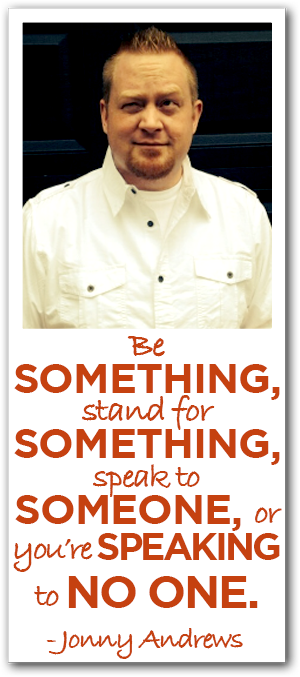
The Three Step Process to Build an Audience – Jonny Andrews

Jonny-Andrews-PinterestLooking for tips on how to “hack” the publishing industry to successfully launch your book by gaining and growing your audience?

Learn how to use your book to elevate your credibility and authority in the marketplace by following a powerful three-step “clarity hacking” process.

Jonny Andrews, the “go to guy” for author entrepreneurs and host of Audience Hacker podcast, joins us this week to tell us how he has helped thousands of authors create huge publishing successes by helping them grow their audience both before and after their books have been published.

Big Ideas:

Now, do you have a special deal on quotes that you’re just using them? You’re like, listen, we’ve got a thousand quotes, we might as well just start putting them in everywhere.

  • Yeah, you know what it was is that broker, or whatever the heck they’re called, that give away ISBN’s, they actually had an upsell after I bought about a thousand ISBN’s and they said, “hey, if you’d like to use some extra quotes in your bio, that’s another twenty bucks for unlimited for the next three years.”
  • And I was like, you know and actually I bought those two and a half years ago and I just wrote that bio again, so I literally have to get about 50,000 quotation marks down in the next couple of days before it expires.

If you want to send those over, when we write up the show notes, I’m going to put so many quotes.

  • Absolutely. It’s funny because what I tell people all the time is when it comes to books, I’ve written and I’m a bestselling author, but I’m not a best writing author.
  • I cannot punctuate or spell to save my life.

I’m going to get you a copy of ‘Eats, Shoots & Leaves’, one of the funniest books ever on punctuation.

  • Seen it. It’s hilarious. Oh my word, that is awesome.

So let’s start with the obvious question, how does one “hack” the publishing industry and what is this powerful three-step “clarity hacking” process you speak of?

  • Ah, very good questions, and thank you. Actually If I could, let me kind of just for your audience and whatnot kind of clarify why the heck this might be something that people would want to do with themselves, because I know statistically speaking because clearly all statistics are real and I read this on the internet which guarantees that this is true.
  • But basically the New York Times, I believe, said roughly 89% of people think that they have some sort of book in them. And especially with the entrepreneurial…

Is that because they swallowed one as a small child?

  • I think so, because I know I ate a lot of book pages as a little kid.

I ate a lot of paper. You know the paper candy dots? I would actually eat all the paper as well as just the candy dots.

  • That, actually they used that to transport blotter acid into the United States, so that might, that makes a lot of sense. We’re kind of coming to a clarity moment here.
  • No, so basically the reason you want to do this stuff is when you use something like a book, books and podcasts to be perfectly honest, podcasts are on their way up to being almost the same level.
  • What a book does for you is it elevates your sort of credibility and authority in the marketplace. It’s like you’re the person that “wrote the book on the subject”. And so when you put that stuff out there, you really do a great deal to elevate your business. And my favorite sort of situation is to use it as lead jet for your business.
  • It’s sort of like, for example, your podcast. You’re the voice in that person’s head, and so you’re very much in a very intimate kind of conversation. I call it conversational conversion where it’s not like you and I, we’re not necessarily selling anything right now, but there’s going to be a certain kind of person that’s very whack and is like “well, maybe I’ll go check out more about this Jonny guy.” And that’s kind of how that whole thing works with the book, you know.
  • Somebody called it, and I don’t remember it’s absolutely not my quote I probably should have done my homework first, but I don’t remember who said this so if anybody else does you can post it probably in the show notes. But, a book is a 7-hour handshake or a 5 hour handshake, or something like that.
  • Because that’s about the length of time on average it would take someone to consume that info. And so if you think about that, you’re living between their ears for that length of time, which is pretty stinkin’ cool.

Absolutely. So how do you take that and then turn that into lead gen? I guess, how do you even take that process and first get a book into their hands and then move them down the sales funnel so to speak?

  • Alright, well, now this gets back into the first question you asked me. So, how do you actually do this? And this is something that since I started audience hacking I’ve been bumping into folks all the time that have these amazing businesses, but a lot of folks seem to be, it’s crazy like, even a lot of very successful people aren’t quite sure who their market is.
  • And there’s nothing quite like creating a book to make you sit down and answer that question. And that’s really what it’s all about is who is this person that you’re speaking to in this book.
  • Because it doesn’t make any sense anymore to write for this massive, generalized audience. It’s very difficult to be a generalist nowadays. You have to be something and stand for something and speak to someone, because if you don’t you effectively are speaking to no one.
  • Because there are so many very large companies out there, like, let’s take you know for example Ryan Deiss and Digital Marketer and folks like that. They’re very much like a generalist company who caters to online business, and that’s going to be everything from social media to email marketing to, I mean, you name it, SEO. You name it, they’re going to talk about it and probably have a product on it.
  • That is a generalist thing. They’ve been around for like, almost fifteen years now. And so they’ve been through the many evolutions of the reality that we now call this interwebs thing. And today, and I was actually just speaking to someone yesterday about this, even a topic like social media is so dramatically fragmented that to just say, “Oh, I’m a social media expert”, people are like, “Ok, how is that relevant to me, because I’m really looking for some help with Facebook right now?”
  • So even though you might have just said social media, and within that umbrella it’s all about Facebook, Twitter, Pinterest, blah, blah, blah, blah, blah, you didn’t directly say to them, “Facebook”, and so now you’re not relevant to them. And so that’s the beginning of the process of creating a book is how can you be relevant just to those people. Like I said, it could be anything.
  • It’s like, people with shar peis are looking to trim their dog’s hair, or Facebook marketing or Twitter marketing or mobile marketing or something like that. And so you kind of pick that moment in time and become the person on that subject. And that doesn’t cement you in it forever. They say the promotion time for a book is about sixty days, which I actually kind of disagree with, but for that sixty day window you’re the dude on that thing. And then after you can go be the dude on a different thing. But right there, just be that dude on that thing for those people.
  • That’s what is really comes down to is knowing who you’re talking to and being so hyper specific and literally alienating everyone else. Because by doing that, I’m serious you’ve got to strategize your audience, that’s why I’m almost on the fence about doing media training, just because I let to get the message out there and stuff like that and there are strategies where I could communicate differently, but I’m sort of like authentically bumbly by nature.
  • And it’s funny because I get these emails from people who I think are high school english teachers, and they’re like, “We really think you have a good message, but my word, man, your sentence structure is just awkward. Can we help?” And it’s like, “Nah, probably not.”. Like, I’m ok with that.
  • When I put out my first book under my name, it was actually a personal finance book, of all weirdness. And I’m not a personal finance guru, I was just sort of telling my story about how I was living in that office and stuff and had all that crazy credit card debt and how I actually figured out a way to make enough money to pay it off. And it was funny everyone said, “Wow, this is a really great book, but dude, learn how to string together sentences because this is horrifying.”
  • And so you just have to be authentic to yourself. And people, what they do is, they’re going to “self select”. And if you try to be vanilla, or if you try to cater to everybody then it just kind of all falls over sideways.
  • So that’s really the first step in producing a good book, is “Who are you and who do you serve and also who don’t you serve?”.

It sounds like what you’re saying is, we’ve got to be willing to alienate the people we’re not going to be able to help.

  • Absolutely. And it’s not like, I’m not talking about shoot them in the head, burn the bridge, that’s not what I mean. It’s like you’re just not going to worry about them for now.

No. And I think this is generally just good business sense, too, is that you need to know who your avatar is, your ideal client, and then focus entirely on what their needs are and not really worry about all those people that you can’t help anyway.

  • Absolutely. I’ll give you a great example. Because what happens is now these people who might not necessarily be your direct market, they all of a sudden start creeping into your sphere because they want to know what’s going on.
  • Great example of this is a website called Working Moms Only, not that you could tell by the sound of my voice or my name, but I’m actually not a woman, and I’m on her list. And I buy stuff that she sells. And it’s for working moms. I’m not a mother.
  • Seriously, look at that. Working moms only, and I have the audacity as a man to sneak in the back door on that one and get on that list. And so that’s what ends up happening, she is catering to working moms only, that absolutely is the clearest message you can possibly imagine.
  • But then look at who shows up at the party. Of course, I dress like a woman when I go, but still. No, I have facial hair so it kind of gives me away, I just tell them I have a gland disorder.
  • But that’s my point, by focusing in and kind of alienating the rest, you’re going to end up attracting more people than you originally thought.
  • So it’s actually the technique of exclusion ends up being a technique of inclusion in a very strange way. And so that’s the beginning, who are you and who do you serve?
  • So you have to know who you are and what you want to do and who your ideal client is, and write the book for them.
  • And then really it comes down to three components then – you have and internal ecosystem, you have an external ecosystem, and then you have your book. Which literally, the importance of those things are in that order.

Ok, so explain those, please.

  • No.

Alright, the interview is over

  • And we’re done.
  • So basically, internal ecosystem – this is what’s really important. I started picking this stuff up listening to Mindset podcasts and things like that.
  • Really just this year I was like, “oh, this is a better way of explaining it”. Internal ecosystem – these are things that you, personally, can control. These are things, like, you really at the end of the day cannot control whether or not someone is going to buy from you. Like, I don’t care how many neurolinguistic programming courses you take, “These are not the drugs you’re looking for, you don’t need to see his identification.” And they’re like, “Here’s my wallet”.
  • That only works so much, and then after a while it just kind of gets ridiculous. But what you control is, you can control how many actions you can take on a daily basis. This is great in sales, I think you would probably really resonate with this one. It really comes down to old school phone sales, like door-to-door phone sales, like knowing your numbers.
  • So guys in the call centers, back in the day when I used to do this, would be like, “Listen, you need to make 50 calls a day”. And they didn’t day have a conversations, they didn’t say schedule deals. And this was back when I was doing loans, I was a loan officer at a mortgage company for a while. And they said just focus on getting those 50 calls. And I was like, ok, I’ll do that, because my job was basically do what they told me.
  • And what ended up happening was, I focused on just getting to that number and what ended up happening by proxy is that I would run into people who were interested in what I had to sell and what I could offer them. It was really kind of crazy.
  • And so what would end up happening is I focused on just smiling and dialing, I would then set appointments, and as I went to those appointments I ended up getting loans to close. But I never focused on closing the loans, I always focused on that one thing that I had control over.
  • Because I can’t control if somebody is going to like me or like what I had to say, or you get to their house and they’re going to have all the documents and a check for the appraisal – you can’t control that.
  • But you can control the fact that you made 50 phone calls in a day. And so that’s what you want to do for your internal ecosystem from a mindset perspective, and let’s kind of bring that out of the cold calling because lord have mercy, everybody hates that.
  • And what you can control is, for example, let’s say I want to go out and do interviews for a podcast or with other podcasts to drive traffic back to my website to then build my list and sell my book.
  • Well, I can’t control how many people are going to say yes, but I can control if I send out, “Hey, would you like to interview me, here’s my cool stuff?”. I can send out that kind of message to 20-30 different shows a day.
  • That’s it, that’s all you have to worry about. Because then what happens is, then those people start responding to you, and as that happens then you start getting interviews; as you start getting interviews those interviews start going live and as those interviews go live the listeners of that show hear you and are like, “Hey, this dude’s not too terrible.”
  • And they go and say ok, where’ s he from, I’m going to go check it out. Next thing you know, you build the audience and people are like, “Wow, I kind of like this idea of this stuff that I’m selling, let’s join up on the mailing list.” They get on the mailing list and then you give them more cool stuff.
  • So you really can’t control anything past that first step. But everything else happens by proxy. So that’s really the internal ecosystem.

And I’ll just say, just to back you up on that, is that I used to do sales, too, and I hate that this is true. But when doing cold calls the experts will tell you, if you make 63 phone calls, you will get 7 appointments out of it and god damn if they’re not right every single time. It sucks that they’re right, but it is true. And if you know that and you can kind of deal with that, if you say, like you’re saying – podcast outreach or blog outreach or whatever it may be – and you say , “I’m going to reach out to 50 people this week to try and get an interview”, then you will get some people who say “yes” because you just hit them at the right time and the right place, those number do, I mean some might be a little higher some might be a little lower, but it does work. And what you’re saying is, this is your sphere of influence, or as you call it your internal ecosystem – the things that you can control. Is that a good way of summarizing it?

  • Absolutely, yeah, that’s sort of the mindset sort of shift I think a lot of people make. And don’t get me wrong, there is definitely something for optimizing your outreach and optimizing your landing page and stuff, because you absolutely can also control that stuff.
  • But just in terms of rudimentary first steps, understand that that’s what’s in your control. That beginning zygote of a concept of reaching out and getting that stuff.
  • Now here’s why this is important – because you’re internal ecosystem, the thing you ultimately control, like you don’t control Facebook, Twitter, Pinterest, Goodreads – whatever site you might be using. Not to say due paid traffic, you don’t control that.
  • I mean, I think the recent changes with Facebook and the minutely changes with Google, I think everybody kind of gets that now, is that you need to have your own email list.
  • And that’s sort of the effect of what you do there, that’s what the tangible part of your internal ecosystem is – to build that email list through actions you control. Does that make sense?
  • So your goal with this, for example when we launched ‘Pure Fat Burning Fuel’, this was a book that was obviously a diet book, it flies a little in the face of my ”be a generalist comet”, but there’s a reason for that – that I’ll share with you in just a second – but it was a paleolithic style book.
  • And the reason it was generalist is that we tested the titles beforehand to make sure that we had the right thing for the right crowd and whatnot. And then we went live with this thing, we tested some of the elements of the cover, the elements of the title, the book – great info, well researched lots of documentation and support – and when we went live with this, is was mostly due to the internal ecosystem.
  • Because this was a company called “The Beyond Diet” – Isabel De Los Rios – are one of the biggest online diet companies. I don’t know if you really call them diet companies, it’s eating habits, lifestyle, that kind of stuff, they don’t sell pills. And they have this wonderful community of people, they had 680,000 buyers on their email list.
  • So when we wanted to make a big ‘ka-chunk’ when we first stepped up to the plate, we wanted to stack the deck in our favor.
  • I can think of very few moments in time when the deck is stacked in the favor quite like this. So its like, we could have literally painted a rock green, hung it on a stick and flung yack feces at it and probably sold about as many copies. That’s just how it is. This is why you want that internal ecosystem.
  • You want to have that email list, you want to have those subscribers and have a relationship with them, because when you go to sell them something, there is an overwhelming response to try to buy it.

Alright, makes a lot of sense.

  • I think so. Literally we hit ‘send’ for 7 days and it’s funny we didn’t actually know we hit the ‘Wall Street Journal’ because I was only concerned with Amazon.
  • Amazon is a very visible place to look at your metrics, and it’s also like, 70-80% depending on who’s looking, of the book buying market. But here’s what’s really funny about this entire situation is that when we did this – this was before the big Kindle craze on how to make money with ebooks kind of thing came around – all of a sudden not very many people even knew what Amazon Kindle was when we did this.
  • So we didn’t have, the obstacle we were trying to overcome was the fact that nobody knew how to actually buy this book, and so we had to teach people how to consume the product. And that was a huge hurdle, so had we done that today, we probably would have sold twice as many.
  • Because more people now are aware that every droid phone comes with a Kindle app preinstalled, and most people understand how to use that stuff. So that’s the internal ecosystem and that is why.
  • Because the bigger that is and the more relationships you have – people say it’s not about the size, it’s about the relationship – I’m a fan of both, personally.
  • And so that’s why you want to grow that, because you can control that. The only way you grow that is by focusing on the mindset, like what actions can you take that you control to get traffic to your list building offer.

So let me just kind of make sure that I understand the steps here. So, before we’re ready to publish our books we’re already going out, we’re doing outreach, we are reaching people through podcasts and blogs of appropriate topics, we’re driving traffic back to our website, we’re building our list – maybe by giving away a free chapter of the book or something like that – but getting them onto our list so that we can have a big push that says, “Alright, the book is now on Amazon, please go buy it.” And then that’s really what we can control, and by doing that we’re going to greatly increase our success.

  • Absolutely! Let me give you a visual for this one that will probably help out those people at home picture this in their minds.
  • Basically picture an empty Colosseum, the Colosseum if that helps you. And so every single person out there who’s in business all owns an empty Colosseum when they first start. And you have a thing that you want to sell, in this particular case we’re talking about a book, so you have your book.
  • Now you’re going to stand on the stage at the Colosseum and you’re going to address it and say, “Hey everybody, why don’t you buy my book?”, and you’re going to hear a bunch of fricken crickets.
  • And so you need to go outside the Colosseum, because that’s where all the Romans are milling around, and you need to say, “Hey, why don’t you guys come in here, we’re going to have some cool shows and we’re going to have some people get eaten by lions and this will be awesome. Some chariot races anyone? Hey how about a beheading? Sir, you look like you could use a beheading.“
  • And that kind of thing, people are going to come in for your free entertainment of wanton death and destruction – and possible some gratuitous nookie, who knows – and you’re going to bring these people into whatever business version of those things you offer them.
  • And now lets say after a couple weeks you have about 500 people in your Colosseum and you’re like, “Hey, I hope you enjoyed the show, by the way, I have this book on how to increase your enjoyment through watching ritualized, public beheadings.” And now you have these 500 people and maybe 100 of them are like, “You know, that sounds pretty good. I think when the kids come over from Pompeii they might enjoy some ritualistic, public beheadings.”
  • And they’re going to buy that book and you just sold 100 books.   You’re like, “Wow, this is awesome! I had 500 people in these seats, what happens if I go out and get more people?” So you go out and you get more people and now you have 1000 people in your Colosseum who are watching people getting eaten by lions and it’s awesome. Then you’re like, “Hey guys, by the way, I have this awesome book on how to increase your family’s enjoyment through ritualistic, public beheadings.” And everyone is like, “Oh, this sounds fantastic !” And you end up selling another 2000 copies.
  • And on and on and on, until you’re at the point where you have an entire stadium literally filled with people chanting and chanting and you say, “Hey, buy my book.” And they’re like, “Hell yes!” That is the difference. And obviously this doesn’t happen overnight, but you can do this very quickly as long as you’re strategic about it.
  • But I just wanted to give that visual along with an absolutely absurd topical example as to why this is so important for these things. Now, we get into the external ecosystem. Things you do not control. And the external ecosystem is, to get back to the situation of ‘Pure Fat Burning Fuel’ and stuff like that, what we did with this is we brought in a bunch of partners who also had these massive email lists.
  • So this would be like joint venture partners. This is basically other people who are in your marketplace who are probably friends of yours, or who you can get to be friends, who also have email lists, their Coliseums are filled with people. And not only now is it just you saying, “Hey, buy my book.”, but all these people at the same time say, “Hey, buy this person’s book.”, and you get this wave of traffic that flows into your ecosystem so that the people then buy your book and that just adds to it.
  • Now the reason that’s an external ecosystem is you really cannot control whether or not these people are going to promote you. Even if you’re best friends, and I came up in an industry where this was the exclusive method of driving business; was you would create a product, you would get in the phone with friends that you had just met at a party or at a conference and say, “Hey dude, hit ‘send’ for my offer, it’ll be awesome.” And then most times people would do it at some point, and it was called a ‘launch’ and it is awesome.
  • You have no control over if these people are going to say “yes” or not, but it is absolutely a thing you want to do. And so if you focus on the internal ecosystem, both like the intangible of just knowing what it takes to do that, and then the tangible meaning actually getting those people onto your list.
  • And then the external ecosystem, meeting all these cool people that you’ve met over a couple months, and you put them together, then you get – it’s cool, I had this live training that I’m doing literally right now called “How To Sell 10,000 Books in 7 Days”, and this is kind of the crux behind it – is that when you combine these two powers, this is where you get your ten year overnight success.
  • This is how you manufacture that outcome. And you use the book then to propel yourself even further forward. That making sense?

Absolutely. In fact, Michael Stelzner’s book, ‘Launch’, calls them ‘firestarters’, these extra people. And just all getting them to all say it the same day can also make a big impact as well.

  • Absolutely, you know, BookScan is the list that feeds the list. Like the New York Times, the Wall Street Journal, USA Today.
  • And they look at a Monday through Sunday algorithm. And so that’s how we ended up on the Wall Street Journal. Like I said a friend of mine actually told me almost 2 months after the fact that we had done it. I was like, “Oh, that makes for a handy screenshot, let’s take that!”
  • But yeah, that’s what it really takes, you want to get those sales within a short window of time because the more lists you’re on the more visibility you get. And it’s one of those things, you’re a bestseller because you’re selling a lot of books, but you’re selling a lot of books because you’re a bestseller.

Exactly. One of those virtual circles.

  • Exactly. And in this case it’s awesome, but you do need to put in a little chutzpah to “fire start”, as they say, the cycle.

Absolutely. Ok, so we’ve talked about internal, we’ve talked about external, and now let’s get to the book itself.

  • So this is one of my favorite things. I absolutely love books. I have this weird kind of like super OCD ritual that I do.
  • Everytime I put out a new book, whether or not I am behind it at all. You know there are lots of folks that have done books and if I was involved with the launch or something, I always get a printed copy of it shipped to me and I literally walk around the house just holding it, because there’s something about a book that’s really cool.
  • So I have all these fiction pen names that I’ve been experimenting with and I always get their books and walk around the house holding this book in which I am a female pen name and just channeling it.
  • It’s really hilarious, like, most of my pen names are women, it’s very fun. But anyway, long story short, let’s talk about the book. The book has a bunch of different components. And the number one most important thing to keep in mind is that everyone will judge your book by its cover. Everybody. That is just a fact of life.
  • There is absolutely nothing anybody can do about this. And so your role in life is to position your book as the thing that your people want. There’s actually two ways of doing this whole thing.
  • The way that I described it earlier with the internal and external, you can do that before the book is created, you can do that after the book is created.
  • Just realize you probably won’t sell a lot of books very quickly if your book was created first. For example, ‘Chicken Soup For The Soul’. Guessing you may have heard of this one?

Yes. And the seventy-four versions that came out after.

  • So basically, that was after they had built their ecosystem that those subsequent books came out. And so what happened was, these guys were literally selling their books out of the back of a car. And so they created the book, and then they had to go and find the market.
  • And so they had this uphill journey, and that is totally fine. I’m actually, there’s a site out there, I can’t remember the guy’s name but it’s called Outthink (outthinkgroup.com), he does a lot of stuff with publishers and books and things like that, but he’s doing the same thing with his book right now, he’s trying to sell 10,000 copies over the course of a year.
  • And that’s cool, that’s awesome. So there’s definitely two ways to come at this. If you already have your book, don’t think the stuff I’m saying – or if you published traditionally – it can kind of be this feeling of discouragement, like. “Oh, man, this stuffs all set in stone”. Well, if you’re self-published it;s absolutely not, you can make tweaks to your book.
  • If you’re published traditionally, you can’t make tweaks to your book, but, you definitely can build these ecosystems. But the first thing you want to make sure, if you haven’t created your book yet, what do people actually want to know?
  • Tim Ferriss was excellent at this. He talked a lot about this as he knew his book was going to be a hit long before he wrote it because the topics and the chapters in there were actually pulled from his blog. So he knew because his audience told him – like voting through reads and like and tweets and this, that and the other thing – or whatever the heck back then when he did his stuff.
  • That’s what they wanted to hear. They wanted to know about these topics, and so that’s why I really recommend you build your audience first, and then get our audience to tell you what they want.
  • Because that makes all the difference in the world. If you did it the opposite way, all is not lost.
  • All you have to do is make sure that you’re positioning your book correctly, so that everything from the title to the cover to the subtitle to the description, and then when it does go live make sure that you have lots and lots of reviews. Because that is social proof.

Reviews on Amazon, or reviews in other places?

  • Amazon specifically, but definitely other places.
  • Reviews are what sell the book at the end of the day. Because people are going to look and they’re going to see, “Oh, you have..”. And you definitely need, like, fifty. And in fiction, that can be a little difficult. Nonfiction it’s pretty easy.
  • Actually, if you have an ecosystem you can go, “Hey, can you guys tell me what you think of the book on Amazon.” It’s a really easy way to boost conversions. Books without reviews, even if they’re free sometimes, people just don;t even want to download them for free because they don’t know if it’s going to be any good.
  • They look at the cover first and they’re like, “Is this cool, does this resonate with what I want to do?”
  • And the trick here, and this it’s funny because you think, like, old school business opportunity products have that person sitting in their Lay-Z-Boy chair on the beach or something with a laptop in their lap and there’s a hand with a fistfull of money flying out of the screen, and it’s supposed to represent leisurely income.
  • That’s sort of like the 80’s version of acting on soap opera television. It’s lampooning itself. And so please do better.
  • When you do your cover, don’t make it cheesy, but do make it representative of the outcome people are trying to get to. Is that making sense?

Yes. Definitely at least in terms of a lifestyle book?

  • Right, well actually any book. Unless you’re doing some sort of fiction thing, in which case you want to represent a crucial moment in the story kind of thing.
  • Or sort of like the overall theme of the book, then you can do it that way. Really, most nonfiction books, unless it’s just sort of a blanketed memoir or an outcome based book, and if they’re not they should be. And this is another big thing, your book – and so few people do this – your book needs to have a direction to it.
  • Meaning, you have this opportunity now with your book to have this 5 hour conversation or this 5 hour handshake or whatever that number was.
  • And so you’re going to be influencing people for this length of time and it would behoove you to not just write content for the sake of writing content or stories for the sake of writing stories, you want to write them for the sake of motivating this person reading your stuff to have no other choice but to take the action which is to go to your website, subscribe to your newsletter and buy your stuff.
  • So that’s what the book means. That’s what it needs to be, to have that direction to it.

But what if you’re writing something that doesn’t necessarily have direction in it? How might you continue to use it, it sounds like you’re using direction to continue to build your audience? It’s almost like it’s a rotary, and this is just one more entrance ramp.

  • Exactly. It’s the difference between having a subscriber list versus a buyer list.
  • And I’ve seen this time and time again when I worked with folks, I’d have people buy the book and move from the book onto the email list to then be presented with an offer.
  • And a lot of times, I don’t remember exactly the numbers but they’re pretty close to this, there was once instance where the people purchased the book and signed up to the list. their offer typically converted to about a half percent with cold traffic, paid traffic.
  • The book buyers were purchasing at a rate of 16%.

And I’m sorry, what was the difference there? I think I lost the thread.

  • One audience is cold traffic, no relationship.
  • They probably just pulled them off randomly off Facebook based on interest targeting.
  • And then the other one was they had come in from the book.
  • So they had developed that, that’s the difference between that 5-7 hour handshake. We’ll call it the 5 hour, who cares?
  • So yeah, that’s what happens when you have an appropriate 5 hour handshake.

Alright, so let’s say that we have a book that’s already out there, and/or that’s just being published or whatever. We haven’t done all this audience building because maybe this isn’t something we thought about in the past. What are some of the techniques that we could use to maybe, let’ say we do have to rely on Facebook advertising based on interest to drive traffic to some sort of platform from a website blog or landing page to get people into our ecosystem . What are some of the tactics authors may use? I mean, I mentioned because I’ve seen it before, download the first chapter of the book, which you know requires and email registration. Great, now we’ve got then our name. What are some of the other things you’ve seen have been successful in terms of building that list for authors?

  • Oh, just a ton of stuff really. It just comes down to whatever works for you.
  • And I’ll break down a bunch of these things, but really quite honestly from a perception kind of situation here a lot of people have the belief that they need to get published, or they need to do a major publisher or even a mid-level publisher or something like that, because the publisher will do all your marketing for you. That will never happen.
  • Publishers are on the ropes right now because they don’t understand this. I think they really fundamentally do understand this, but they don’t know how to adjust their business model accordingly.
  • And so there’s this really, really awful – it’s called a false belief – not quite a lie because people aren’t really screaming it to the high heavens. But it’s definitely a false belief that if you get a publisher, the publisher will market you. The publisher will not market you.
  • And so you need to understand this stuff before you go live. You need to be willing to get out there and do this because that’s why so many people are self publishing.
  • Publishers are literally driving the best authors into the arms of self publishing. It’s just crazy because, you know, the best authors are also understanding that they also need to be at least workable marketers, which then, takes us to this thing.
  • How do you build a platform? How do you grow those ecosystems? One thing that I’ve seen is, for example, I own this awesome little online ecosystem or the paranormal, romance genre called “I Love Vampire Novels”, I know it’s hilarious.
  • It can reach up to 3.7 million, there was actually a time it hit like 5.1 million people every single week.

I’m guessing my wife is on your list, personally, but that’s a whole other story.

  • There you go! Yeah, so what that is, it’s called a ‘book discovery’ ecosystem.
  • So it’s slightly different than an author ecosystem in terms of it’s more of a magazine style.
  • You know, it’s like Rolling Stone magazine, for example, doesn’t have their own band kind of thing. They’re just a place where you’re going to go to read about bands and find more music and get some news, that kind of thing.
  • And so that’s one way to do it, and this is actually called “one step removed’ where you can do something like that where it’s like a magazine-style site and you get to then cater on a very non threatening level.
  • You get to cater, let’s say on Facebook, to all of the people who really like you. So for example, with entrepreneurs, you could do like Gary Vaynerchuck, Entrepreneur On Fire, all these different kinds of people and you can pull their fanbase to you and speak to them in sort of a non threatening kind of way.
  • Whereas an author has an agenda and so it’s less likely that you’re going to get a 93% opt in rate kind of thing. You can definitely optimize, but it’ll be a lot more than that.

So are you suggesting that authors might consider creating a pseudo-online magazine about their genre? And that’s obviously a huge undertaking for a lot of people, people who are like, “I just want to sell more books.”

  • Absolutely, and that’s actually what I was going to say is that is a really big thing to do. I know this because I’ve done it multiple times.
  • And so it’s sometimes easier to create an author ecosystem just for the author. The reason I mention this is because there’s – specifically in fiction – a lot of times there’s very, until you hit a certain level of success, it’s very hard to monetize that side of the books.
  • And this gives to the ability to do that. Like you can sell ad space and different kinds of things to actually make a workable living while you’re making a living with your books. And so you sort of build your audience by proxy with this.
  • So the problem I’m trying to solve by mentioning this is how some people go off the rails with shiny object syndrome. They’re like, “Hey, do you think I should produce this money maker while I make this money maker to make money?” It’s like, “No, don’t! Focus on one thing and do that.”
  • And this is like focusing on one and a half things, so it’s not quite chasing because it’s still very much in the line with.

Or whoever would be running my genre. So if there is a small business book one out there or a local business, I want to find that, I want to find those type of industry magazines and make sure they’re aware of my book and hopefully review it or talk it up or whatever it may be.

  • Absolutely. And that’s part of the external ecosystem that you want to focus on as an author of getting that big list of dudes. That’s very, very important stuff to do.
  • And so, yeah, you know, if you really want to just get out there and kind of shake the tree and see what falls out.
  • So for entrepreneurial kind of people who are personal development, self help, health, all these different kinds of things, there’s a billion and a half things to sell on top of your book.
  • You can add coaching, you can add done for you services, whatever your business turns into, and so you can grow and monetize very well while you’re building this. Because there is a lot of paid traffic that you should utilize.
  • You were asking me what a lot of these things are, you can do things like Facebook now is pretty much a pay to play environment, but it’s obviously still one of the best. And I want to recommend it heavily if you have a budget.
  • But drive traffic out of Facebook, you know, build your fanbase and then build your list through Facebook and obviously if you do have a book, then give away a free chapter and then encourage people to buy the rest.

Alright, so I have a question. These are some tactical questions, I just want to make sure, because we have been talking, I know you have things to do. But a couple things I’ve been running into over the years I’ve been doing web design and internet marketing for 17 years and have had my share of authors and one of the questions that always comes up is , “Do I build a site for this one book – whether it’s my first or my tenth – or do I just create an author website and have this new book on the homepage and maybe one other page?” Do you have any strong feelings about whether or not every book deserves its own website?

  • Absolutely. I love this, that’s a really good question. And you’re right, I bump into that a lot, too, with folks asking about that. I call it the “umbrella concept”.
  • You always want to be publishing in something that can be a brandable series, because that’s going to further push your brand.
  • Like if you look at Tim Ferriss, ‘4 Hour Workweek’, ‘4 Hour Body’, he’s probably working on ‘4 Hour Foot Rub’ or something like that.

That sounds nice.

  • I know, doesn’t it though?
  • Yeah, so you want to definitely not necessarily have the one book. Although the one book page is cool, that’s not going to be your predominant focus.
  • What you want to be doing if you think about this in terms of the amount of steps, involvement, and money that you’re going to put into this.
  • Every time you create a new ecosystem it’s going to cost you a certain amount of money and take a certain amount of time. How many books are you going to publish? Say, three. Well now you have three times as much time and money to invest.
  • Whereas, if you build a singular ecosystem that is focused around you as the brand, now you have one location. You can have one continuous conversation and you only have one ad spent to be able to get that stuff out there.
  • So you reduce your cost, you reduce your time you reduce your daily involvement with it. And so I have a very strong opinion on that. You can absolutely put up a website just for the book and use that as a promotional tool, but I do not recommend going off the rails and doing a bunch of different sites, like per book kind of stuff.
  • Always publish in a series and always focus on building your audience. And this was a big problem with the make money and Kindle market , was that people were doing a book on dog training, then they’d do a book on cooking, then they’d do a book on how to raise your baby, something like that.
  • And the audience was literally nowhere close to synergistic. And so they had all these books all over the place and just nothing was working because they couldn’t focus. In fact, the very first thing I talked about was who’s that one person you’re speaking to.

Alright, makes a lot of sense. Well listen, and I know I feel that you and I could talk forever about this,and I even have a few more questions that are bubbling to my head, but let’s let the people do some of their own homework and dig a little bit deeper. Where can people find out more about you and what you’re up to online?  

  • Awesome, well right now I have a cool, free training called ’How To Sell 10,000 Books in 7 Days’, even if you haven’t written your book yet. You can find that at audiencehacker.com/free.
  • And if you just want to check out the show, audiencehacker.com, it’s for who I call the “author entrepreneurs”, so anyone using content marketing to grow their business, build their list, drive more leads and sell more stuff.

That sounds awesome. Jonny, always entertaining and always full of information. Thanks a lot man, I appreciate the time.

  • Thank you.

Juicy Links:

Rich Brooks
Is hacking you right now.

Generate New Streams of Revenue – Jon Goodman

Jon-Goodman-PinterestDid you know personal training and self-motivational techniques can help you strengthen your small business? Do you know how to maximize Facebook comments to re-animate old blog posts and generate new streams of revenue?

If not, then you’re not alone. A lot of small businesses don’t know how to motivate themselves to tackle big projects let alone motivate their clients. By breaking out your big projects into smaller pieces and then creating a reward system when you complete each step, your tasks will be much more palatable. This week, we talk it up with long time personal trainer, owner of PTDC (Personal Trainer Development Center), author, and social media maketer, Jonathan Goodman, to learn more about how to push through tough goals and make the most out of what our core talents are.

Big Ideas:

Jon, you started out as a personal trainer. How did you end up becoming the guy behind the Viralnomics blog and basically running your own small social media empire up there in Toronto?

  • It’s a very long winding tale. I was a personal trainer and I saw a need for how you get somebody to want to do a workout and adhere to a workout better which stems mostly from psychology than it actually does any kind of physiology or biomechanics.
  • So I started doing a lot more research into the psychology of adherence, even word of mouth and social contagion theory when I was in training for marketing purposes.
  • As I wrote my first book, Ignite the Fire, I decided I needed to promote the book using a website and that’s where the PTDC (Personal Training Development Center) came on and social media was, and I believe still is, to promote a blog through word of mouth.
  • I took a lot of the same theories that I was using to try to get clients to speak about me and just applied them to whatever social media networks I found to be the most effective at the time; Facebook being the biggest one.
  • The result was uncanny and I started doing nominal research and started getting in touch with John at University of Wharton School of Business as well. I started to really expand upon those theories and that’s how the Viralnomics blog came about.

In a lot of industries you sort of hit this glass ceiling. There’s only so many hours in the day you can make money, so you have to branch out. Was that part of what was going on as well?

  • That was 100% of what went on and that was a huge issue for me at 23 years old. I had kind of hit what was known to be the highest income level for a personal trainer working in downtown Toronto. I was making $100-$120 an hour and I had anywhere from 40-50 contact hours a week which for anybody that knows personal training means you work anywhere from 60-80 give or take.
  • I was also managing a group of trainers at that time and making a bit of a salary from that so really my only options were to own a gym which I felt and still believe for most people is a fool’s proposition. Or, to sell things like supplements and all of these multi-level marketing schemes which is something that I fundamentally don’t believe in.
  • I started to read up a whole bunch about multiple streams of income, passive income, income generation and all that fun stuff. Eventually I came across the term “infopreneur” and that’s how it all started.

How did you segue into doing multiple streams of income? What were the steps? Can you tell us a little bit about how you carved out time in your day and what research you did?

  • Carving out time in the day is a good point to hit on. I’m glad you spoke about it. Actually I had a number of very good mentors because of where I worked it was a very affluent neighborhood and one of my clients was the dean of medicine at University of Toronto. Another one was the head of psychiatry at one of the major hospitals in Toronto.
  • So I have some very high-level, very well educated, just incredible people who were mentors to me who were my clients. One of them gave me this principle that I later called the “freedom number” and it became the basis for one of the courses I put out.
  • It’s very basic. Pretty much it’s just this equation for establishing what amount of money I need to make to make sure all of my basic needs are looked after. That’s of course my food and rent, but it’s also if I have dependents. I call it “do something special for the girlfriend” fund. What is it you actually need each month?
  • At the time, all I needed was $2600 a month. I didn’t have dependents or anything like that, so it was quite low. So then I took a look at how much money I was making each month and I actually whittled down my clientele to eventually 15 hours a week (and this is from 40-50 previously).
  • I first went to 25 and kind of cut out all of the sort of wishy-washy clients that personal trainers have. Then I cut it down to 15 and very much condensed and organized and made my schedule much more efficient and I started to block off times for personal development and I started to block off times for writing throughout the day.
  • That, I will say, is by far the most important thing I ever did. Was take a really strong step back and say, “how much money do I really need to make? How can I make that in the most efficient way possible over the course of my day so that I can focus on building assets?”
  • The first asset that I focused on was this huge project was this book, Ignite the Fire, that took eventually three years to put out. The book was fortunately well received but if I were to do it again, and I spoke to a personal trainer the other day and this goes for pretty much any industry where there’s a service need (like plumbers for example), building up an asset for a business that is just a passive income stream is actually really easy to do.
  • In terms of just packaging what you know over the course of a day is as simple as walking around with a clipboard and writing down notes of all of the little tasks you do over the course of a day and putting it together in a 20 or 30 page guide or workbook.
  • You can put this thing out for $4.99 or $9.99 as an ebook. I put one out about three weeks ago that was about 125 pages. It was a compilation of a bunch of things. I put it out for literally zero dollars. I didn’t even create a cover for it and used PayPal so it doesn’t cost me anything unless people buy it.
  • So, I think anybody in any industry can do that and to get started and start seeing potential of producing these high-value but these short, information rich resources that act as an asset for that business.

As a personal trainer, what were some of the techniques you used to get your clients to behave in a way that helped you but more importantly helped them to succeed?

  • I think that there’s two separate things at play.
  • The first is kind of away from personal training specifically and more in this idea of creativity and the theory of creativity which is a fascinating area of study for me right now. There’s a psychiatrist who’s name is Rollo May and his book is absolutely fascinating and he’s one of the few academics who writes material that people like me can understand. One of the most interesting facets of his theory of creativity is understanding why it is that people who are inherently creative never actually see their projects through to fruition.
  • This is something that I’ve fallen prey to and it speaks to a lot of people as well. Where by you have this great idea and you take all the actions to do it, but the minute there’s that time to flick the switch and actually ship it, as Seth Godin says, people eventually run the other way.
  • His argument is saying, “what are the benefits and gains that somebody is getting from creating?” And often it’s not actually producing whatever the output is that they want to produce. Say it’s a book for example. Often it’s not that, there’s something much deeper. The example he gave in one of his books is that it’s his need to get acceptance from his mother. So, the minute that his mother says, “oh, that’s a really good idea,” all of a sudden his motivation wanes.
  • What I think is really interesting about that concept is saying, “well why is it that you’re actually creating?” Money is a good motivator to a certain extent, but money is ultimately a really poor motivator once that person becomes comfortable with their living and once all their bills are paid and the people they love are looked after.
  • So what is it that’s actually motivating you? Is it ego? Maybe. But again, where does that ego stem from? I think the first thing to understand is to be really honest and say, “why am I doing what I’m doing?” and, “who am I trying to please?” then you can kind of shift your work process into pleasing those aspects and being happy and fulfilled from that because fulfillment is really what’s important.
  • When it comes to working out though, and I think it’s important to discuss the nature of procrastination. There’s a quote that I really love that says, “procrastination is opportunity’s natural assassin.” What that really hits on is procrastinators are addicted to what’s called immediacy. Meaning that the reason why most people don’t accomplish this huge task in the future like getting in shape, is because a lot of the things that are really great to have, to own, to be in this life have almost a punishment to get there a lot of the time. But, once we get there there’s this goal in sight a long way away. But, there aren’t rewards built into the process.
  • I think that’s the most important thing. If you can build rewards into the process while achieving some major goal in the end, then those rewards become gratifying and they’ll help you accomplish that large task.
  • The simplest example is in my second book, I actually split it into 82 cue card. Each cue card was one hundred words. Each cue card was a sub heading. The cue cards all sat on the right side of my computer I’d pick one up and write out that section of 300-600 words – it’s not as daunt ing as 3,000-5,000 word chapter – and when I’d finish it I’d pick up the cue card and physically put it face down on the other side of my computer.
  • That tiny habit, that little reward and the gratification that I got of knowing that I completed a section and to pick it up and put if face down on the other side of the table allowed me to finish the book. And I knew that when the cue cards were done the book was finished and went off to editing and all the people who are good at that kind of stuff.
  • So, anything that I think is really worth achieving is a matter of breaking it down into its fundamental pieces into manageable chunks that are 20-30 minutes of time each and providing some sort of reward for achieving that little chunk – and it could be as small as flipping a cue card over.

So, this is great, introspective advice for an individual, but what about when we’re trying to motivate our clients? Are there ways that we can show them or motivate them when we’re the outside source? What do we do then?

  • I think you need to be a little bit more creative then. Going back to working out, there’s a fantastic program company called Fitocracy, and I’ve been good friends with the founders for years and they’re at like 1.5 million users now based out of New York, and they use gamification techniques.
  • You have a status bar and you can level up and get points for the exercises you do. Every workout that you do you put in your workout, you get points and you see your status bar go up and up and other people you’re connected to give you props. The like button is props, and the picture is two knuckles.
  • If you can build something into your business like that when a user updates a Facebook page, then they can go into the backend of your system and they say, “yes I updated my Facebook page,” and they put a little check in a box or something like that and then you could build out almost like a token system and that token system is a certificate, sort of like Weight Watchers. Where, if they do it ten times then you send them a gift in the mail.
  • I mean, it would be different for everybody but it would be helpful for people to go in and show off that they’ve done something.
  • It’s also important to consider tangible vs. non-tangible rewards. Something that somebody can physically hold in their hand and they say, “I have this because of this,” is generally for most people going to be a more powerful reward than something else.
  • Also, what also needs to be considered is this nature of “third drive,” illustrated by Daniel Pink in Drive, but the research goes back to the 1950s. From that you look at the difference between tangible and non-tangible rewards and extrinsic tangible rewards can be powerful but they can also be damaging to intrinsic motivation.
  • In the end you want people to become inherently intrinsically motivated and going forward the task becomes its own reward.

Jon, you and I had talked via Skype a few weeks ago and I couldn’t remember how we met. It’s actually an interesting story. Would you be willing to share how we met?

  • A little while back I thought I wanted to get more into the social media marketing space. I’ve decided now to kind of write about that stuff for fun as a way to explore my own thoughts and actually market it but I thought that I wanted to become more notable in that space and go on the speaking circuit and write books about it and all that fun stuff.
  • So, I identified five or six people that were in positions that I aspired to be in – social media marketers, people with popular blogs, people based on an idea, number of metrics, whatever – were in positions that I wanted to be in.
  • Then I went and searched, and I had an intern at the time, we both went and searched for articles that had been written about them in major websites and major magazines. Then my targets were not these influencers because they’re so busy and they generally don’t care that much and there’s what I realized later on was there’s a bit of a focus group and a monopoly that they formed trying to almost have a net and choose who they bring in and who they don’t. But anyway, I didn’t want to be a part of that.
  • But, Rich you were one of the people who were written in a number of articles written by these people that I aspired to be in their position. So I started to then try to figure out what social media or medium has the least amount of friction in Rich’s life. For Rich, it was Twitter, and for most people it’s Twitter.
  • Twitter is a very good networking medium. Facebook is either very personal or business-y. Instagram is kind of tough because people don’t pay much attention to it. Pinterest is Pinterest, again it’s not very good. And LinkedIn, I don’t really see the benefit of it for networking beyond looking for jobs and head hunting. Although a lot of people disagree with me.
  • Then it became a matter of finding all of these people’s Twitter accounts and just over a period of time building a relationship with them. I mean intelligently responding to their tweets. If they had an article, reading the article and maybe giving some sort of input. And looking for an opportunity to enhance that relationship.
  • For Rich, it was I think you had asked a question? And I had just written something about it and we kind of had a unique viewpoint with it (at PTDC, my other business) and I so I just shared that with him and immediately he got back and said, “hey let’s jump on a call and talk about this.”
  • So it’s not pitching, pitching, pitching it’s building a relationship slow enough and looking for an opportunity to actually increase the relationship with that person. With Jonah Berger it was that he had a book coming out and so after five months of tweeting back and forth with him I sent him a message and said, “hey, if I buy a copy of your book can you give me an early copy and I’ll write a review of it?” From that we were able to build a better relationship.

You love using Facebook comments for you blog. Can you share with us what exactly that makes Facebook comments a good solution for you?

  • Right. It can be very very interactive. You can have people watching in the audience and asking questions live and you on the inside can see those questions with the tools you’ve got. You can even bring those questions right onto the screen if you want which I think is very very engaging with the audience and it’s live!

Let’s say I’m a small business owner, I do my broadcast, it automatically goes to YouTube. What easy things can I do to get people to find and watch my Hangout on Air up on YouTube?

  • The question wasn’t about Facebook comments, I remember it now. The question was about how you get your old blog posts new life. I had sent you an example of a blog post that I’d written in November of 2011 that I had reshared. This is like three months ago, so like February or March of 2014. I had showed you an example of how I reshared that blog post on my Facebook page and got 12,000 views to it in a day and a half just by resharing it and using the system of Facebook commenting.
  • I’ll try to be as brief as possible about this. Pretty much my view on comments is that people on the most part on Facebook and blogs don’t really care about adding that much more to the conversation.
  • People read blogs to reaffirm what they already now. Fort the most part, people aren’t actually tribe or community members, your quality readers aren’t actually learning that much necessarily from your blog. They’re going there because it reaffirms what they already know and they’re going there because it gives them an opportunity to articulate their own thoughts better than they could perhaps do or have time to do it to their own audience.
  • In commenting, what they’re doing is they’re commenting to almost boast to the abyss or tell you that you’re stupid – which I get is a form of boasting by saying, “hey, I’m smarter than this guy,” – so I really don’t like comments. I find that for the most part on blogs they’re a waste of time now. Five years ago I think it was different.
  • So I decided to eliminate comments on the PTDC blog, but when I did it again I said, “maybe I can get an added benefit with these comments by using them not necessarily to stimulate discussion but using them to take advantage of Facebook’s story bumping feature to get new life out of old blog posts.
  • What we did is we took the embed feature for a status update. So, we create a status update promoting an old blog post, put it on our Facebook page and then we’d actually embed that status update right to the bottom of a blog post and say, “hey, join the discussion. Comment below on the Facebook status update.”
  • What this did was accomplish two things. First of all, it makes the entire conversation for the article take place on our Facebook page as opposed to the general Facebook comments you embed where the conversation takes place on your website but really on individual threads on everybody else’s Facebook page.
  • What it also did, most notably, and where we’re seeing the biggest benefit now, is Facebook came out with this story bumping feature whereby you could have a status update from a few years ago, if there’s new comments on it all of a sudden it will pop up in a feed to a whole bunch of people that are relevant to other people based on their edge rank (which is a conversation for another day).
  • What we’ve been doing is methodically sharing old blog posts, taking those status updates, embedding them to the bottom of these old articles, and then as people go through the archives and like a status update that’s embedded at the bottom of that blog post then all of a sudden now that status update on our Facebook page gets shown to all their friends.
  • It’s just this perpetual system of old blog posts getting seen by new people interested over the course of a day. I can’t log in to Facebook and see any less than 20 or 30 notifications on our Facebook page. It’s because there are so many notifications happening on old status updates.

Which Facebook page is this that we’re talking about now?

  • This is the Personal Trainer Development Center. Facebook.com/theptdc

I guess you could argue that any blog could benefit from Facebook comments.

  • Yeah, and I agree with you. I mean we’ve been using it and having extraordinary success both with the growth of our Facebook page, but more so the growth of our email list.
  • I still do believe that everything is about the email list. I don’t think Facebook is going anywhere. Facebook has kind of become that comfortable place and any reasonable competition they have they’re pretty much buying up. You could argue that Instagram is the young kids’ Facebook. Well, Facebook owns Instagram.
  • I don’t think that Facebook is going anywhere. Even if they do right now Facebook is the best place in the world, and I don’t think you’d argue with me here, to gather people who are interested in a subject in one place, create a community around them, and create enough value with them that they become interested in your more premium materials to opt in.
  • We share on our Facebook page a squeeze page from Facebook once a day or every other day and as a result our email list grows 200-500 people every single day. Just from our Facebook page.
  • It’s because we’ve built up so much relevancy with our Facebook page on a continual basis that on a Facebook page of 81,000 people a squeeze page will get seen by 30,000 every single time we post it.

Juicy Links:

Rich Brooks
Panning for gold in revenue streams

How to Build Your Audience with Google Hangouts – Ronnie Bincer

Ronnie-Bincer-PinterestDid you know Google Hangouts and Hangouts on Air (HOA) can help you build an audience and increase your online visibility? Or help you build valuable relationships when you’re not face-to-face with someone?

If not, then you’re not alone. A lot of small businesses don’t know how to use Google Hangouts or even how they can connect their existing Google Plus page to YouTube. By setting up a Hangout in Air and sharing your broadcast of the video, you can boost engagement and find more ways to interact with your audience.

This week, we chat it up with Google+ Trusted Tester, Google Plus Hangout Helper, and consultant Ronnie Bincer, to learn more about how to use Google Hangouts for your small business and bring some face time back to interactions with clients and friends.

Big Ideas:

Ronnie, how did you get so passionate about Google Hangouts?

  • I imagine I became most passionate because I didn’t even start with Hangouts, I started with Google Plus. When I did stuff in Google Plus I did stuff differently than when I started looking at it from an SEO perspective.
  • I was quite shocked and amazed at how well it performed for me. What happened is that I moved into the realm of video and specialized in video SEO before Google Plus existed. So it was a natural thing for me to poke around at this video tool so I could meet people, chat with them, and get to know them.
  • Then, they eventually came out with the broadcast version which is what we’re doing, which is the “Hangout on Air” thing. And then it was a no-brainer for me because I knew how to optimize videos that a lot of people never did after they did their shows. They’d just do their shows and they’re done.
  • As far as I’m concerned you’re creating content when you’re using this Hangout on Air broadcast thing and what you do with that content is a lot can happen afterwards.

Can you walk us through exactly what we’re doing today for the people who are listening or watching at home?

  • You bet. We are meeting inside what is technically called an “Unlisted Hangout on Air.” You and I are just chatting with each other and no one else is watching live but YouTube is actually doing the heavy lifting and making a recording of this live. When we’re done, in five minutes or less, there’s a video.
  • So the normal version that many people will use when they’re in this Hangout on Air environment is a show, like a broadcast and they’re watching and interacting with it live which is another thing and I just did another one less than an hour ago and I have another one later.
  • I’m really big into the broadcast part. I train people how to do this but then there’s another valuable component which is similar – because I want to give you an idea of all the breadth that you could have with this tool – which is the private video conversation which doesn’t have to be recorded at all.
  • It’s just me meeting you and talking about stuff or ten people in this video room where we can all communicate and share our information and collaborate. It does not need to be recorded or broadcast.

So it’s a networking and communication tool as well?

  • Yeah. I’ve seen companies in the same building actually open up a Hangout because it’s just quicker to ask a question real fast.
  • It’s like making a phone call but what you get are the visual cues you cannot get on a phone. Whether that made sense and clicked with that person right then, or no, you need to explain a little bit better. That visual cue is just massively important to me.

Okay, so we make this video of the show, we put it out there, and I assume this is going to a channel you’ve already created on YouTube that’s associated with your Google+ account

  • That’s correct. Every account on Google+ that’s a profile – meaning a person – is automatically connected to a YouTube channel in one way, shape, or form.

Is there a way I can create stuff for my business and have it automatically sync to a different YouTube channel because my business YouTube channel has not been able to connect with the Google+ account just because of the rules Google+ set up?

  • It’s a complicated world when you have multiple email addresses that you’re using and you’ve got multiple profiles, possibly by accident, and maybe you’ve made a business page which is connected to one of the emails but not the right one and you need to move stuff around. It’s a mess.
  • I deal with that mess daily. People navigate with that. I don’t have the mess but I know people that do, so I try to help people move things around.
  • Google and YouTube have made it more difficult and have made it much less “self-service.” You actually need to now request that YouTube tech support help you. They have a special form for it, but you actually have to ask them to move things around when you need to change things.
  • Many times when I work with a client I say, “are there any real videos or any real value to that particular YouTube channel that you accidentally got connected?” If they say no, then we just make a new one, we connect it, and we’re done.
  • But, if there’s stuff out there that you want to keep and you want to keep the engagement you’ve already got on that particular channel, you can move things around but you have to go through a process and it’s a little bit tricky.
  • So there is a help form. What I’ve done when I meet with my clients I help them write up the wording so that it only goes back and forth once or twice with the people. I promise you that if you don’t do it correctly you will be having an interesting conversation for many times.

So you and I are having this conversation, what process might we do to bring more people into this live conversation we’re having now?

  • The process is relatively simple if you are the host, meaning the person that started the conversation. This is a broadcast and because of that it’s a Hangout on Air. When you’re in a Hangout on Air in general – and here’s the simplest answer – if the host invites somebody else in they can come on in.
  • If you, as an additional guest, want to bring someone else in you basically need to tell the host who to invite or send your friend a special link that the host can give you that you can then use as an invitation.
  • In general, with these broadcast things you don’t just want people dropping in in the middle of nowhere because that would be bad. So you get to control who gets to come in by sending an invitation and the host is the easiest one who’s able to send that but others can do it as well.

So, you can also set it up to allow people to watch live and can even submit questions?

  • Right. It can be very very interactive. You can have people watching in the audience and asking questions live and you on the inside can see those questions with the tools you’ve got. You can even bring those questions right onto the screen if you want which I think is very very engaging with the audience and it’s live!

Let’s say I’m a small business owner, I do my broadcast, it automatically goes to YouTube. What easy things can I do to get people to find and watch my Hangout on Air up on YouTube?

  • I’m going to treat this as if people don’t know much about SEO and then accelerate fast into the nerdy stuff.
  • With any video, whether it’s a Hangout on Air video or a recorded video that you’re putting on YouTube, some of the key comments are your title, the description area, and the tags. Those are the three main areas you get to edit.
  • In the title you want to have the primary keyword phrase or the words you think people are interested in that will give you the results of your video.
  • That’s your goal. It’s to figure out what they’re searching for and use that text in the title. Here’s the nerdy nerdy part – Don’t use it at the end of the title, use it at the beginning. The first few words in a title of a video will give you more “Google juice” than the last few words.
  • Also, I’d like to tell people to repeat that title somewhere appropriately, the keywords, inside the description text. You should be saying it multiple times because hopefully the title ties to what you’re actually talking about in the video.
  • It’s easy for you in the description to say, “in this video we’re talking about blah blah blah,” and you’re using your keyword phrases.
  • The hidden part that people don’t see is what’s called the “tags.” This is the equivalent in the old days to what were called “keywords” in the meta for your keywords. Those are still built in and are still part of YouTube and they still work really well. So, what I encourage people to do especially if you’re doing multiple videos, whether they’re Hangout on Air or regular videos, is to put in some unique keywords (maybe your business or personal name) in every single video you do as a tag.
  • It’s not bothersome or get in the way, but what it does is help group all your videos together on the right sidebar when you’re watching a video inside YouTube. There’s suggested follow-up videos or related videos that are all going to start to populate with your own stuff if you have a consistent keyword tag from video to video to video.

One thing I’ve heard about video is that YouTube actually listens to your video (and that’s part of the algorithm) and so I’m assuming we should be using and saying the keywords from our description in our video out loud as we talk as well. Correct?

  • Exactly. If you can do it naturally, hopefully, there’s a reason why you’ve named the video what you’ve named it and you’re going to be talking about it using those words.
  • It’s a natural occurrence if you plan it. If you don’t know what you’re doing and then add the keywords later, you’re going to have more of a difficult time.
  • So, it’s best to think in your mind ahead of time, “what are the primary keyword phrases I want to make sure we talk about?” and then do your best to talk about them when you’re doing your show.
  • Then the text that is actually crawlable – because they transcribe it into words they can read – it does a pretty good job, not always, but then you can fix that and tweak it but as long as it matches the title and the things you’re talking about then there’s going to be a better match from Google’s perspective.
  • As a result it’s going to help match the search that people are looking for and therefore you’ve got all your cylinders playing together, they’re all working together, and it helps make it work out.

So consistency with those keywords is going to be critically important?

  • Yeah. This is an old SEO trick and I don’t know if it’s still valid or not but I still do it.
  • I will use those keywords at the beginning of the video, and somewhere near the middle, and then I’ll definitely repeat them at the end.

How do we bring in people into Google Hangout if they’re not necessarily using Google Plus?

  • That’s a question that I’m asked a lot.
  • One of the best meeting grounds is a common area called YouTube. A lot of people watch videos on YouTube. You can point people to your Hangout on Air as it’s being broadcast live. You can point them to the video link of the show.
  • That can be done by sending a link to their email if their on an email list. If you work with them in another social environment you can send them that link right there.
  • You don’t have to necessarily draw them in to the Google Plus world unless you need them inside the video part and they actually need to be a player in that world. Otherwise it’s just a video. That video can be posted on your website. You can stick up a video embed.
  • Just because it’s an embed doesn’t mean you can’t work with a Hangout in Air. It’s a live show that shows up in that embed. When you’re done with the live show it just automatically turns into a video that’s still in that same embed holder. There’s nothing you need to change from the live to the recorded side of things.
  • Not only on your website, but you can show it on Facebook, LinkedIn, Twitter, or anywhere you can send a link of a video you can send out the broadcast link. While it’s live or even before it’s live.

So, if I know that someone has a Gmail address, can I invite them to a Google Hangout and they can be a part of that as my guest?

  • Yes, that is correct. It’s technically called a “Google account” and not even a Google Plus account. As long as they have a Google account and you still need one to add any comments.
  • As long as they have a Google account then that will allow them into Hangout filmstrip (is what I call it), inside the video room. So yeah, it works.

You said that “Google Hangouts build relationships.” Can you elaborate on that?

  • You bet. That’s the biggest thing about it besides the broadcasts and the show, it’s allowed me to reach out to people literally all over the world and build a relationship.
  • The only way to say is that I’ve seen somebody interacting online somewhere and I decide that I like what they’re talking about and I just want to get to know them a little bit. I will send them either a private message or in a public environment and say, “hey, I’d love to hangout with you sometime. Would you be interested?” They say, “yes,” and a click a couple buttons and now we’re in a video room.
  • What that means is that I can now meet them literally no matter where they are in the world. Then from then on I am now growing a relationship with them so from that point on if I see text that they’ve done it has a different feel for me because I’ve met them.
  • It’s strange, but I have some really good friends that I’ve never met in real life but I hangout with them almost every single day.

It’s not the same as meeting face-to-face, but we live in a time where that’s not always possible, but this is the closest the internet can sometimes give us.

  • Now with the communication with the verbal and the visual here’s what happens sometimes – I’ll be typing text with someone, they’ll be typing, it would go back and forth and back and forth – it’s like, “look, let’s just hangout. I can get this done faster.”
  • That is literally what I’ll do nowadays. We’ll do a little chat and I’ll say, “are you ready to join me? Yes? No? Yes? Okay, boom. You’re in the video call.” Just get through the process because It’s easier to work out the misunderstandings and get to the resolution and then you both move on. Really really helpful. I find it to be almost indispensable now. I can’t just do a webinar without doing the visuals.

Can you tell me one tip or tactic for small businesses about reaching more of your ideal customers in regards to Google Hangouts?

  • It’s gonna be an odd one, but here we go.
  • Don’t try to jump into the Hangout right away. Try to jump into the conversations around the Hangout that others are having. This allows you to identify other commenters that are active in another video where someone else is running.
  • You get to see what they’re talking about. You get to easily identify who they are based on their level of interest. Then you build this relationship in the comments before you ever get into the video with them. And now you all of a sudden have an audience because you’ve created almost a following because you’ve had some good interactions with your commenters.

So just to clarify. You’re saying to go to other people’s broadcast and Hangouts on Air, and engage in chats to build up relationships similar to leaving comments on blogs. Then from there I build up an audience and then I take the next step and have my own Hangout?

  • I would think so. It’s worked out really well for me and other people. It’s a way for you to get known in a less threatening environment because people don’t have to respond to you right away. They can just read it whenever they want.

Juicy Links:

Rich Brooks
Let’s Hangout on Air

Personal Branding and Social Media Marketing – Joel Libava

Joel-Libava-PinterestDo you like your own brand? Do you know how to find a passionate audience that respects your brand? Do you know to market and sell your goods and services with personal branding?

If not, then you’re not alone. A lot of small businesses and franchisees don’t know how to bring their personal branding across all aspects of their business. By taking your best work and branding it with your true self, you can find your natural message and brand.

This week, we talk with author, franchise ownership advisor, and business coach, Joel Libava, to learn more about how find our own perfect brand whether it’s on your own or with the help of a branding company.

Big Ideas:

How did you become the “Franchise King?” Is this handed down generation to generation and is there a crown?

  • Yes, there are a couple crowns. My main red crown which I travel with and I have my spare crown for the times that my main crown has been stolen and I have to have my other crown sent to me from the castle.
  • To make a long, really really boring story short the name was not my idea. I was at a huge chamber of commerce event and the director of the chamber of commerce saw me walk in and he yelled at the top of his lungs from across the room, “hey, it’s the franchise king!” and I said, “who, me?” and we started talking and before I knew it I was talking to Jim Cooperal who’s an internet marketer here in Cleveland. He said, “dude, you gotta get a trademark on that. Get an attorney now. That is a great name.” So I did.
  •  It’s been trademarked for 5 or 6 years now and it works. I’m really careful because it could become a little tacky with the crown and stuff. So I don’t wear the crown, but I bring it along with me wherever I speak and wherever I go.
  • It’s a great conversation piece.

You seem to be fed up with Facebook as a platform for small business. Why are you hating on Facebook?

  • I kind of liked Facebook in the beginning, but then I watched what Mark Zuckerberg and his executives where doing to privacy controls and to all the things they were changing without my permission.
  • When Facebook came out, my daughter who’s now eighteen, was a lot younger and I was really worried about her safety and security if she was going to get on Facebook.
  • So I’ve never really liked Facebook. I use it to put cool stuff out like videos, music videos, funny stuff that I find, things about dogs, and links to the articles I write. I get a fairly decent amount of traffic so that’s why I’m on it. I’ve also been able to connect with a few friends from high school but I don’t like it because I don’t like the company.
  • If I had a lot of money I wouldn’t buy stock in Facebook. I feel like they’ve really made a lot of mistakes and they don’t take my privacy seriously enough for me to like them. I guess I don’t like their attitude.
  • When they come up with Facebook ads and Facebook targeting and all this stuff, it’s not like I really want to hand them a lot of money.
  • First of all, Chris Brogan and a lot of people say, “you have to know, like, and trust people if you’re going to do business with them.” I kind of know who Facebook is, but I kinda don’t like them and I kinda don’t trust them so it’s really hard for me to convince franchisors to spend a lot of money on Facebook.
  • Those reasons are personal, but the real business reason is because you don’t have control. If you don’t have control of things it’s really hard to remain profitable.

When you say we don’t have control as a small business or franchisor, what do you mean? Can’t I decide what I’m going to post up?

  • You can decide what you’re going to post up, but Facebook decides when and where it’s going to be seen and by how many people for the most part because they keep changing things. They change the newsfeed, and they change the look of things.
  • All of a sudden franchisors and brands like mine where there used to be a few hundred people seeing a post now there’s like 20 or 30 because we are not spending money on Facebook. So there’s another reason for me not to like it.

How about other platforms? Do you feel the same way for things like LinkedIn and Twitter as you do about Facebook?

  • I’m okay with spending some money on social media platforms. Facebook I dislike the most because it seems like there’s the least control because they’re always changing things. Whenever they do they seem to blow it. The technology messes up.
  • I think it’s okay to spend a little money, but once again for me, it’s about control. I can control my main website. I can control all the things that I have hosted. But I can’t control other platforms.
  • That’s why I would say 80% of the money I spend is on my own platform. 20% of it is on other people’s and companies’ platforms, but for me it really is a lack of control and that’s why I have a problem with it.

So you’re spending more time on your website or blog. Is that because there’s a certain amount of ownership?

  • That’s right, yeah. It is ownership. Except for things like the server going down, I control what’s put out there. I can write what I want. I can share to the places that I want.
  • That’s why I like it. It’s mine. It’s my brand and I don’t have to rely on someone else to show off my brand maybe in a different way than I would.

But isn’t using Facebook maybe part of just doing business? Don’t I want to ultimately bring them back to my website where I can do business with them?

  • Yeah, it’s integrated, right? You want to be in as many places as possible. I think it’s just how you do your budget.
  • I just wouldn’t spend a lot of money on Facebook and other platforms. Of course there’s a lot of people that make their living by helping people place ads and by writing ads. I understand that, but boy, it’s gotta be frustrating because every time they think they have it down the platform changes again.
  • Look at Twitter which is my absolute favorite social media platform. For me it really works. Now they’ve changed all the image sizes, so what does that do? Because we don’t control the platform, we have to figure out what the right sizes are, and then we have to get those sizes going and it’s more time away from our own platforms.

Then how do you feel about Google+?

  • Man, it has been the strangest journey for me and I know for a lot of people as well. I guess that I’m maybe a creature of habit, but I go on Twitter first. It’s Twitter and email and sometimes at the same time.
  • I had Google+ up there, but I don’t go to it first and I always threaten to. I don’t know. It’s okay. The images are really nice. I don’t know, Rich. It’s a tough one.
  • I think that if Google maybe came to the table 6 or 9 months earlier I would be on it more and it would be a little more of an automatic. But I think they came to it so late.
  • They brought a social media network on board and online so late that I think that’s part of the problem. Our attention has been focused elsewhere for so long.

Should people running a franchise be thinking about social media and marketing any differently than a small business would?

  • There is a difference because for the most part franchisors are really really helping things along with social media for their franchisees. Franchisees need to be aware of it, but I don’t expect franchisees to set up a blog, write a blog post, and be on Twitter and Facebook all day because they don’t have time.
  • Franchisors really need to get that thing going and help the franchisees along.
  • An independent owner once again, controls their own platform and controls their own media. So they have a lot of leeway and they’re better off hiring someone local to help them along.

There are certain rules, structures, and steps for setting up and running a franchise. Do we have an opportunity as a franchisee to personally brand ourselves or do we have to say within the brand of the franchisor?

  • I can see doing both. I think that one of the reasons a lot of people buy franchises is because of the brand.
  • Let’s say I owned a UPS store. Why wouldn’t I want to be know as “the box guy,” or the “shipping guy,” in my own local neighborhood? Why wouldn’t I set up maybe a little site if I was allowed to, because the franchise operations manual and the franchise agreement will tell me, why couldn’t I be “the Cleveland shipping guy?” And when I went to local expos and stuff, I put on the franchisor’s logo and I’d also have mine.
  • If it works and if I’m legally allowed to in the franchise agreement, then heck yeah. I think it’s a great thing.

How should we go about personal branding assuming we’re allowed to, or if we’re an entrepreneur and we can do whatever we like? How does somebody go about developing a personal brand when somebody doesn’t scream a perfect name across the room at us?

  • I’ll tell you how I did it and anyone can do it this way. Whether or not someone comes up with a cool name for you, like in my case, or whether you think of something, I did it in a way that maybe isn’t recommended now. But early online, the 10-12 years I’ve been online, it was about volume for me.
  • I listed my name and my brand name in as many business directories online as possible. Any new site that came on that allowed me to put my name and a link to my website, I did it.
  • Then when I became a brand, when the Franchise King was registered legally as a brand and trademark, I even went on more! I spent days, weeks, months getting my name on as many websites as possible that would give me a free link and free branding.
  • If you look at the search results on any major search engine for either my name or for the Franchise King, you won’t believe how many there are and how many links there are because I’d been doing it for so long.
  • Now today, experts will say, “well, it’s not about volume. It’s not about the amount of links in as many places as you are. It’s about the quality.”
  • You know what? I think for me, it’s about the amount because the more places you are mathematically, the more opportunities you have to be found. That’s my philosophy.

Do you go to a branding company and say, “hey, I need a good name,” or do you do some research on it to come up with something or find, “hey, this rhymes!” and be done with it?

  • If you haven’t come up with anything on your own I think it would be great to work with a marketing agency.
  • First of all, as you said, Rich, it’s so crowded out there now that for me to do it on my own like I have, if I would start now as opposed to ten years ago it would be a lot harder because there’s hundreds of thousands of websites being created every day. Back then there weren’t.
  • I think it would pay to pay someone to help you along with branding and online strategy. I think it would be money well spent because you really do need to be in a lot of places. If you want to be well known speed is of the essence because there’s so much competition now.

Do you have anything in terms of visual branding? Should we be thinking of working with a graphic designer to create some graphic elements for branding?

  • For sure. The lady that created the newest version of the Franchise King website put together a cool logo that’s on top of it. That’s what I use and it has a crown. The crown is my calling card.
  • Whenever I go to a conference or attend one, someone always says, “Joel, where’s your crown, dude?” If I’m speaking somewhere, “I hope you brought your crown.”
  • It is part of what I do and it is a visual for sure. There’s a lot of images with me holding the crown or with beautiful blondes standing next to me wearing the crown. It works.

So we should be thinking of as many ways to connect our branding to what we do to help us reach a broader audience and cement it without going overboard or being tacky?

  • Exactly. There’s one thing that you and I did not mention. You mentioned that I wrote a book early on. Two years ago when I wrote that book a few people told me that it’s going to really change things (and it did) because it’s a nice calling card to walk in with a hardcover book. That certainly helps with branding.
  • I have people that contact me several times a month, “hey, I’m reading your book. Can you give me a link to that quiz of yours? Hey, I’m reading your book. I think I’m gonna use your advisory services in about a month or so, so thanks a lot.”
  • If you can get a book published with a publisher that is also very powerful.

Has the Franchise King brand help you land speaking and writing opportunities besides your book?

  • Oh for sure. But I don’t know if it’s the brand as much as what I write about and that I’ve been able to because I’ve been better over the years to inject my personality into my writing. Which isn’t hard for me.
  • I write and I don’t care. I just put it out there. Does that make sense? I care so much that I don’t care if I offend a franchisor or if I offend the president of the international franchisors association because I disagree. I don’t care!
  • I want to make sure that I do the right thing and for me that’s protecting people that want to buy franchises and making sure that franchisors do a really really good job and award franchises to the right people.
  • If I can make that happen for both sides, then franchising continues to be an amazing business model. A lot of it is how I write and also where I’ve been writing. Because if you can write in authoritative places all of a sudden people take you more seriously.

So what you’re saying is that you have to walk the walk and talk the talk and really embody whatever that personal brand is?

  • You’re right. For me, Rich, and I bet it is for you too, it’s easy because I’m not a perfect human being but I try to do the right thing.
  • If I’m true to myself my brand stays the same all the time because I’m not acting. I’m not faking things. Here’s me. What it is is what it is.
  • I hate to give this guy publicity, but I’m going to. You know, Ted Nugent? I mean, love him or hate him you know what he stands for. I dislike the guy so much that I won’t listen to his music anymore and I used to go to concerts of his – that’s kind of what the internet did – but he has such a powerful brand. Donald Trump, love him or hate him, but you know what the dude stands for.
  • So when people think of the Franchise King they know what I stand for too because I’m being true to myself.

So, the more true you are to yourself, the more you can build up a passionate audience of people who are likeminded and can really use your services and products to achieve what they want to achieve. Be your own freak.

  • I agree. And I love Chris Brogan’s book and at first I didn’t like the word “freak.” I kind of was like, “oh man, I’m not a freak. I’m just different.” So I even put that in my Amazon review of his book but I understand what he’s trying to say.
  • It’s so busy and so noisy out there. There’s so many marketing messages being thrown out there that you’d better be a freak. You’d better be different because that’s the only way you’re going to stand out unless you have a billion dollars.

Juicy Links:

Rich Brooks
Personally Branded But Won’t Tell You Where

Getting Started with Facebook Advertising – John Haydon

John-Haydon-PinterestDo you use Facebook advertising? Do you know how to target your most relevant audience? Do you know to create and market to lookalike audiences from your existing email lists?

If not, then you’re not alone. A lot of small businesses don’t know why exactly they’re running Facebook ads. By taking your most liked, commented, and shared content and then advertising it, you multiply your success.

This week, we chat it up with author, digital marketing consultant, and Huffington Post contributor John Haydon, to learn more about how to use Facebook as an secondary strategy to compliment our existing content.

Big Ideas:

How did you get involved with Facebook?

  • I guess it’s the place where everybody is. Working with non-profits, a lot of them eventually are asking, “what do I do with Facebook?”
  • I’ve been involved in Facebook and MySpace when it first came out; Twitter when it first came out. So I tend to be what you might call an early adopter.
  • With Facebook I saw a lot of non-profits having a lot of success, so that’s how I got into that, but my background is really marketing and sales.
  • For for-profit, I work for software companies, health care companies, traditional media companies. I feel like that experience is what I’m bringing to non-profits because they generally don’t have a marketing headset.

What do you say to small businesses and non-profits that say, “Facebook should be free. I can’t believe we have to pay for this?”

  • I say that it’s a non-issue. That’s not a discussion because it’s not free.what a
  • Some people say, “why, why isn’t it free? Why is our reach declining?” It’s good to understand why, but in the end it’s happening.
  • Facebook is a public company, and knowing this is important because they actually have to make money every three months. They have to make not just money, but MORE money every three months so they’re always tweaking things and tweaking how they’re doing ads and any way they can even get an extra penny they’re gonna go after it.
  • That’s the model of most public companies and they do it pretty well. They’re very successful.

Once you do convince somebody they have to spend money on Facebook, how do you get started?

  • My thinking about Facebook ads, and this might apply to Google ads and other kinds of ads, is that they are salt and pepper, so seasoning. You can’t just eat salt and pepper. You have to have a meal. You have to have steak, potatoes, salad, french fries, whatever you’re going to have. That has to be the meal.
  • The meal in a sense, is the content – understanding your people and what gets them going. Facebook is a pretty powerful platform for learning this. You can post an update on your Facebook page and you can actually compare that content with other content that you’ve posted on your Facebook page. And you begin to learn, “wow, our Facebook fans really like it when we talk about this. Or they like it when we post pictures of new dogs that are up for adoption. Or new shoes we have in our shoe store. Or they really respond when we post pictures of pizza.”
  • The first step is to really understand the community and the people. Then supplement what you’re doing with Facebook ads. So, if you do post that picture of a pizza that people are going crazy about, then you can give that more exposure with Facebook ads.
  • That’s the general rule that I have. Don’t think that Facebook ads is a primary strategy. It’s more like a secondary strategy that’s going to supplement and enhance what you’re already doing.
  • It’s interesting because I’ve seen more than a few examples where the cost of a Facebook ad will actually be lower if you’re promoting a post that has a lot of likes, comments, and shares.

So, should we first create this content and then if it starts to get traction, then spend money on it?

  • Yes. That’s the short answer.
  • The reason why is that if you say, “well, we have an event that’s really important and we think it’s important and people need to see it.” Whenever I hear that I say to myself, “geez, that’s a backwards way of looking at things. ‘What WE think. What WE want people to see…’ Well, let’s see what your people say first. Let’s get proof that that is an awesome piece of content and then go from there.”
  • When you take out a Facebook ad the only thing you’re paying for is reach. In the long run, reach doesn’t necessarily matter as much as engagement.
  • So the way that Facebook’s newsfeed works is that the more a user, and let’s say you, Rich, like my Facebook page, the more that you like, comment, and share my content from my Facebook page the more likely you’re going to continue to see that content in my newsfeed.
  • If I decide, “well, this post is really important and I’m gonna promote it even though it’s a dog,” and it’s really just a waste of everybody’s time, but I promote it anyhow and you see it in your newsfeed, you’re not going to like, comment, or share it because it’s just not interesting.
  • So what does that do? That enables you to see it, but in the long run what you really want is likes, comments, and shares. You want people that engage with the content so that their friends see that content and are exposed to the organization or business.
  • You can even think of Facebook as a massive word-of-mouth monster. It’s like Godzilla word-of-mouth. The key  from a strategic and marketing standpoint is to see it that way and to leverage your current community – the people who are already customers and who are already consistent donors and supporters, event registrants, and event attendees – to get those people telling their friends about you through your content.
  • A lot of people view Facebook as a place to just push something out there and hope somebody likes it. There’s really no thinking.
  • Let’s say there’s an event coming up like Agents of Change, I’m sure you’ve thought about this, but you could post a couple of different updates about that. What do people really care about? Like you said, you’re basically testing the market in a very inexpensive way. You see how people are reacting, what topics they like, what content they like, and then taking the best of the best and then promoting that.

So, with our Agents of Change conference, we think we have some great speakers coming, one thing we might try is to create posts about each speaker and the ones that really start to take off are the ones we want to throw money behind and turn those into Facebook ads.

  • Exactly. What’s really great are the targeting selections in Facebook are so incredible. There are so many different targeting options.
  • Let’s say you publish a post about Pat Flynn. People really start talking about it and it really starts to excel and becomes one of your best updates compared to the other updates about other speakers. You can actually target that update to fans of Pat Flynn’s Facebook page that happen to be located near Agents of Change. People may not come from Arizona, I don’t know, maybe they might?
  • Anyhow, I call it poaching. You can basically poach the fans of another Facebook page like Pat Flynn’s page. You can put that ad right in front of those people. Of course, what are they going to do? They’ve already liked the page and they’re gonna see that post about Pat and of course they’re going to be interested in that.
  • You also mentioned retargeting which is a such a brilliant approach with Facebook ads. I think that’s an underutilized feature. Someone goes and visits an Agents of Change landing page or the information page and then they leave. They say, “ah, I’m not ready now.” Then they go to Facebook and what do they see? They see the ads in the sidebar. They see that ad in the newsfeed about Agents of Change.
  • So marketing 101 says to expose people from multiple angles. The more angles you have – email, SEO, blogs, Facebook, Twitter, Facebook ads – the more exposure you create for people the more likely they’re going to take whatever action you want them to take.

What kinds of things should I be looking to accomplish with my advertising? Am I trying to get people to like my page? Or am I trying to drive them to take a certain action like buying something, or sending them to my web page? Where do you recommend people spend their money here?

  • It depends upon the goal. In your case, you want people to go to a page and register for the event. So you want to drive traffic to a web page. You may pay a little bit more money because Facebook generally charges a little bit more of a premium if you’re directing traffic off of Facebook.
  • Facebook wants people to stick around, because when people stick around they increase the page views and that’s a direct effect on their revenue. The more page views they have the happier the shareholders are. Shareholders’ happiness is the name of the game.
  • The first thing is to clarify the goal. What is the goal?
  • Second thing is to understand the people which we talked about before – posting and testing different updates to see which ones people like and what topics they like. Do they like a photo? Do they like closed questions? Trying different things like that is always a constant thing that people should be doing on Facebook.
  • And finally, targeting; so the more you understand your people the better you’re going to be able to target that ad. It does depend upon the goal.
  • So if the goal is to like a Facebook page you’re going to take out a Facebook page like ad to get fans. But even those you have to really target. If you just go based on what Facebook says. Facebook will say, “hey, click here. Two mouse clicks to get more fans.” Of course they’re gonna target very broadly. That’s not going to be effective because then you’re going to have very low quality fans. You might get a fan but they’re not going to see your updates. It’s almost meaningless and you’ve wasted money.
  • But, if you target really specifically by understanding your people, you’re gonna get fans of your page that are more likely to engage and stick around.
  • Another goal you could have is to increase engagement on posts. Again, in that case you’re still going to pick the posts that are performing the best and Facebook pages, as you know, has a tool called Facebook Insights. You can quickly go in there and see your top ten updates over the past week. Then based on what your business goals are, you can decide that of these ten posts, these two are really really relevant for the event that’s coming up or really relevant for this product.
  • So it does depend upon the goal.

Sometimes you can advertise to get into the newsfeed or advertise to get into the side. Is there one that beats the other? Or does it depend?

  • I would say newsfeed is going to beat the sidebar ads every time. They’re much more effective. They’re much more engaging. Sidebar ads are good because they have more of a permanent fixture, but the downside is that they look like ads. You look at them and know it’s a Facebook ad. Everybody kind of knows what they are.
  • With the newsfeed with a sponsored story, it is literally a piece of content that hopefully is useful and relevant that’s just simply being pushed out a little bit further to the Facebook users.

Do you have any recommendations for setting a budget or what people should spend to see some results?

  • Yeah. The first thing is Facebook by default is going to have a setting that says, “let my ad run from today onward.” Like literally, let my ad run forever. Maybe somebody’s hoping that you’re gonna have a heart attack and die and then making money off that. So that’s the default setting, so you always want to select a specific date range.
  • For the run date, I’d recommend around 3-5 days for any Facebook ad. Because Facebook ads are kind of like relatives and fish – they last just a few days. People see the ad and then they reach this point of diminished returns and then you have to switch up the ad and do something else. You have to keep things fresh.
  • The other benefit of doing a short run like 3-5 days is that you can get a test. You can test something out and see how it performs. Facebook ads does have an analytics tool so you can see how many clicks, how much exposure, what money you’re spending, and even the click-through rate (which is kind of the magic number or value of the ROI of the ad).

Do you know anything about “unpublished post” and then advertising off of that instead?

  • Yeah, so unpublished posts are basically a Facebook update, a regular old Facebook update, that’s not published but is pushed out using an ad to very specific, targeted audiences. It is published on the page, but only the people you target are going to see that. It’s an unpublished post.
  • The example where you might want to use that is for the people who attended Agents of Change last year and you want to offer them a discount. You want to say, “hey, this is just an early bird discount for previous registrants who came last year,” so you want to create a Facebook post about that and you want people to engage with that. But of course we don’t want everyone to see it. We just want the people who attended last year.
  • That’s where you could take that unpublished post and then publish it to only the people who attended the event last year.
  • How would you present that ad to only people who attended Agents of Change last year? You would do that through a custom audience. Facebook ads allow you to take an email list, upload it into Facebook ads and create an email list. In this example, you would simply have an email list of everyone who registered and attended last year. So then you’re only presenting that ad to those people that have a Facebook profile associated with each email address on that list.

So you could target any of your other email lists as well?

  • Exactly. I’ve actually used this approach with a number of non-profit clients, but it applies in the for-profit world too. A typical non-profit problem I encounter is that someone donated once a year ago and we haven’t heard from them. They’re not opening our email list. They haven’t come to events. Where are they? We’ve lost touch.
  • Well, they’re on Facebook. This is a way for you to get in front of them. Are you suddenly going to reignite their interest and passion? No. But you might remind them and a subset of those people you’ve lost touch with can be pulled back into the fray.
  • Because guess what? You have their email. I feel like email is still the most important marketing tool. A lot of people feel like email’s dead, but I think that’s idiotic.
  • So social media does it all the time. When you join Facebook you give them your email and they want the emails of all your friends too. That’s what happens when you sign up.
  • Targeting to people who you’ve lost touch with, there are so many ways to use those custom audiences. You can even create lookalike audiences. So let’s say that you have an email list of customers and you really want to attract those people who are very similar to your customers. You can upload that list of a thousand people or so and create a lookalike audience which might be 10 -15,000, but they all have similar characteristics.
  • Let’s say most of your email subscribers are in Maine and they like certain things like the State of Maine, fishing, biking, these different things and so Facebook will assemble a lookalike audience that will basically match the prevalent likes an interests of your email list.

What are some of the biggest mistakes you see some non-profits and small businesses doing when it comes to these Facebook ads? What should we avoid?

  • Targeting too widely. If you say, “oh, I want to get more fans of my Facebook page and I’m just gonna spend as much money as possible.” There is a mindset and tendency to think that if you throw money at it it’s going to solve the problem.
  • Money is just money. It’s not going to solve a problem if we don’t go about it wisely. Sometimes they’ll say, “well, I’ve got a thousand dollars, let’s just get a whole bunch of fans.” Whoa, hang on. Let’s not waste your money. Let’s find quality fans.
  • So targeting is a big issue. Not targeting wisely is a huge huge mistake.
  • The second biggest mistake is promoting content with an ad that’s just a dog. Like it’s just not good stuff. Why would you want to do that? Your fans aren’t going to like it. No one’s going to like that because no one has liked that in the past because it doesn’t have any likes, comments, and shares. Also, you’re going to pay a higher rate for that ad because Facebook, as a business, don’t want that junk in the newsfeed either.
  • If they have that junk in the news feed, guess what? The users start disappearing and without the users they’re in big big trouble. They really are truly trying to put the most interesting and relevant content in the newsfeed even if it’s an ad.
  • So targeting wisely and only promoting the posts on your page that are performing above and beyond the average performance on your page.

Juicy Links:

Rich Brooks
Seasoning Content with Facebook Sauce