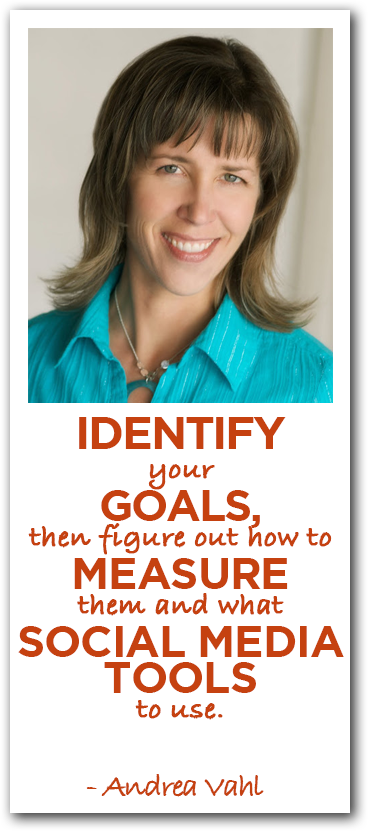
Social Media Marketing Tools for Your Small Business with Andrea Vahl

 Andea-Vahl-PinterestA lot of small businesses don’t put enough time into managing their social media. Do you know how to maximize social media for lead generation and buzz-worthy content?

Do you know what tools to manage and analyze your social media marketing?

If you don’t, you’re not alone. Many small businesses don’t feel social media is worth their marketing dollars or understand why it’s important. That’s why we asked Andrea Vahl, social media marketing coach and strategist, in this week’s episode of The Marketing Agents Podcast.

Big Ideas:

  • Who is Grandma Mary? And why haven’t you two been seen together?
    • Grandma Mary is the co-founder of my company.
    • She’s my alter ego.
    • I started blogging as Grandma Mary and planned to never reveal my name, but people were like, “what’s the deal?”
    • I wanted to be a little different in my market when I started.
    • I noticed that a lot of tutorials were boring and dumb.
    • I used that character that can be cranky and can bitch about things on my blog.
    • It’s a fun way to be authentic – and wear wigs.
  • How did you get into the whole social media consultancy game?
    • It was kind of a natural extension.
    • I had started blogging and teaching people how to achieve things like starting a Facebook page, grow a Twitter following, etc.
    • I found that people had really specific questions about their business and I got more into helping people directly.
  • A lot of small businesses say they don’t have time for social media because they’re too busy. What do you say when you hear that?
    • That’s the number one complaint I hear.
    • You have to pay attention to where marketing is going these days.
    • You have to spend the time on social media because that’s where people are hanging out.
    • Really, just streamlining your processes can save you time.
    • I put together an activity calendar for clients.
    • How are you going to spend your time each day? Put it into a calendar so it’s a to-do for creating content.
  • What are some of the tools that you use that you recommend for content creation that will attract your ideal customers?
    • HootSuite. I find that a lot of business owners are not using it! It’s a way to have a dashboard to pull in all your news feeds and quickly see what’s happening.
    • It’s great for scheduling content out.
    • A good tool for visual content is Canva. It creates really cool graphics that are shareable. It’s something useful for your audience that you can share out. You can make tip pages, quotes, little graphics, etc.
    • Then I can reuse these shared images to create on a blog post and share across all the platforms.
  • Can you then work the Canva images into HootSuite and other schedulers to share?
    • HootSuite is not as easy for images, but for Facebook Scheduler and Twitter it’s great.
  • Can I use the Facebook Scheduler like Hootsuite and do multiple scheduled shares?
    • You can do it like that and schedule up to 6 months of shares.
    • HootSuite pro lets you upload an Excel spreadsheet with up to 50 entries at a time.
    • It’s not the case anymore that you get penalized for using a third party app to do sharing and posts.
  • What kind of tools do you use to manage your social media?
    • Shareist for creating and managing for groups of people to share content.
    • People can schedule it and also create blog content and then post it to your blog (like a top 10 list of things).
    • It’s also good for managing your social sites – especially if more than one person is managing it.
    • Sprout Social is another I like. It can pull in content and be scheduled out to social sites. You can do really cool reports and you can see stats and create a PDF report (for clients).
    • Buffer is a great tool for sharing out content easily. I love the Chrome extension where you can quickly add items from surfing Chrome to your Buffer to share easily.
    • Buffer will make sure you don’t tweet a bunch of tweets in 5 minutes, it’ll spread them out and schedule them in a queue.
    • I love the Facebook scheduler and Post Planner. They not only help you get content ideas and then post it out and schedule it out later.
  • What are some tools you use for measuring social media results?
    • First sit down and understand what your goals are. What do you need to have happen to make it worth it for you? Is it a sale, engagement, connection, email list growth, etc.?
    • What’s success for you?
    • How are you measuring your success markers for social media? What can you do to grow?
    • Facebook Insights are great for measuring engagement and growth, but for sales you need something like Facebook ads with a conversion pixel where you know when someone’s actually bought something.
    • Sales online can be tracked by Google goal tracking.
    • Agora Pulse is another Facebook tool for measuring your Facebook stats.
    • Twitonomy is a Twitter analytics program.
    • Sprout Social has analytics as well.

      Identify what your goals and objectives are beforehand, then figure out how to measure it and what tools to use.

  • Everyone is concerned by the change in Facebook algorithm recently. What do you suggest now that our Facebooks aren’t getting the organic reach it used to?
    • I suggest a mind shift on Facebook and how we thing about it.
    • Facebook is no longer a free platform.
    • I did some analytics and tracking and I still see higher engagement in my Facebook than on other platforms.
    • It has changed and you have to now use some of your marketing budget to get more shares and likes. Take some of that money and split it up between top posts, more likes, and driving people to an opt-in and using conversion pixels to track the success of it all.
    • You can get a lot of bang for your buck on Facebook in terms of advertising.
    • It’s now more of a subscription model now to get the results you want.
  • What’s your new Facebook ads webinar all about?
    • It’s going to go through ways to use Facebook ads, as a small business owner, to intelligently get returns from these ads with precise targeting and more in-depth on conversion pixels.
    • Where you should allocate your budget on what types of ads in a smart way.
  • You teach on online course for social media managers. When is it starting up?
    • April 1st.
    • I love this course. It’s geared to folks who are doing this for clients and who are looking to run social media or get it started with a new business or run social media for other clients.
    • It’s for people doing this full-time, part-time, on the side.
    • It goes over all the tools and tactics, but also how to market your prices, packages, and services and how to get more clients and marketing your business.
  • Juicy Links:

    Rich Brooks
    Should I Wear a Wig When I Blog?

How to Create Blog Posts Influencers Will Share – Michael Stelzner

Mike StelznerA lot of small businesses don’t even know what linkbait is let alone how to go about implementing it. Do you know how to curate and share relevant content from outside sources?

Do you know how to properly notify your audience and contributors once your post goes live?

If you don’t, you’re not alone. Many small businesses don’t know how to use linkbait techniques and tools to curate relevant content. That’s why we asked Mike Stelzner, founder of Social Media Examiner and author of Launch: How to Quickly Propel Your Business Beyond the Competition, in this week’s episode of The Marketing Agents Podcast.

Big Ideas:

  • In one of your recent videos you talk about Linkbait. What do you mean and how do you do it?
    • The idea is to create content that will draw people (with a bigger platform than you) to your site in hopes they’ll share it.
    • One example, at My Kids Adventures – my new blog – has an article “5 Daddy Date and Mommy Date Ideas for Quality Time With Each of Your Kids” that talks about parenting tips and we asked for tips and provided a link back to their blog with a mention of their name – it’s aggregated content in a post that is designed to be popular and shared.
    • When these bigger platforms give feedback, they might feel compelled to share with their larger audience.
  • How did you go about that? How do you get these bigger platforms to contribute?
    • We all like to see our name in lights.
    • You promote, tweet, and share this content so it’s reciprocal.
    • The secret sauce is most people don’t get enough recognition and people love getting that opportunity.
    • Even if you’re unknown in your niche, if you reach out to these targets and say “hey, I’m putting an article together on ‘x’, and I’d love to get a few sentences from you – and these other people are contributing to it as well.” Once they see that other respected peers are involved, that helps.
    • It helps that you have a nice blog and they find cool stuff they may want to contribute just on that fact.
    • You can also created Linkbait pieces without people at all. You can find bigger blog content and curate relevant content into a new post.
    • People love someone that does the hard work for them.
    • On Social Media Examiner our recent “top 10 social media blogs” post had a contest and it was a Linkbait campaign on steroids. People submitted their choices, there was judging, nominations, and we offered a graphic called the “badge of distinction.” It’s very prestigious and the winners put this badge on their site.
    • You can do it the easy way by finding and sharing, have contests, there are so many angles to it.
    • Businesses don’t do enough to find curated content. People like to read posts from someone they trust.
    • You can create something new out of the best curated content that is of value to your audience.
  • Can you walk us through what you do about notifying your audience once a post goes live?
    • One of my interviewees told me to do a video podcast, and that I should use my looks to help.
    • Remind people that the post is live and twitter is the easiest way to do this.
    • You can schedule slightly different tweets based on the user’s name and it’ll get their attention plus the likelihood they’ll retweet is good.
    • I’ll email the person and thank them for their contribution and let them know the article went live with the article name, and a link, but don’t ask for a share.
    • It gives them the opportunity to click through and share it

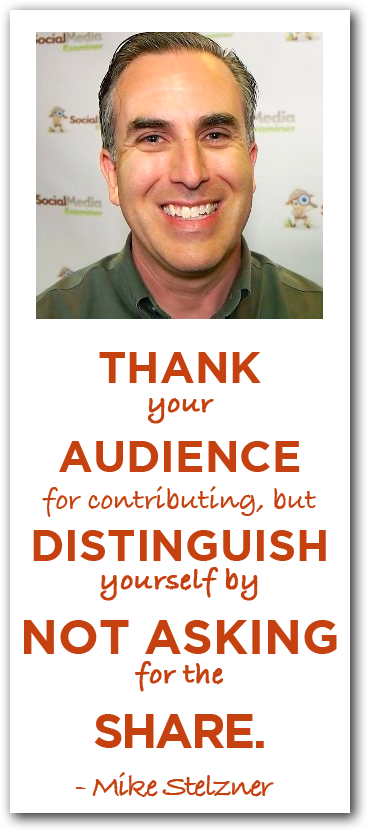
      Do not ask for the share. It converts that communication into a pitch and it’s a turn off.

    • When you go out of your way to not ask for it, the likelihood they will share it is higher, because it looks more like a favor when you remind them of their contributed post.
    • Distinguish yourself by not asking.
  • Are there other post archetypes that you find successful for a small business blog?
    • There’s bazillions!
    • I think the “how to’s” are the best.
    • As small biz owners we don’t have a lot of time. Any time you can put “how to” in your post, it has search benefits.
    • 80% of our posts are “how to” posts.
    • Why do we turn to the web? We want to know how to do things.
    • It’s a universal thing for any type of blog.
    • The art of writing the headline is so important to your blog post.
    • I do have another tip. Use “numbers” (i.e., 18 Ways To Improve Your Facebook News Feed Performance, 5 Dangerous Projects You Should Probably Let Your Children Do, etc).
    • We all like numbers. There’s something magical about a numbered list.
    • This formula for both my blogs is nearly all “how to” or “# tips/ways.”
  • In your blog, your page title and SEO title can be different. Do you mix that up or do you write one title for everything?
    • We use Yoast for WordPress because it does an analysis.
    • I rarely ever change the titles. Whether they find it via search, or Twitter, I just try to find the best headline for human consumption that is slightly search optimized.
    • I design one title for both, but we haven’t tested that. I’m not sure if that’s better or not in the long run.
    • If one title is stronger, then probably use it for both versions.
  • You get an insane number of comments. What are you doing to get people to engage with your content and leave comments?
    • An important caveat, Social Media Examiner has millions of readers, and we don’t get as many comments as you’d expect. We do get a lot of sharing on social channels. Sharing is a one-click way to say they appreciate your content.
    • Even big sites like Mashable don’t have a lot of comments.
    • We get comments by saying “what do you think?” at the end of every on of our articles.
    • On My Kids Adventures, we also say that and ask for a comment or input as well.
    • By adding that you greatly increase the chance your readers will comment.
    • The other thing that’s absolutely essential is that we ask our authors to engage with comments on their posts.
    • If someone makes a comment, they’re investing time in your post. If you don’t answer that comment it’s rude.
    • Try to reply within the first day to every relevant comment.
    • The end result of that is that people are becoming more affiliated with your brand and it starts real engagement and evangelism of your content down the road.
  • What social share tips do you have? What tools or techniques do you use?
    • Decide which social platform for your website is most appropriate and put those share buttons at the top of the article and you can see how many people shared it.
    • Just google Twitter widget or Facebook widget.
    • We also use a persistent share bar on both our sites. We’ve got Digg Digg and it remains in view on the article throughout.
    • If you have a mobile plugin, like WP Touch Pro, you may have to disable the Digg Digg plugin if it interferes. You can put share buttons at the bottom of your post for your mobile users. Facebook for WordPress is a good plugin too.
    • On My Kids Adventures we use jQuery Pinit Button for Images that puts a PinIt share option over any image on your post for people to easily pin things.
  • What can we expect from Social Media Marketing World if we’re new to it or a repeat visitor?
    • What makes this different from other conferences is the networking. We have a pre-conference networking event. This year’s will be on an aircraft carrier! It immediately helps you to meet people.
    • We also have dedicated network ambassadors and they try to help to make connections for you.
    • We have a big space called the “networking plaza” to get to meet people and know people.
    • We have the who’s who in social media coming to speak. We have over 80 sessions.
    • It’s bigger and better than last year. It’s an incredible opportunity to get to meet people and to learn.
    • We have 9 simultaneous sessions under four different tracks – social tactics, social strategy, community management, and content marketing.
    • It’s in March in San Diego so it’s nice and warm there!
  • Any last things you want us to know?
    • Check out #SMMW14 on Twitter and look at how many people are already crazed about this conference.
    • I’ve never seen this kind of excitement.
  • Juicy Links:

    Rich Brooks
    Another Link Baiter Fishing for Content

How Podcasting Grows Your Small Business – Jaime Tardy

Jaime-Tardy-PinterestA lot of small businesses struggle with getting a grasp on podcasting. Do you know how to identify your target market so you can start a relevant podcast?

Do you know how to tie your blog or site into promoting and posting your podcast?

If you don’t, you’re not alone. Many small businesses don’t know how to use podcasting to increase their relevant content and promote it to their audience. That’s why we asked Jaime Tardy, podcasting pro and author of The Eventual Millionaire, in this week’s episode of The Marketing Agents Podcast.

Big Ideas:

  • What’s your martial arts of choice?
    • Pinan-Do. I’m a brown belt, second queue.
    • I can break three or four boards of wood with one hit!
  • How did you get started with your podcast?
    • I started a blog, but didn’t like writing, and my group suggested starting a podcast.
    • I do what I love instead of writing.
    • I’m much better at what I do now since I can express myself best with audio and video.
  • What made you choose video over audio?
    • One of my interviewees told me to do a video podcast, and that I should use my looks to help.
    • It helps me speak on camera and in person.
    • A lot of logistical things are better – Youtube, iTunes x2 (audio AND video), you get to see the guests a lot better.
    • It’s easier to make a connection with your guest.
    • Talking over people happens more in just audio – you don’t get the physical cues.
  • Podcasting seems to be an item small businesses struggle with. How should they get into that? Can you address their doubts?
    • Find out who your target market is – do they use podcasts or technology?
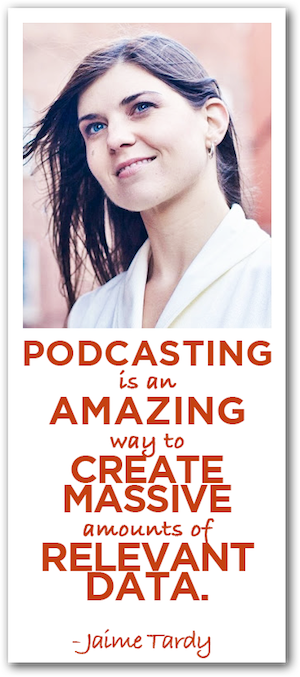
    • It’s an amazing way to create massive amounts content.
    • If your market does “get” digital media, then definitely do it.
    • iTunes and Stitcher are ways to get out to your audience.
    • Every interview I do is about 17,000 words of content.
    • You start to build your framework of what you want to talk about.
  • When you put your podcast together, how does that interact with your blog/site?
    • Your podcast does have to be a post, and iTunes and Stitcher will pick it up.
    • I use Libsyn for audio, but video can be maxed out quicker. The cost raises,.
    • I don’t use Amazon S3 since it’s based on data, and if you get a big audience you get a big bill.
  • What other ways can you let people know you have a podcast and to tune in?
    • You’re trying to get eyeballs, so try to get on the new and noteworthy list in iTunes. I got on that list and got 1,000 downloads a day!
    • It depends on your category and list.
    • If you already have a decent email list, it’s very similar to any other marketing plan. Have them subscribe as much as they can.
    • I have Millionaire Monday so they get a new post every week and they expect it.
    • Everyone listens on a different platform, iTunes, Stitcher, SoundCloud, YouTube, blog, etc.
  • When I post my podcast on Libsyn, do I have to take an extra step to put it on Soundcloud?
    • Soundcloud can be a host or aggregator.
    • You can set up your feed through Libsyn, and you should be able to auto-post to Soundcloud.
    • It depends on how your auto-publish settings are set.
  • Are you doing any Facebook or Twitter paid ads?
    • Most of my stuff is organic.
    • I do a lot of YouTube stuff, but no paid right now.
  • Are you monetizing your shows?
    • What I do is I make a point of saying I don’t want sponsorships on my show.
    • I do have one sponsor that doesn’t require me to mention them.
    • I have a link on my site, but I don’t have to mention it.
    • In general, I don’t do any specific ads on my podcast.
    • What I do is ask people to subscribe, signup, etc.
    • I’d rather have my audience go the route of buying my own products.
  • Blogs get comments, Facebook gets interactions, but podcasts are one of the least social platforms. How do you get engagement on your podcasts?
    • Most of the time people are listening to podcasts in the car, on a run, or not near a computer. It’s an effort to comment.
    • It doesn’t mean you’re not connecting with your audience, but the biggest difference is that you’re in their head. I’m technically in your head. The engagement level on a personal level is huge. It’s much more personal.
    • It makes a big engagement difference, but it’s hard to measure.
    • I gave away one of Michael Hyatt’s courses on the podcast, and required a comment, but it was a great success.
    • Incentives can bring people back to your site to engage or comment on your podcast.


    Once you get them to your site, the next step is to get them to subscribe once they’re there.

    • I have a bunch of lead magnets through LeadPages. One of the things that LeadPages does is put a specific lead magnet on a podcast transcript so they have to signup to get a transcript.
  • Your podcast helped you win a book deal. How did that all come about?
    • You can’t really pitch a book unless you know someone.
    • I made a goal to publish a book.
    • I chatted with a bunch of people for advice, and I realized I wanted to traditionally publish a book to be able to charge more for speaking deals.
    • My publisher noticed I already had a platform and audience. It’s about how big your audience is.
    • I talked to a few literary agents and found one great for my niche.
    • They told me that they liked me so much because I had a lot of press on TV and talk shows.


    Juicy Links:

    Rich Brooks
    Caster of Pods

Hubspot’s Laura Fitton Shows How Inbound Marketing Can Help Your Small Business

Laura-Fitton-PinterestA lot of small businesses haven’t used social media as a tool for inbound marketing. Do you know the steps and tools to use to deliver specific relevant content to your customers?

Do you know how to best use Twitter to help your business grow?

If you don’t, you’re not alone. Many small businesses don’t know how to hone their social media platforms to focus on what matters to their business. That’s why we asked Laura Fitton, inbound marketing evangelist at HubSpot to show us how, in this week’s episode of The Marketing Agents Podcast.

Big Ideas:

  • How does one become a “marketing evangelist?”
    • It involves a lot of public speaking and tons of communication.
    • Make sure that you’re listening to marketing influencers and giving their work attention and telling them work we’ve done (when appropriate).
    • I’m paid to be nice to people I already like!
  • How did you end up at HubSpot and how did social media play a part?
    • I used to be a speaker coach and was blogging about it.
    • It led me to Twitter and to create Pistachio Consulting and then the idea for One Forty came along.
    • It made sense for my company to look for a bigger entity to support us.
    • I reached out to Brian and next thing we know it was a beautiful marriage.
  • Do you think it was a good or bad move for Twitter to limit its tool and app ecosystem?
    • I think it was a bad move because there’s great potential for revenue from the Twitter data stream.
    • They are getting 15% of their revenue from the few licensed third-party companies.
    • An app store would help market incentives and monetize that data stream.
    • A platform is a tough business strategy to execute because you have to try to keep everyone happy and protected .
  • What are some of the biggest reasons people are telling you why they’re not embracing social media?
    • The resistance to inbound marketing is usually – “I haven’t heard about it yet, I don’t quite understand it, I wonder if it’s like content marketing, what is it?”
    • Social media offers the chance for a company to throw a lot of material out there for a prospective audience.
    • How do I attract the right group of people that are likely to convert?
    • Building community is key – attracting the right people to take action.
    • The inbound marketing philosophy is to earn your audience by generally being of value.
    • The company that’s using inbound (marketing, recruiting, training, or whatever) – the inboundy way is to say –  “what can I do that is of use, of service, that is helpful to the people I want to attract.”
    • These people can be your buyers or the people close to them.
    • All our marketing is focused on “what can we do to be useful to the marketer?” and how to add value by using blogs, emails, lists, etc.
    • What can you offer without being pushy. Make it about your reader or buyer.

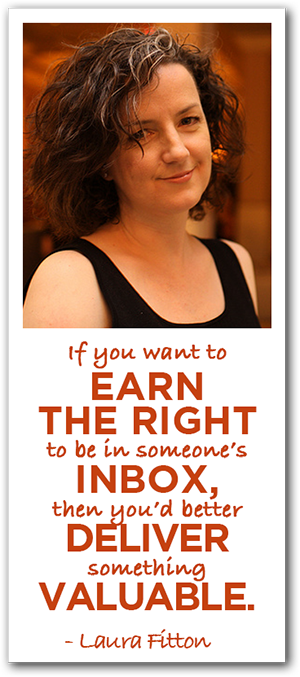
    If you want to earn your right to be in someone’s inbox, you’d better be delivering something valuable to them.

  • Do you have different definitions for inbound marketing, content marketing and social media marketing?
    • Inbound marketing is the car and the content is the fuel.
    • Inbound marketing is a set of practices and attitude that help your marketing. It can involve emails, landing pages, content in that offer or blog – without it it’s useless.
    • Inbound is all the steps and practices that you use to attract, convert, and delight once they become customers.
    • Social media marketing is an important tool for content marketing and inbound marketing.
  • Is Twitter still your favorite platform?
    • Oooh…no! I answer that question differently now though.
    • It’s my favorite platform for doing x, y, and z…
    • I love using Path for being brutally honest with a core group of friends.
    • Twitter is still my favorite platform for seeing if I have a contact, or for seeing someone I know who knows a prospect to get leads from.
    • I use LinkedIn and Facebook for a specific set of things.
    • When people say “I don’t get Twitter” then it may mean they just don’t get it, or don’t have a specific use for it yet.
  • Although businesses “get” Facebook, a lot don’t “get” Twitter. How do you explain it to them?
    • I try to ask them questions about their business and what their needs and we look at some examples of people in their industry.
    • Maybe we talk about the types of people they want to build relationships with them.
    • Maybe they’ve already been doing some inbound marketing and want somewhere where they can get their content found.
    • In August 2007, I had emailed my blog post to Guy Kawasaki about Twitter and he replied back. I told him he could do efficient rumor hunting on Twitter much quicker than RSS. He was blown away.
    • It’s stupid to be insulting to someone and say “you’re just dumb, and you don’t get Twitter.”
    • If you just jump onto Twitter without knowing who you need to find or what you need, then you won’t get it.
    • It’s like changing the channel on the radio. Keeping tuning until you find what you like.

    It’s important to interact with people on a low-key business basis way because it builds trust.

  • Using our social media software from HubSpot I was able to watch tweets from a talk and could tell who were leads, which were customers attending, I could selectively retweet customers that gives me a chance to see when leads are tweeting and helps us follow up with them.
  • Using those tools is pretty darn practical. We can see specific segments of new customers or revenue that come in from Twitter.
  • Is the future of social media for small businesses going to be the “pay-to-play” strategy using ad platforms?
    • Yes, definitely. People will tag other things and we aggregate those as well.
    • Yes, it can be a part of the mix, but the inbound philosophy is to offer high quality content to your niche of users.
    • Using a search strategy, or a social media strategy, it can be about liking, sharing, and interactive content.
    • You can do social media marketing in a really annoying outboundy way or a likable, shareable inboundy way.
    • It’s like a soap opera. I’m paying to put on this show to sell my product. But I need to make it a good show or I won’t sell my product.
    • There are certain brands that I love so much that I love sharing their product.
    • Brands can respond to your customer tweets or feedback quickly via Twitter or social media.

    A lot of times we forget that the client relationship is very important to ongoing and future business. When you can’t cement your bonds in real life, then what are you doing for your clients on social media?

    It’s much better to be that guy who tells you “you have spinach in your teeth.” You want your customers to be comfortable with coming to you. You really should be doing everything you can to delight your customers. The delighted customers are the long-term insurance for your business growth.

    Relationships do have ROI.

Juicy Links:

Rich Brooks
Pickle Back Evangelist

How Ski Resorts Use Social Media Marketing – Ethan Austin

Ethan-Austin-PinterestA lot of marketers haven’t fully utilized social media to increase their engagement. Do you know the steps to take to get your social media shares booming?

Do you know how to manage user-generated content related to your brand?

If you don’t, you’re not alone. Many small businesses don’t know how to fully leverage social media for marketing and how to manage it. That’s why we asked Ethan Austin, director of marketing at Sugarloaf Ski & Golf Resort, to show us how, in this week’s episode of The Marketing Agents Podcast.

Big Ideas:

  • How did you end up at Sugarloaf and what do you do there?
    • I was a consultant helping small biz owners with their marketing and realized I was limited with my reach.
    • I used to ski here as a kid.
    • I was an English major in college and the ski bum style appealed to me, so I spent a winter in Colorado, then hiked appalachian trail.
    • When I ran out of money, I saw a job opening for marketing at Sugarloaf and applied for the job and got it. That was ten years ago.
  • What are some of the social media platforms you’re using at Sugarloaf and how are you using them?
    • Facebook and Twitter, and Instagram.
    • Our Facebook following is one of the largest in New England ski resorts.
    • We dabble in some smaller platforms – Tumblr, Google+, and Pinterest (focus on wedding offerings).
    • We try to make them work together. We aggregate content from all of them.
    • We have a tool called the Sugarloaf Blue Room.
  • What are you doing on Facebook to engage your audience?
    • We provide daily captivating content.
    • Our snow reporter comes in and talks about weather conditions, takes photos on the mountain, activity shots, scenic shots of valley and mountain.
    • We do a lot with video. We have a full time videographer on staff.
    • On Facebook we’re focused on creating content our fans will enjoy.
  • Have you done anything to overcome the advertising dip recently?
    • We have done some promoted posts around our college snow fest week.
    • We’ve done promotions around our lodging offerings.
    • If you put money behind your posts you see your reach skyrocket.
    • If we have a really great photo or video it takes off organically.


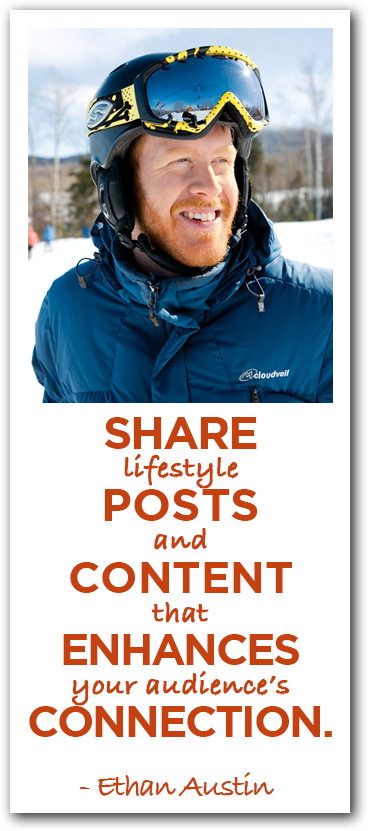
    The bulk of what we share is lifestyle posts and content that enhances the connection to Sugarloaf.

  • Do you promote your posts with money and put money towards promotions for packages?
    • We focus on adding money to topics that have more ROI like a kids ski free lodging promotion, college week, discounted lift tickets, concerts, etc.
    • We put money behind these conversion events.
    • If we see things take off organically, we usually just let it go on its own.
  • When you’re putting money behind something, what tools are you using for advertising?
    • We promote in the news feed and right hand column.
    • We use audience targeting. It’s very easy to target demographics on Facebook.
    • The college week videos we promoted, was very easy to identify that demographic and it has worked well.
  • How do you manage dealing with user-generated content related to your brand?
    • We use the Blue Room which is a social media aggregator.
    • We try to organize things around hashtags for Instagram.
    • We put hashtags (i.e., #theloaf) and we’ll put it on our advertising or printed media.
    • We’ll highlight certain user photos and encourage people to share their experiences.
  • You mention promoting #theloaf. Do you search on other hashtags?
    • Yes, definitely. People will tag other things and we aggregate those as well.
    • We can actually highlight specific hashtags to encourage people to use that hashtag and share their experiences.
    • Throughout college week we’d pick our favorite photo and offer a reward for the day or week.
  • You’ve got thousands of visitors every week. How do you handle negative social media comments? What’s your response or action?
    • Yes, it happens. Maybe the weather’s bad, or their experience didn’t live up to expectations.
    • Our goal is to immediately address negative comments and acknowledge they’re upset and offer ways to alleviate concerns or make it right in their eyes.
    • The biggest thing is that their experience wasn’t great.
    • We can turn those situations into our favor.
    • We saw YOUR comment last year on Twitter about someone stealing your hitch cover in our parking lot and replaced your hitch cover and replied to you. You retweeted our tweet.
  • When those negative situations occur, are you paying attention to who’s got the loudest megaphone or a lot of followers?
    • Yeah, absolutely we are. We knew you had influence on social media.
    • We can’t do this every single time, but when it’s something simple, we can make things right.
    • We’ve done that for lots of people – tshirts, hats – things that are very easy for us and can make a difference.
  • You guys have a great relationship with Seth Wescott. Do you guys work together and how (on social media)?
    • Seth is awesome. He’s a tremendous ambassador for Sugarloaf, for Maine, and for snowboarding.
    • He’s humble and great to work with.
    • He’s very active on Instagram and Facebook.
    • Currently we have a video documentary called from Surgery to Sochi about his journey out of surgery last summer to the Winter olympics this year.
    • It’s awesome to share his story on social media and it helps foster the connection to Sugarloaf.
  • What are the biggest changes in social media you’ve seen with Sugarloaf?
    • The ability and amount to aggregate has skyrocketed. The amount of stuff people are creating is huge. Instagram is big with image creation.
    • The amount of content is staggering.
    • We launched the Blue Room last year and it gave us focus on hashtag conversations with greater depth.
    • User content has quadrupled in the last year.
  • How do you measure success when it comes to social media? What metrics do you follow?
    • In terms of reporting, we’re very lucky there’s not a corporate overhead.
    • We have a lot of freedom to try new things and be experimental.
    • The biggest numbers we focus on in Facebook is shares. How many people have shared a piece of content we put up. We watch number of shares and total reach.
    • We watch what works best to figure out what works and why so we can replicate that in future posts.
  • When are we gonna have a Maine tweetup at Sugarloaf?
    • We should definitely make that happen.

Juicy Links:

Rich Brooks
I’d Never Tweet About Losing a Hitch Cover